Digital dreams, decaying reality City’s smart kiosks turn to scrap as NMC shrugs off responsibility
| Date :01-May-2026 |
By Reema Mewar :
- Officials claim rising use of smartphones caused the kiosks to fail, as most services could be availed from private phones
- NSSCDCL claims to not possess any financial data regarding the smart kiosks
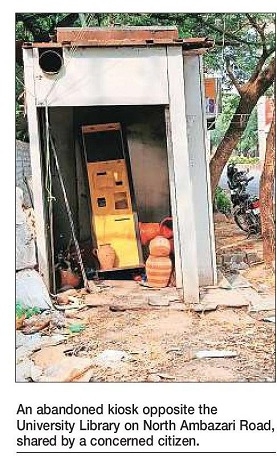
A network of 65 ‘smart kiosks’ affixed across the city at various bus stops in 2018, now stand as a glaring reminder of how casually public money can be spent and forgotten. What was once projected as a step toward a smarter, more connected city has, in most locations, degenerated into a garbage dumping point. These kiosks were commissioned as part of the Rs 520 crore Smart and Safe City Project initiated by the Nagpur Smart and Sustainable City Development Corporation Limited (NSSCDCL), and later taken over by Nagpur Municipal Corporation (NMC).
NMC blames smartphone penetration
When questioned, an officials of NSSCDCL told The Hitavada, “The kiosks failed because of widespread adoption of smartphones. Their utility diminished because citizens began accessing the same services on personal devices. The explanation, however, raises more questions than it answers. Smartphone penetration was already significant in 2018, and only expected to grow. If the redundancy of such infrastructure was foreseeable then, why was the project conceptualised and executed in the first place?
The official also vaguely referenced billing and metering issues but did not offer any explanation. When asked about the total expenditure incurred on the kiosks, he stated, “We do not have any separate data of the expenditure on kiosks, and I am not authorised to disclose the figures over the phone.” On the question of revival, the response was equally blunt -- ‘there is no budget left under the Smart City project to restore or repurpose them’.
Commissioned by MAHA IT
Another officer mentioned that the kiosk construction was initiated by Maharashtra Information Technology Corporation Limited (MAHA IT), and carried out by Larsen & Toubro (L&T) Construction. When asked for data on how much the kiosks costed, the official said that they had no data available, and that L&T or MAHA IT should be contacted for the same. The Hitavada also requested contact information of concerned L&T or MAHA IT persons, but were told that the person who was initially coordinating with them was no longer working with NSSCDCL, so they had no contact details either.
No clear outcome,
no accountability
What remains, then, is a publicly funded project with no clear outcome, no transparency in expenditure, and no roadmap for accountability. The kiosks have not been maintained or repurposed. Instead, they occupy public spaces as decaying symbols of poor planning and administrative apathy.
At a time when Government-run schools struggle with basic facilities, anganwadis operate in miserable conditions, and public hospitals remain under-resourced, the prioritisation of hollow projects like these raises serious concerns. Infrastructure spending must be guided by necessity and long-term value, not by the appeal of ‘smart’ labels.