State’s ‘hidden’ workforce revolts, Thousands demand end to Rs 3,000 salaries and ‘forced labour’
| Date :01-May-2026 |
Staff Reporter :
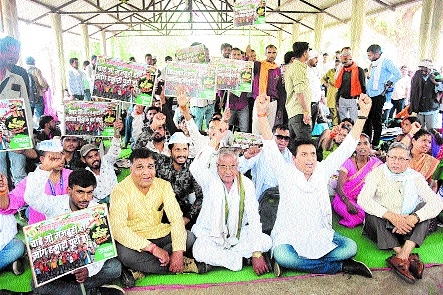
A massive wave of industrial and departmental unrest hit the State capital as thousands of temporary and outsource workers flooded Neelam Park for the ‘Mahasangram’ (Great Battle) protest. Representing the backbone of the state’s rural and urban machinery, from Panchayat watchmen to school staff, the workers delivered a sharp ultimatum to the government: stop the culture of free labour and guarantee a living wage of Rs 26,000 per month.
The Great Wage Paradox: On Paper vs. In Pocket
The core of the protest lies in a shocking disparity. While the Government’s official books list minimum wages between Rs 12,425 and Rs 16,769, the reality on the ground is grim. State President Vasudev Sharma revealed that the very government departments tasked with upholding the law are paying their own workers as little as Rs 3,000 to Rs 8,000. “The Government must change its habit of getting work done for free,” Sharma stated, highlighting that even in industrial hubs and power plants, contract workers are being denied their legal dues. Survival on Pennies: Who is Earning What?
The sheer scale of the wage disparity is most evident in the hunger wages currently being paid across various essential departments.
At the bottom of the scale are Revenue Surveyors, who struggle to survive on a meagre Rs 1,000 per month, while Gram Panchayat staff, including watchmen, sweepers, and pump operators, receive only between Rs 3,000 and Rs 4,000.
This pattern of exploitation extends into the Education and Health sectors, where
part-time school workers and Ayush trainers are stuck with earnings of Rs 4,000 to Rs 5,000, and health department outsource staff receive roughly Rs 7,000.
Even those serving the state’s most vulnerable populations, such as Mid-Day Meal workers and PESA Mobilisers, are forced to manage their households on a flat payment of just Rs 4,000.
A Vanishing Future for the Marginalised: Beyond the low pay, the movement raised a deeper social issue. Leadership argued that since 2003, the systematic shift toward outsourcing has killed permanent Class III and IV jobs. These positions were traditionally the gateway to stability for the poor, Dalit, Tribal, and OBC communities. By replacing these with insecure contracts, the state has stripped away pensions, job security, and the dignity of a fair day’s pay.
Next Stop: High Court Intervention: After the administration denied permission for a demonstration at the BJP headquarters, and even objected to the original name of the protest, symbolic collective self-immolation, the workers shifted to Neelam Park with a new title: the ‘Mahasangram Kranti Andolan.’
With over 50,000 petitions ignored by the State, the workers are now looking toward the judiciary.
The union has announced that on July 6, they will bring their plea before the Jabalpur High Court, seeking a legal mandate to force the government to pay a dignified, inflation-adjusted wage of Rs 26,000.