Buddhavan: Turning remembrance into a living forest
Date :11-May-2026
By Kunal Badge :
AS CLIMATE anxieties deepen
and conventional conservation
efforts continue to fall short, a
quiet yet compelling environmental movement rooted in
Buddhist philosophy is steadily
taking shape on the outskirts of
Nagpur.AtRamgiri in
Kalmeshwar tehsil,‘Buddhavan’,
developed by Vishwa Maitreya
Buddhist Sangh (V MBS), has
emerged as a rare example where
ecological responsibility is woven
directly into spiritual practice,
transforming remembrance of
the departed into an enduring
act of environmental restoration.
In an era marked by accelerating global warming, indiscriminate tree-felling, and faltering conservation measures,
this initiative offers a direct, tangible response. Instead of
immersing ashes in rivers, a longstanding ritual that contributes
to water pollution, followers of
Lord Gautam Buddha are choosing to return remains to the earth.
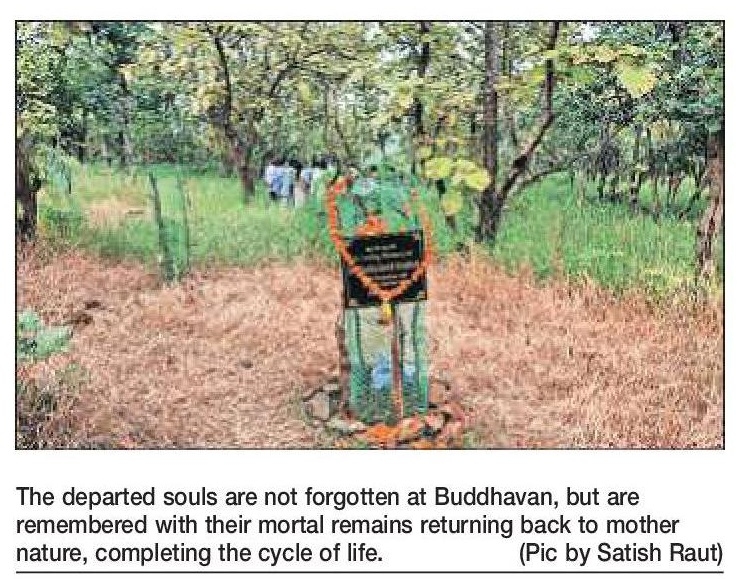
The ashes of the departed are
buried in carefully prepared pits,
over which saplings are planted.
Each tree is then nurtured and
maintained by the organisation,
ensuring continuity rather than
symbolism.
Dhanraj Bahadure, Secretary
of VMBS, articulates the underlying rationale with clarity. He
states that the cremation of a
single body consumes the equivalent of at least one tree.
Buddhavan attempts to restore
that ecological loss.The act is not
framed as charity, but as restitution. It aligns closely with
Buddhist teachings on interdependence, impermanence, and
respect for all forms of life.Over thepast fiveyears,what
began as a modest initiative
has expanded steadily.
Participation has grown not
through campaigns, but
through conviction. Families
now express specific preferences for the species of tree to
be planted, turning remembrance into a conscious environmentalchoice.
The site itself
has evolved into a green
expanse, where each tree carries both memory and purpose.
Beyond its ecological dimension, Buddhavan is emerging
as a point of interest on
Nagpur’s Buddhist circuit,
alongside Deekshabhoomi,
Dragon Palace Temple, and
Chicholi.Visitorsaredrawnnot
only by its spiritual relevance
but by the model itrepresents,
onewhereritual adapts tocontemporaryenvironmentalrealitieswithoutlosingits essence,
but also by the calm and peace
oneexperiencesamidst the forest.
Buddhavan does notrely on
rhetoric. Its impact is cumulative, rooted in repeated, individual acts. Each tree planted
marks a departure from passive tradition towards deliberate conservation.