GREEN NETS AT CITY SQUARES: Relief measureor another half-planned half-planned civic experiment?
| Date :11-May-2026 |
By Dheeraj Fartode :
IS THE Nagpur Municipal
Corporation (NMC) really offering a practical solution to help
commuters beat the harsh
summer heat, or is the green
net project turning into yet
another temporary civic experiment without proper planning? This question is now
being widely discussed after
several green shade nets
installed at busy city junctions
collapsed during recent strong
winds.
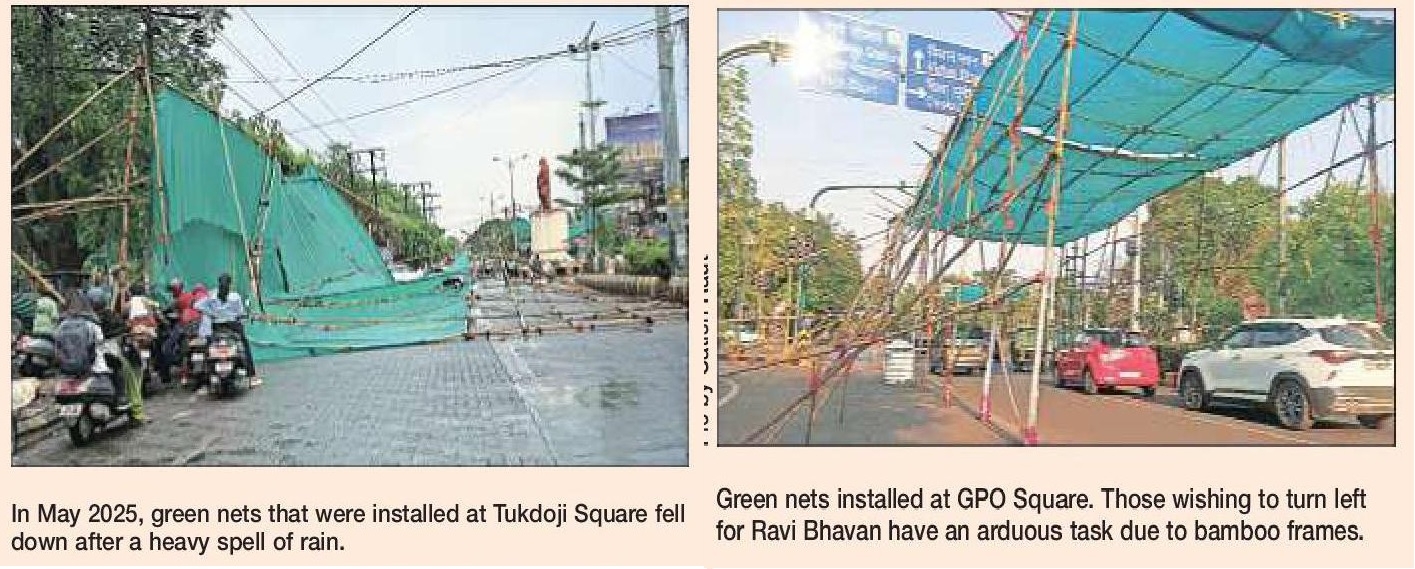
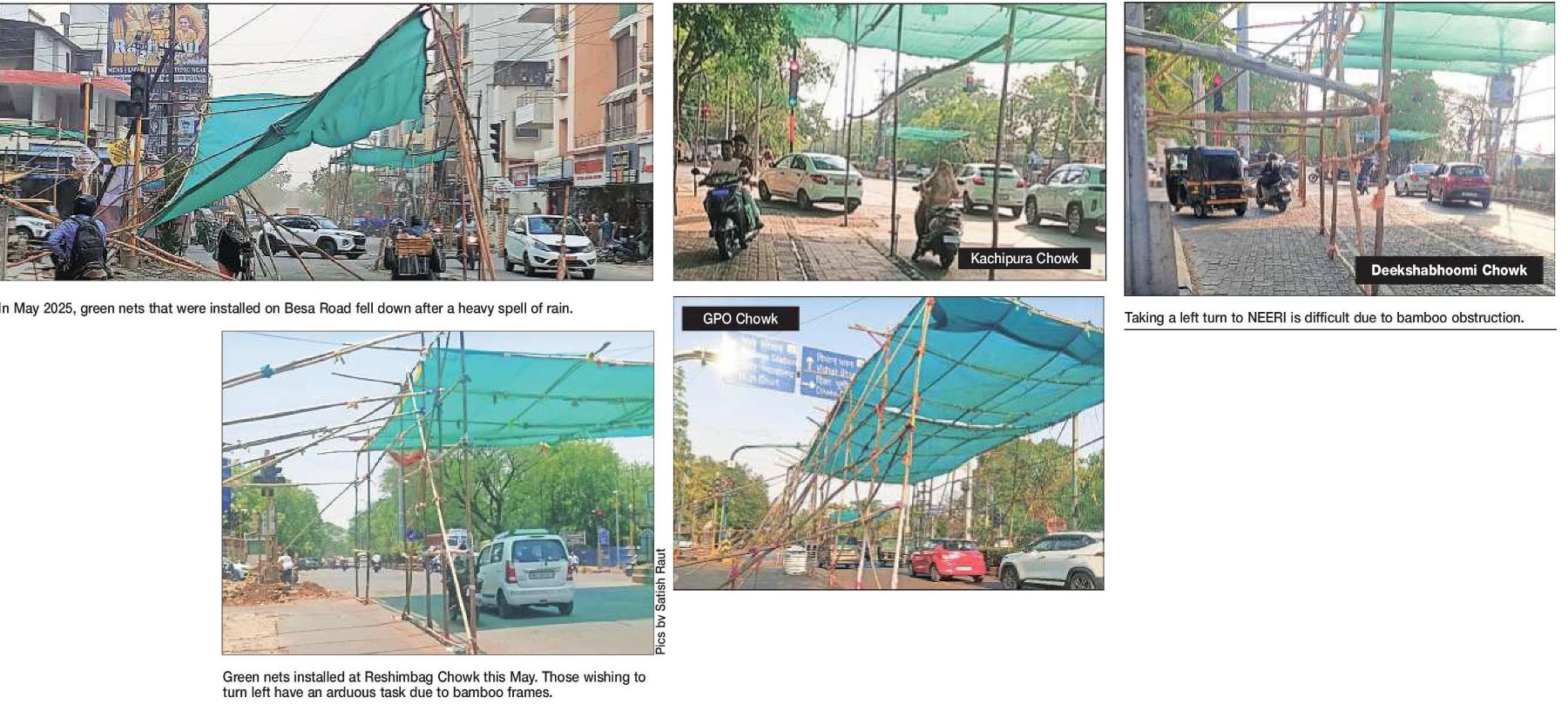
The green nets, stretched
over bamboo frames at major
traffic squares, were meant to
provide some relief to motorists
waiting at traffic signals in temperatures crossing 45 degrees
Celsius. While many commuters welcomed the idea, the
poor execution is now drawing
criticism.
The concept was inspired by
a similar initiative introduced
in Puducherry in early 2024.
After videos of shaded traffic signals went viral on social media,
many cities, including Nagpur,
adopted the idea. But civic
activists and commuters are
now questioning whether NMC
implemented the project without fully studying its safety,durability and long-term
feasibility.
At present,green nets have been
installed at around 10 to 12major
junctions across East,West,North,
South and Central Nagpur.
However,recent strong winds
exposed the weak infrastructure
behind the project.At several locations,the nets were either torn
apart, had tilted dangerously or
collapsed completely.Most of
these structures are supported by
bamboo poles tied with ropes.
Over thelast few days,NMC workers have repeatedly been seen
retying and tightening thenets
after wind damage.
“If the NMC has been working
on this project for the last three
years,why is there still no permanent design?” asked aretired
police officer.
“These are high traffic junctions where thousands
of vehicles pass everyday.If one
of these bamboo structures falls
on commuters during rush hour,
who will be held responsible?”
Safety is not the only for concern. Motorists and traffic officials say the bamboo structures
arealso creating visibility problems at some junctions,especially for vehicles taking left turns. In
certain areas,commuters claim the
poles erected near the road are
obstructing smooth traffic movement.
The scale of implementation
has also come under scrutiny.
Nagpur has nearly 550 traffic
squares and junctions,out of
which around 171 havetraffic signals.Yet the green net project currently covers only a dozen sof locations.Manycitizens question
whether such limited installations
can make any real difference to
the larger issue of heat exposure
across the city.
Meanwhile,the traffic police
havealready started operating
nearly 31 signals on blinker mode
between2 pm and4 pm to reduce
waiting time for motorists during
peak afternoon heat.While the
move has provided some relief,
traffic experts believeit also highlights the lack of proper coordination between the NMC and the
traffic department.
This hasled to larger questions.
Why not build permanent heatresistant shelters at major junctions? Why rely on temporary
bamboo structures instead of
durable steel frames?Was any scientific study conducted on wind
pressure, traffic movement or
pedestrian safety before the installations began? A senior official, speaking on
condition of anonymity,admitted that Nagpur certainly needs
innovativesolutions to deal with
rising temperatures.
However,the official also
stressed that such civic experiments should not be carried out
without proper durability studies
and traffic safety audits.
Commuters,too,have mixed
reactions.“The shade definitely
helps,especially for two-wheeler
riders waiting at signals in the
afternoon heat,”said a motorist
near Sitabuldi.“Butif the nets keep
collapsing every time strong winds
blow,then they become more dangerous than useful.”
Thematter also comes atatime
when issues related to faulty traffic signals and traffic management
are already being discussed before
the High Court. Urban planners
say the city needs along-term heat
action plan instead of seasonal
temporary fixes.Green activists
have suggested alternatives such
as permanent tensile roof structures,shaded pedestrian zones,
smart trafficsignalsystems,urban
tree plantations and scientifically designed commuter shelters.
Fornow,the NMC continues
repairing damaged nets and reinstalling them at junctions across
the city.
But one question still remains
unanswered: is Nagpur genuinely addressing the problem of
extreme heat, or simply trying to
cover it up with temporary green
cloth?