Young innovators develop glow-based road technology to improve night safety
| Date :13-May-2026 |
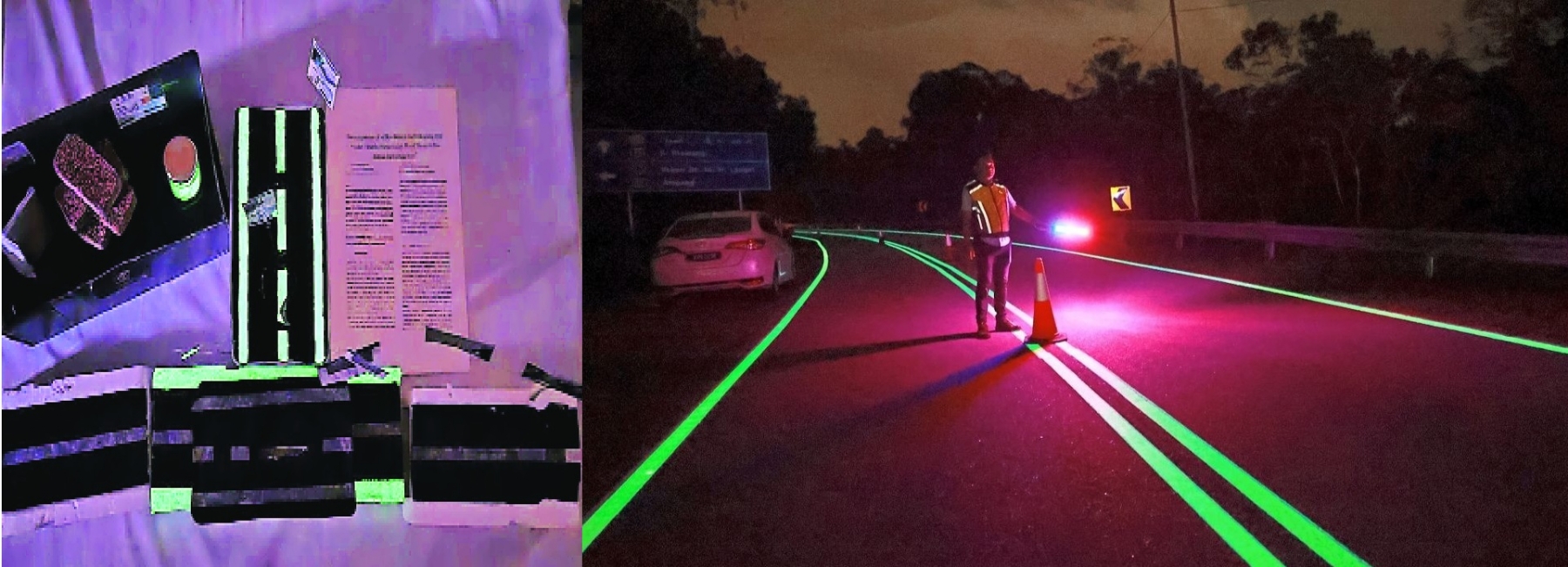
Demonstration of the glow-based night visibility road technology.
Staff Reporter :
The coating absorbs light during the daytime and emits glow during dark
Two young innovators from Shegaon have developed an early-stage prototype titled Bio-Based Self-Healing and Night Visibility Road Technology, with the aim of reducing mishaps due to low visibility.’ The prototype, developed by Rajvardhan Thakur, founder and Atharv Deshmukh, co-founder of Relvian Group,’ aims to tackle one of the major causes of road accidents in India - poor visibility during night time. The students have developed a special glow-based coating that absorbs light during the daytime and emits it during dark conditions, helping drivers identify road edges, dividers, turns, and pathways more clearly.
This unique road safety concept could help improve night time visibility on roads without the use of electricity.
The duo got this idea after regularly witnessing poorly visible roads, faded lane markings, and accidents during night travel. According to them, many existing thermoplastic road markings lose visibility due to continuous tyre friction, rainwater, dust, and environmental damage.
Their research therefore focuses on creating a more durable glowing road marking system with protective transparent coatings to preserve brightness and increase lifespan. The concept was inspired by international smart road technologies used in Australia and then the idea was modified according to Indian road conditions and to ensure low cost implementation. The total expenditure was around Rs 7,500. Strontium aluminate glow powder, acrylic/ oil based road painting, waterproof protective coating, reflective pigments and binding resin materials are used in this technology.
The project took nearly one year of research, experimentation, failed trails, and testing. Alongside academic studies, the duo dedicated nearly two hours daily towards the project. The students have already conducted small scale demonstrations near the Sant Gajanan Maharaj temple and railway station in Shegaon. The trials received positive results and appreciation from the residents. Their project has received recognition at various technical competitions, including prizes in project presentation and research paper events.
Apart from the glow-based technology, the project also includes research on bio-based self healing cement aimed at reducing potholes formation. The concept focuses on developing concrete capable of automatically sealing small cracks before they expand into major road damage. However, the students said this part of the project is still under experimental research and further testing is underway.
Through Relvian Group, Rajvardhan and Atharv hope to continue improving the technology in highways, smart city infrastructure, village roads, and accident prone areas across India.