From Samvidhan Sq to Ashok Chowk, city reinforces its national identity
Date :16-May-2026
Staff Reporter :
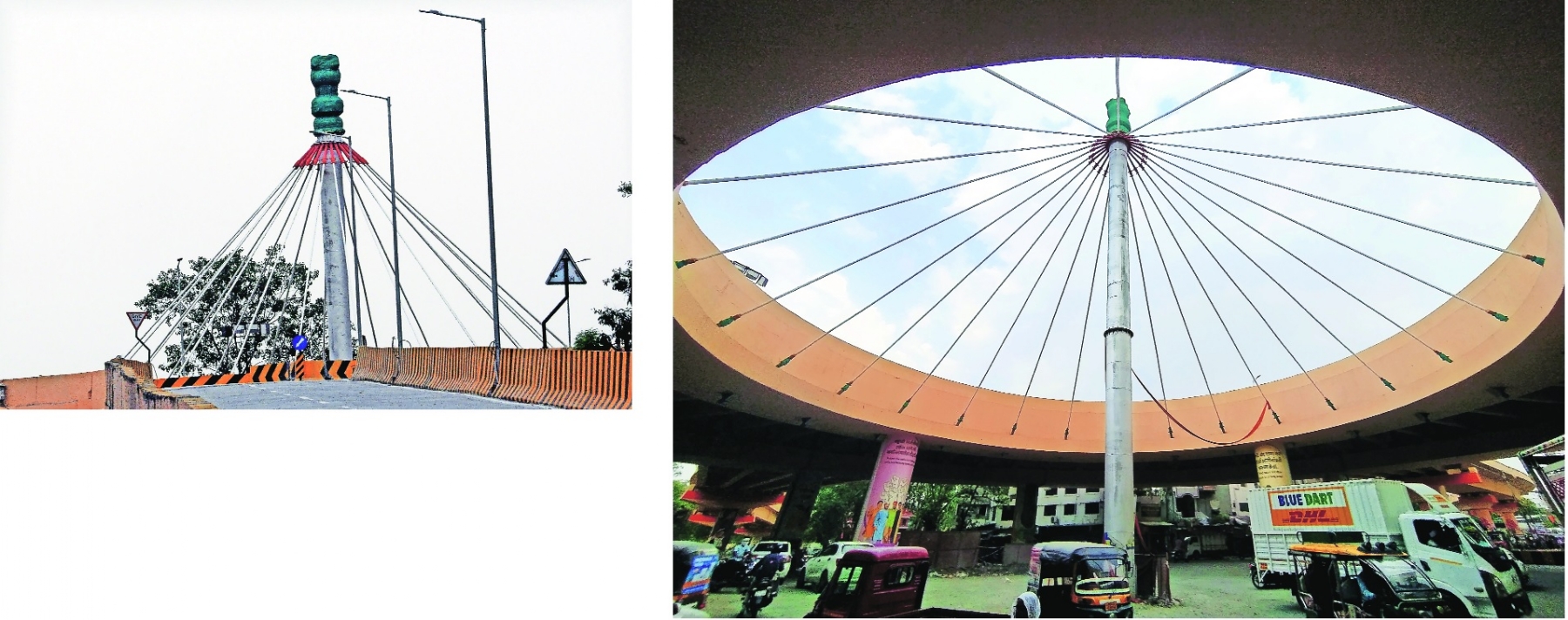
Nagpur’s skyline has acquired a powerful new symbol of national identity. Rising above the elevated rotary at Ashok Square, a massive replica of the Ashoka Stambh, the National Emblem of India, now stands atop a 22-metre central pylon, commands attention from across the city. Installed by the National Highways Authority of India (NHAI) as part of the Rs 998 crore Indora–Dighori flyover corridor, the structure is more than an engineering landmark. It is a constitutional statement cast into the urban landscape of a rapidly transforming city.
The 1,200-kg emblem, crafted entirely by artisans from city, represents the four lions that India adopted as its national emblem in 1950 after becoming a republic. Built using fibre reinforced polymer (FRP), the structure combines lightness with durability, enabling it to withstand wind, vibration and weather at such a height. Hoisted carefully into place using heavy cranes, the installation demanded precision engineering due to the emblem’s scale and sculptural detail. The statue is currently wrapped under covers and will be officilly unveiled during the opening of the flyover, informed NHAI officials. Yet, the symbolism extends far beyond the lions themselves.
The elevated rotary has been designed as a tribute to the Ashoka Chakra. From an aerial view, 24 steel cable spokes radiating from the central pylon resemble the 24 spokes of the Chakra on the Indian tricolour. The result is a rare fusion of transport infrastructure, civic art and constitutional symbolism. Seen from the ground, the lions dominate the skyline with authority and dignity. Seen from above, the entire rotary becomes an architectural interpretation of the Republic itself.
The location deepens the meaning. Ashok Square derives its name from Emperor Ashoka, whose transformation from conqueror to advocate of dharma, peace and ethical governance remains central to India’s civilisational imagination. Installing the national emblem at a junction named after Ashoka creates a symbolic continuity between ancient statecraft and modern constitutional democracy.
The city already occupies a unique place in India’s constitutional identity.
The city is home to Samvidhan Square, where a towering Constitution-themed monument celebrates the ideals of justice, liberty, equality and fraternity. The city’s Constitutional Park in premises of Dr Babasaheb Ambedkar College of Law further reinforces this civic identity by embedding democratic values within public space. Together with the new Ashoka Pillar at Ashok Square, these landmarks are shaping Nagpur into a city where infrastructure increasingly reflects constitutional consciousness.
Equally significant is the fact that this national symbol was made locally. The emblem was not imported from another metropolitan centre or fabricated in an industrial unit elsewhere. It emerged from the skill of city’s own craftsmen. That local artisans have created one of the city’s most visible national symbols gives the project a deeper emotional resonance, linking civic pride, craftsmanship and national identity in a single monumental form.