GMCH milk bank emerges as a lifeline for critical newborns
| Date :17-May-2026 |
By Saniya Chakraborty :
A silent but life-saving initiative has been functioning at Government Medical College and Hospital (GMCH) for the past six months, where donated breast milk is helping premature and critically ill newborns survive in the Neonatal Intensive Care Unit (NICU). Despite operating from a comparatively small space at present, the human milk bank has become an important support system for vulnerable newborns, and hospital authorities are now planning to expand it into a larger dedicated facility to meet growing demand. It was established to support babies whose mothers are unable to produce sufficient milk due to medical complications, premature delivery, illness, surgeries, or post-delivery stress.
Prof Ashish Lothe from Paediatrics Department at GMCH, stated, “Many NICU babies are extremely fragile and require immediate nutritional support at the time of their birth.
The milk bank is equipped with specialised processing, pasteurisation, testing, and storage systems.” Nurses working at the milk bank said that even a small amount of breast milk can help in recovery of newborns. The milk bank is helping to reduce newborn mortality by 2 per cent among NICU babies. Currently, the milk bank has a storage capacity of nearly 30 litres, with plans underway to expand it to around 50 litres in future. Nurses working said nearly 3 litres of milk is required daily for NICU babies, while current collections range between 1.5 to 2 litres.
The milk bank follows a strict four-stage process before donor milk is supplied to newborns. The first stage involves donor selection and counseling, where lactating mothers are educated about milk donation. This is followed by detailed medical screening, including tests for Human Immunodeficiency Virus (HIV) and other infections, to ensure donor safety.
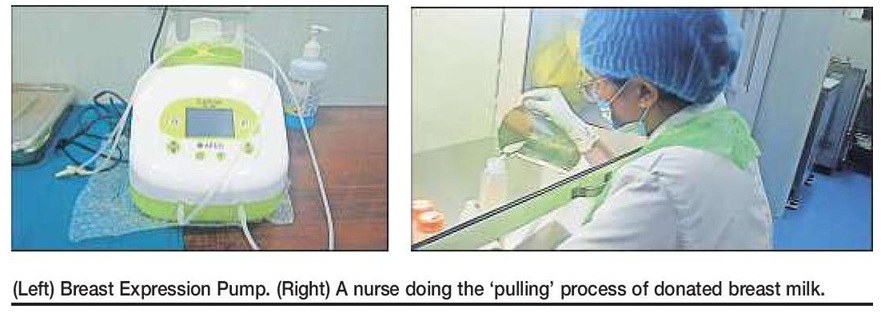
The second stage is called ‘Pulling’ where breast milk is kept under UV light to avoid contamination, and then all the milk is mixed together in a bottle to give babies all the required nutrients. The third stage is pasteurisation, where collected milk is heated to 62.5 degree celsius for 30 minutes under controlled conditions to eliminate harmful bacteria while retaining nutritional value. After pasteurisation, culture testing is conducted to confirm the milk is completely safe before being dispensed for NICU use.
The milk can be safely stored up for up to six months at minus 20 degree celsius in deep freezers, while refrigerated milk remains usable for 24 hours. Despite its importance, Varsha Wagh, a Senior Nurse, expressed, “Lack of awareness remains a major challenge. Many relatives still hesitate or refuse permission for mothers to donate milk due to social misconceptions and limited understanding about human milk banking,” she explained. She further stated that some mothers think that donating breast milk will reduce the milk available for their own child, which is a myth. Keeping this in mind, the hospital staff will soon initiate the awareness campaign.