NMC to chop 61 Aamrai trees for sewage line
| Date :17-May-2026 |
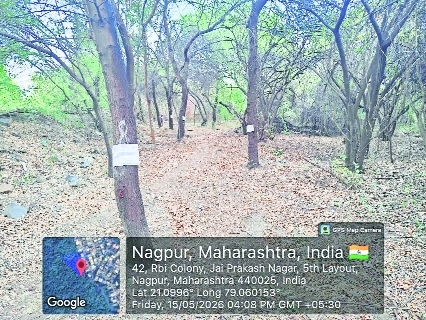
The notice pasted on the trees in the Aamrai marked for felling.
Staff Reporter :
Even as Nagpur reels under an unforgiving summer and rising temperatures linked to vanishing green cover, the Nagpur Municipal Corporation (NMC) has once again drawn criticism over a fresh proposal to fell 61 trees in one of the city’s last surviving dense green pockets.
The latest controversy centres around Aamrai, the historic grove near Dr Babasaheb Ambedkar International Airport where the NMC has initiated the process to cut 61 trees for laying a sewage line from Sahakar Nagar ghat to Mulik Complex through land controlled by the Airport Authority of India (AAI). A public notice issued by the Garden and Tree Authority Department of NMC on May 13 has invited objections from citizens within seven days
regarding the proposed tree felling. The notice has also been pasted directly on trees marked for cutting inside the forested patch.
Heritage trees among those marked: The official notice reveals that three heritage-category trees are among those proposed to be felled. The trees identified for cutting include Babhul, Kat Savar, Apta, Subabhul, Neem, Karanj, Nilgiri, Banyan, Palas, Bael among others.
The trees range from 8 years to 93 years in age, emphasising their importance to local ecosystem. Of the 61 trees, 58 are classified as non-heritage, while three fall under the heritage category.
Fear of irreversible ecological damage: Environmentalists have warned that, permitting infrastructure work inside Aamrai could become the beginning of irreversible destruction of the fragile urban forest ecosystem.
“The contractors, during construction, damage adjacent trees along with those officially marked for cutting. Many of those later die silently,” said Anusuya Kale Chhabrani, environmental activist and President of Swachh Association, while speaking to ‘The Hitavada’.
“It has become the modus operandi of the administration. The NMC must redesign projects in ways that minimise environmental damage rather than routinely sacrificing mature trees,” she added. Activists argue that, the sewage line alignment can be altered to reduce ecological loss, especially in a sensitive green zone that shelters numerous bird species and wildlife.
Aamrai’s historical legacy: Beyond its environmental significance, Aamrai carries deep historical value. The grove is believed to date back to the Bhonsla era and forms part of city’s old natural landscape associated with the erstwhile rulers of the city. Once known for its dense mango orchards and thick vegetation, the patch has survived decades of urban expansion around the airport corridor.
Citizens fear that, repeated permissions for infrastructure projects inside the area could gradually erase one of the city’s last remaining historical green lungs. With temperatures soaring and tree cover shrinking across Nagpur, the proposed felling has reignited debate over whether development planning in the city is being pursued at the cost of its environmental future.