Once repaired, now replaced: The changing nature of repair economy
| Date :17-May-2026 |
By Reema Mewar :
There was a time when a cracked tea cup was not immediately thrown away, when a torn school uniform returned home with fresh stitching along its seams, and when a pair of worn-out sandals sat outside a cobbler’s stall waiting for one more round of use. It was a time when, objects stayed long enough to become familiar -- and familiar enough to matter.
Repair once formed an unspoken, but essential part of everyday life in Nagpur. Things were used, worn out, and then taken to someone who knew how to fix them. Shoes were stitched back together, clothes were altered and mended, and even broken household items were restored, often because they carried sentimental value. Today, that rhythm has slowed, and the people who once depended on it speak of a subtle change.
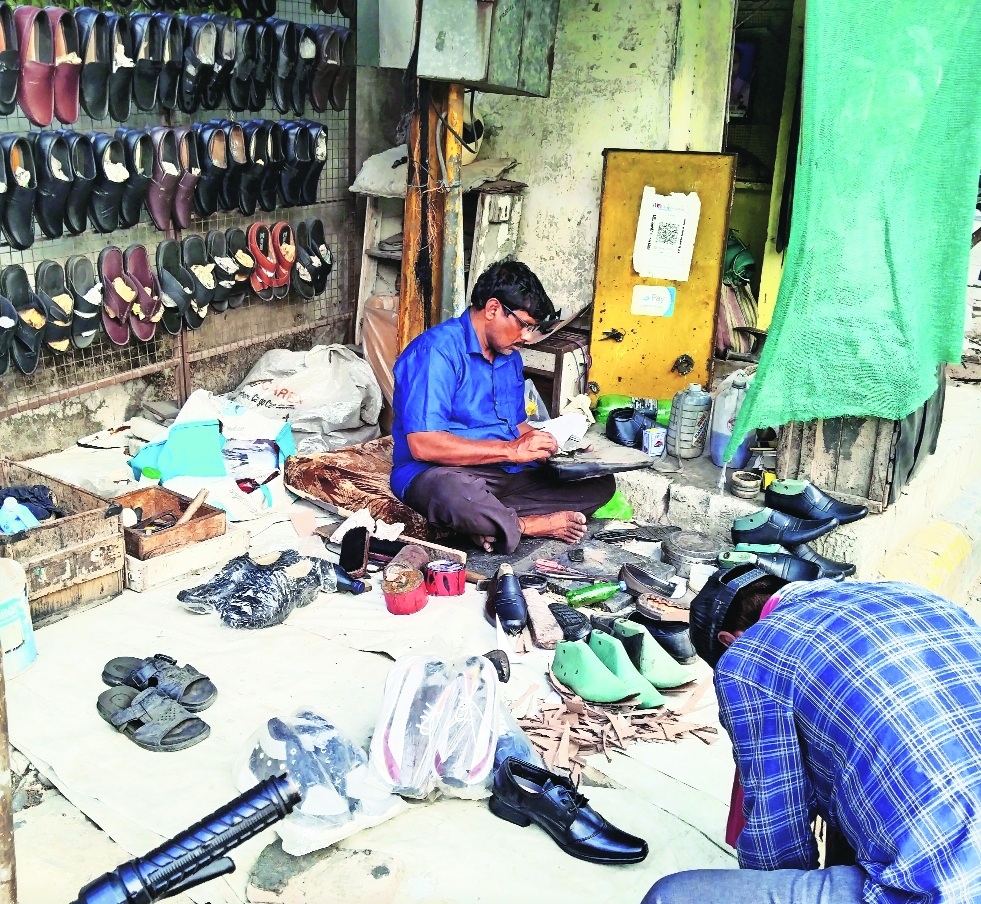
Rambabu Dhoke, a cobbler by trade, has both inherited his field, and witnessed it changing. His father was a cobbler in Pathakheda (a village in Madhya Pradesh) nearly sixty years ago.
Dhoke learned the trade from him and has been working for four decades at the same spot in Nagpur. “Shoes were not for everyone in the village,” he said. “In many middle-class homes, even having one pair each was a big thing. If something tore, they would get it stitched. They would use it till it could not be used anymore.”
What he sees today feels almost like the opposite. “Now everyone has shoes, but no one comes to repair them. Earlier, fixing was very feasible because the material used
to make footwear was strong, so it could be mended properly. Now, even if I fix it, the material gives away and then, what remains is neither worth wearing nor repairing. Everything is cheap now. People think why repair when you can buy new?” he said. “Besides, now every few weeks, there are new styles of shoes in the market, and everyone wants to keep up with the trend, so they just throw away or donate old shoes.”
A few kilometres away, Mohammed Umair Shakir sits with tools that once served a similar purpose. Now nearing his 90s, he no longer remembers his exact age, but he remembers the kind of work that used to come to him. “People came to me with chipped porcelain, broken figurines, old sets of china, but functionality was rarely part of the reason why they wanted things fixed.” He smiled as he explained, “At the time, repairing ceramics meant preserving a loved one’s memories. Some would be wedding gifts, mementos from the first house they purchased, a cup-and-saucer set adored by someone’s mother who had long passed -- pieces that had been handed down from generations. That kind of work has almost disappeared in the last 25 to 30 years,” he added.
When asked why, the answer was simple, but saddening. “The idea of what is worth leaving behind has changed. Today, people think of money, land, gold as inheritance. But, these things rarely have sentimental value. The real value once lay in ordinary objects, like a cupboard, utensils, handmade clothes -- things that stayed in a house long enough to become part of its memory. Now people don’t think twice before replacing, so there is nothing to leave behind.”
For Kailash Jha, a tailor, the change has not meant the end of work, but it has altered what that work looks like, and more importantly, disrupted an ecosystem that supported so many women. “In homes where women were not allowed to step out to work, they found that, taking up stitching or mending jobs could give them a small, albeit steady stream of income. The work was often simple but it was steady. School uniforms would come regularly, for torn pockets, ripped buttons, or needing to be loosened up for the next academic session,” he said. “But now, even that has died down to a great extent. School uniforms aside, regular clothes are cheap, in terms of quality and price.
So they are easily replaced.”
Repair has not vanished from Nagpur, but it occupies a different place than it once did. It survives where it is needed, adapts where it can, and recedes where it is no longer viable. In some cases, the shift is less visible, but equally significant. When objects are no longer kept long enough to gather meaning, the need to repair them also fades. What is lost is not only work, but a certain continuity, where things stayed in use, and in doing so, became part of a household’s memory.