Kala Vaibhav houses extraordinary lives of ordinary things
Date :18-May-2026
World Museum Day today
By Reema Mewar :
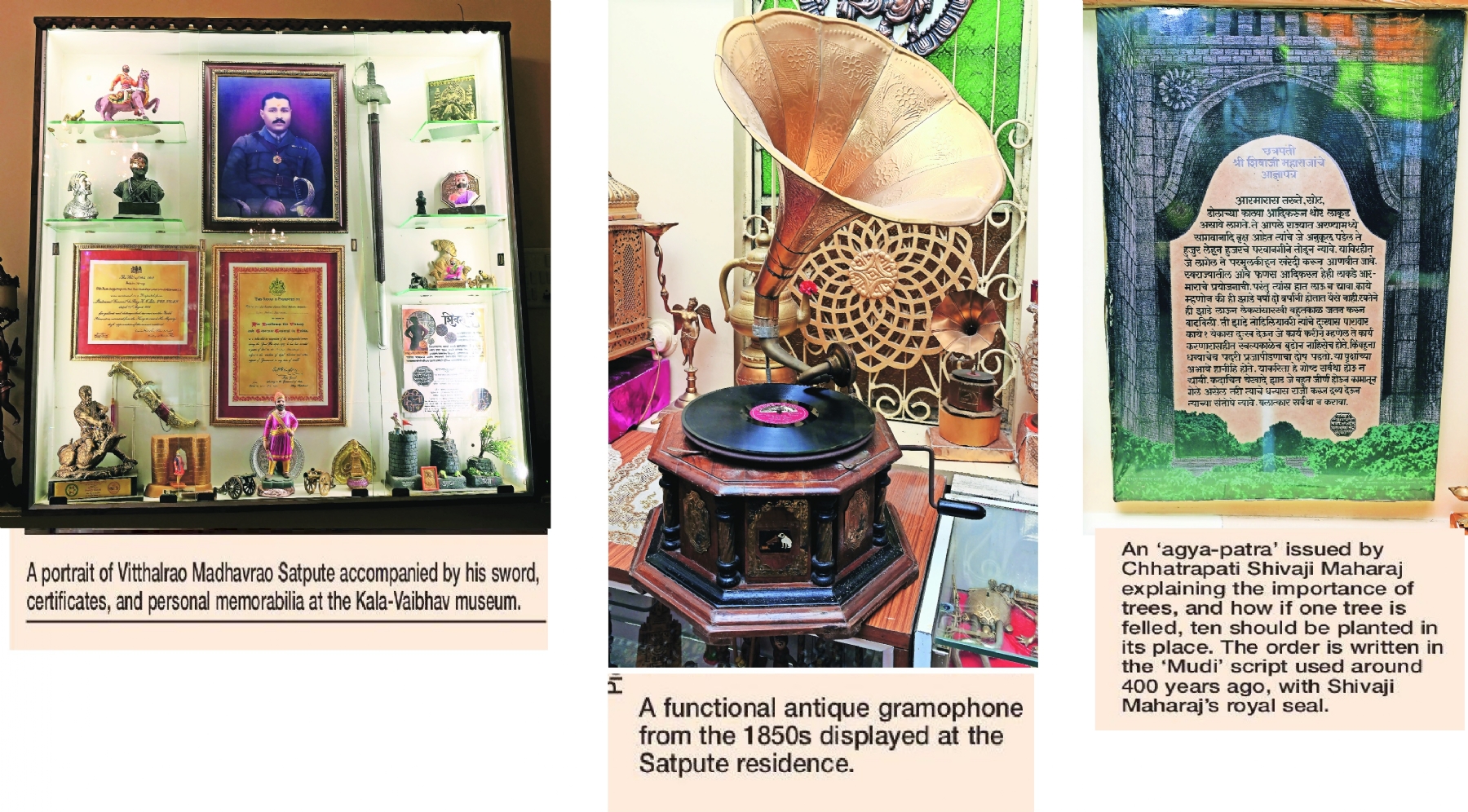
Pushing open the door to Kala Vaibhav, the residence of Ramesh Satpute, feels less like entering a house and more like stepping into another world. His home resembles a personal museum, packed with curiosities and memories collected across generations. Among its many oddities sits an emu egg, sharing space with old photographs, paintings, currencies, and keepsakes that preserve fragments of the past.
The Satpute family has preserved their history through objects that may seem ordinary, but hold extraordinary memories. The Satpute home also houses century-old paintings by Shakuntala Satpute, corals, antique brass locks, over-150-year-old Italian chandeliers and Ganesh idols of various sizes and materials, each carrying its own story. One such story belongs to Ramesh Satpute’s grandfather, Vitthalrao Madhavrao Satpute.
“My grandfather came from a family with substantial ancestral land, but chose to pursue medicine. Opportunities for medical education were limited, so he joined an army medical institution in Rawalpindi and went on to become a surgeon,” said Satpute, adding “Posted in the then Calcutta’s Alipore camp, he served on the Burma front during the First World War, earning the ‘Order of the British Empire’ and 90 acres of land in Chalisgaon.” Among the family’s treasured possessions is also a certificate of appreciation signed by Winston Churchill, the then Secretary of War and later, British Prime Minister.
Sometimes, history sits quietly in people’s homes waiting for someone to ask questions. The objects are ordinary -- papers, medals, letters, keepsakes -- but they carry the weight of memory. Long after voices fade and generations pass, objects continue remembering on our behalf.
Vyas Puratan Vastu Sangrahalaya: Home to History
By Reema Mewar :
Time has a strange way of disappearing. New objects replace old ones, technology makes yesterday obsolete and countless things that once formed part of everyday life fade away. Yet, some people refuse to let those pieces of the past vanish. Inside Vyas Puratan Vastu Sangrahalaya, these objects are given second life.
For the Vyas family, collecting history was never a hobby that appeared overnight; it became an inheritance passed from one generation to another. The family’s roots trace back to Jaisalmer, where Dilip Vyas’s great-grandfather served as a Raj Jyotish to the royal family. The family later shifted to Nagpur in 1957, but they brought with them a fascination for preserving the past.
Nayanshi Vyas, daughter of Dilip Vyas, explained, “My father’s grandfather had always loved collecting antiques, a passion that was later inherited by my grandfather and eventually by my father. He began collecting at just 10 years old, starting with things like old notes and coins.
Today, that childhood curiosity has grown into a collection of nearly 30,000 artefacts.”
Among the museum’s prized possessions are a Yashica twin-lens camera, nearly a century old, which once cost around Rs 300 -- a considerable amount at the time. The museum also houses original Victorian-era crockery, antique clocks and carefully curated series-based collections of ashtrays, antique watches and diya salais, commonly used during the Bhonsle era. What survives in places like these is more than history; it is memory preserved in objects that outlived eras they belonged to.