A Rarity Two rare damselfly species spotted in Central India for the first time
| Date :20-May-2026 |
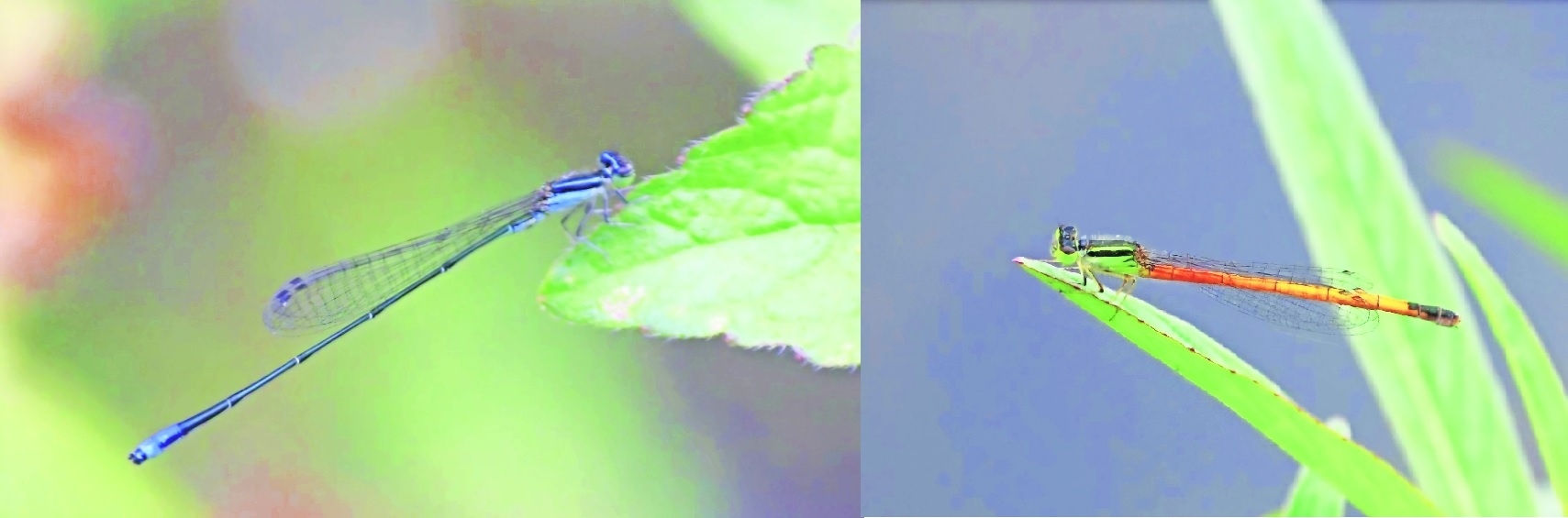
Indian Violet Dartlet Ruby Dartlet
By Simran Shrivastava :
Damselflies only survive near clean, healthy water. Finding them in Gadchiroli and Amarkantak confirms that the rivers and waterfalls in these areas are ecologically healthy.
A rare damselfly, Ruby Dartlet (Ischnura rufostigma), has been spotted in Vidarbha for the very first time, along the Indravati River in Hemalkasa village, Bhamragad, Gadchiroli. Another rare damselfly, Indian Violet Dartlet, was spotted in Madhya Pradesh (MP) for the first time, at Dudh Dhara Falls in Amarkantak. Both sightings have been published this year in ‘Natura Croatica’, an international science journal based in Zagreb, Croatia.
The research team includes Ashish Tiple, a zoology lecturer from Dr R G Bhoyar College in Seloo, Wardha, and Atul Deokar, Divisional Forest Officer (DFO), Navegaon Dam, Gondia.
The team had spotted five individuals of the ‘Ruby Dartlet’ sitting on grass and plants along the edge of the Indravati River in Gadchiroli. The area has rivers, ponds, marshes and rice fields all around it.
The Ruby Dartlet is a colourful damselfly, which displays striking orange-red to black patterns, with a distinct, brilliant blue segment on the abdomen. The males were flying back and forth, defending their territory. The females stayed hidden in the shade and dense vegetation nearby. This species was earlier known to exist in states like Assam, Bihar, West Bengal and Uttarakhand. “Nobody had ever officially recorded it in Maharashtra before,” claimed Tiple.
And the team had spotted 11 individuals of the damselfly ‘Aciagrion approximans krishna’ (Indian violet dartlet) at Dudh Dhara Falls in Amarkantak, Madhya Pradesh. It is a small, slender damselfly characterised by a predominantly violet, black, and pale blue coloration. Nine were male and two were female, all sitting on grass, plants and low shrubs near the water. Males were seen basking in sunlight and patrolling near the waterfall. Females stayed in shadier spots.
Central India, including Vidarbha in Maharashtra and Madhya Pradesh, has enormous forests, river systems and tiger reserves. But the scientific documentation of what actually lives in these areas is still seriously incomplete, said Tiple. This species was previously known only in the Western Ghats states and Chhattisgarh.
Nobody had ever officially recorded it in Madhya Pradesh before. Damselflies only survive near clean, healthy water. Finding them in Gadchiroli and Amarkantak confirms that the rivers and waterfalls in these areas are ecologically healthy and pollution-free. Importantly, the researchers say, both species were almost certainly living in these areas long before this. They simply went unnoticed because these forests and riversides are remote and scientists rarely go there to survey.