Citizens to get CLEAN, SAFE DRINKING WATER, BMC ends groundwater dependence to ensure uninterrupted water supply across Bhopal, The civic body to shut 111 TUBE WELLS; decisive step taken to prevent groundwater contamination following lessons from Indore sewage tragedy
| Date :20-May-2026 |
Staff Reporter :
THE Bhopal Municipal
Corporation (BMC) has decided to ensure uninterrupted
water supply to city residents
throughout 2026 without any
water cuts, despite falling
reservoir levels during the
peak summer season. In a
major policy shift, the civic
body is completely phasing
out its groundwater-based
tube well system to distribute
drinking water exclusively
through safe surface water
sources.
As a part of this transition,
the municipal corporation has
officially requested the power distribution company to
disconnect electricity lines for
111 out of 247 tube wells,
which will be permanently
decommissioned and
removed from official records.
According to municipal
records, Bhopal’s daily surface
water supply capacity stands
at 514 million litres per day
(MLD) for its population of 2.5
million, safely exceeding the
actual consumption of
approximately 450 MLD.
Clean water sourced from
the Narmada River, Upper
Lake, Kerwa and Kolar dams
is fully treated at modern
plants before distribution.
Despite summer pressures, the
Narmada River remains a
robust source at 288.80 meters,
well above its dead storage level of 276.85 meters, while
Upper Lake holds 2,230 million cubic feet (MCFT) of
water, ensuring stable supply
until the monsoon arrives.
The decision to abandon
groundwater reliance is rooted in public health safety,
drawing lessons from a
January 2026 tragedy in
Bhagirathpura, Indore, where
sewage contamination in
groundwater led to several
deaths.
Following that incident, the
detection of harmful E. coli
bacteria in a well in
Khanugaon, Bhopal, prompted the municipal corporation
to ban drinking water supply
from public tube wells, hand
pumps, wells, and stepwells.
The remaining 128 functional tube wells will now be
used strictly for non-potable
purposes, such as irrigating
public parks, central verges,
and roadside plants.
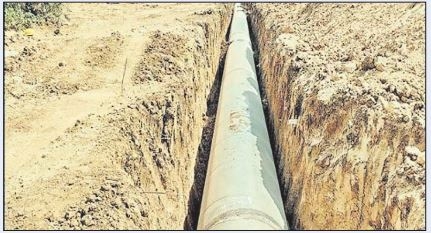
Over the past decade, the
municipal corporation has
invested over Rs 300 crore to
develop a massive 3,885-kilometre-long water distribution
network across a 412 square
kilometre area.
Currently, the city has
2,72,690 direct household connections, 1,028 bulk connections, 1,101 commercial connections, and 265 institutional connections linked to its
surface water network, supported by 15 water treatment
plants, 173 overhead tanks and
110 underground reservoirs.
BMC Superintending
Engineer Udit Garg stated that
with clean, treated water available from surface reservoirs,
there is no need for
groundwater extraction, effectively eliminating any risk of
water contamination.