Nagpur metro ridership sees 10% drop
| Date :21-May-2026 |
Staff Reporter :
Despite searing summer heat, citizens shying away from safe, comfortable and affordable public transport
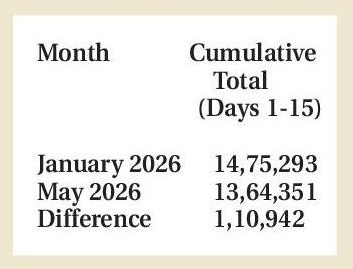
Nagpur Metro’s ridership in May has taken a sudden dip as the city closes its schools and colleges owing to the summer season. When compared to the ridership of the beginning of the year, Nagpur Metro recorded 13,64,351 riders, which is on average about 10 percent lower than that of January, which was 14,75,293. This totals a difference of 1,10,942.
Most of the schools and colleges were active in January. Hence, the data suggests that schools, colleges, and other educational institutions form the biggest pillars of Nagpur Metro’s daily passenger flow. Given the adverse weather, one would have thought that citizens might flock to metro in large numbers, but that is not the case, it seems as yet.
In the first half of April, when schools and colleges remained functional, Metro recorded 14,97,187 riders during the same period, which is a difference of more than 1.3 lakh passengers in just fifteen days.
That translates to nearly 9,000 fewer riders every day in May compared to April.
May exposed the system’s summer baseline. Weekday ridership remained functional, ranging between 87,190 and 1,02,990, but the consistent one lakh-plus weekday pattern seen in January, February, March, and April largely disappeared.
The ridership figures showcase that despite availability of mass rapid transport system, citizens still rely on personal vehicles to commute for daily work in the city, since it offers them greater flexibility and lack of walking culture. Given the short distance, wherein one can reach any corner within maximum half an hour, people are not yet ready to latch onto metro to ditch their personal vehicles.
Ridership on Sundays
decreasing by 25%
The numbers also show a remarkably stable Sunday dip throughout all months. Sunday ridership across each month stayed mostly around 70,000 regardless of season. Weekdays, meanwhile, averaged around 1,00,000 riders. This has created a recurring weekly gap of nearly 28,000 passengers.
The consistency of that Sunday drop suggests the metro’s demand is affected
by city schools, colleges, offices, coaching centres, and businesses. The ridership is connected to them all slowing down together every week. The approximately 70,000 passengers who continue using the metro on Sundays appear to represent the network’s core demand. Everything above that level, the data suggests, comes largely from Nagpur’s working and academic week.