Desilt, spend, repeat: Nullah cleaning raises questions over long-term civic planning
| Date :22-May-2026 |
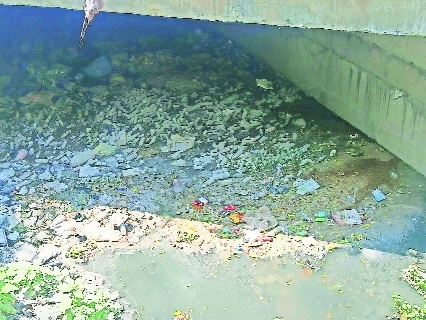
Garbage accumulated under the bridge that runs over the dried up Naag river beside RTO.
Staff Reporter :
Despite routine desilting and repeated interventions, concerns persist over recurring waste accumulation and long-term vision
The recurring desilting work at the nullah adjoining RTO compound on Amravati Road in Civil Lines has once again brought attention to a larger issue -- whether repeated cleaning exercises are addressing the root problem or simply postponing it.
According to an official from the Nagpur Municipal Corporation (NMC), major nullahs across the city are cleaned twice every year -- once before the Winter Session and again before the onset of monsoon to prevent blockages that can lead to water stagnation and create breeding grounds for flies and mosquitoes. However, while the exercise is intended to prevent recurring civic and public health issues, questions are now being raised about whether the process itself has become redundant.
Prabhag 14-D corporator Abhijeet Jha had earlier approached NMC regarding waste accumulation in the nullah. Cleaning work was subsequently carried out on March 19, 2026.
The silt and waste removed during the process were deposited along the guard railings near the nullah, allowing conditions to gradually return to their previous state. Even the underside of the bridge is clogged with garbage and plastic waste.
The NMC official claimed that since the retaining walls along the nullah are old and weakened, a layer of approximately one metre of silt is intentionally retained as support for the walls, while excess deposits are removed and transported and dumped in Bhandewadi Yard.“There are two parts to this cleaning exercise, firstly removing the silt and plastic waste, and secondly transporting the excess waste. The process itself does not involve significant additional expenditure. The JCB machines and transport vehicles used for cleaning and carrying waste away are owned and operated by the NMC, eliminating rental costs.
The primary operational expense is fuel required for these vehicles.” claimed the official.
The issue is not simply about the amount of money spent, but about the cycle itself. Even if direct costs are limited to diesel and operational expenses, the manpower, machinery and administrative resources continue to be repeatedly directed towards the same exercise.
Officials say long-term measures are being planned. According to Dr Gajendra Mahalle, Chief Sanitation Officer, NMC, a Detailed Project Report (DPR) has been prepared for renovation and reinforcement of the nullah’s retaining walls.
Still, unless stronger monitoring, waste disposal enforcement and preventive mechanisms are put in place, desilting is less of a solution and more of a recurring exercise -- one that repeatedly consumes public resources without delivering a lasting outcome.