The Great Informal Economy: Hawkers generate Rs 3,000 cr annual turnover Yet, not one operational vending zone exists in the Second Capital of Maharashtra
| Date :24-May-2026 |
By Simran Shrivastava :
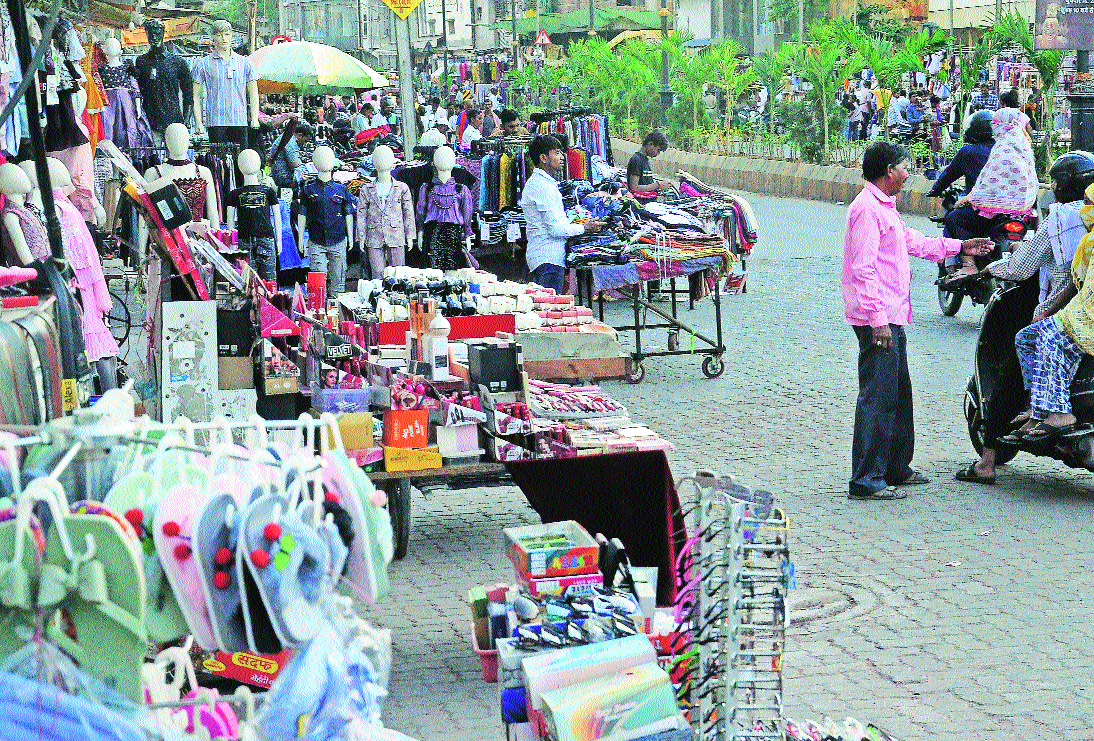
BEFORE the sun rises, vegetable carts are already arriving at roadside markets, tea stalls are boiling their first kettles, and push-cart vendors are unloading sacks of onions, chillies, and coriander. The city’s aathvadi bazaars (local weekly markets) are lined up by tens of thousands of street vendors. By the time Nagpur’s offices open, they have already sold breakfast, stocked kitchens, supplied households, and moved lakhs of rupees through an informal economy.
According to calculations by the Maharashtra Hawker Federation, city’s estimated 80,000 street vendors generate more than Rs 8 crore in daily turnover.
Across the year, that amounts to nearly Rs 3,000 crore. The sector also sustains an additional 40,000 helpers across the city, from chai vendor assistants to garment sellers’ loaders, taking total dependent livelihoods past one lakh.
“And not just that, the sector sustains even more livelihoods when family dependants of loaders, assistants, suppliers, and family dependants are included,” says Maharasthra Hawkers’ Federation President and National Hawker Federation Vice-President Jammu Anand.
Government figures place street vending at 14 per cent of all non-agricultural urban informal employment in India.
The scale of the sector’s consumer base reflects its position in the city’s economy. “In fact, 70 per cent of Nagpur’s population, particularly lower-income households, depend on street vendors for daily food, clothing, and household goods,” Anand adds.
Sunil Suryavanshi, a Nagpur representative of the National Association of Street Vendors of India (NASVI), shares that along the Lohapul to Variety Square stretch, in an area locally known as the Kitabkhana market, an estimated 150 vendors operate alongside 60 permanent shops on either side of the road. Vendor stalls in the area always draw higher customer footfall than the formal outlets beside them,
he adds.
What vendors provide, as asserted by Suryavanshi, is speed, affordability, and reach that the formal economy struggles to match. “A packet of spices sold by a street vendor may move from manufacturer to consumer in one or two days. Formal retail outlets often take more than two weeks to turn over the same stock,” he notes.
That turnover, says Incharge of Hawker Division in Kamgar Ekta Union Kiran Thakre, matters beyond the street. Manufacturers have already paid GST on packaged goods before vendors sell them.
“Faster sales trigger faster reorders, quicker production cycles, and earlier tax payments further up the supply chain. Vendors collect no GST directly from customers, but they accelerate the movement of goods through the broader economy,” she states.
Yet in Nagpur, not one operational vending zone exists, not one comprehensive round of vending certificates has been issued, and the law that required both has remained largely unenforced for a decade.
“There is no alternative arrangement for vendors,” says Niyaz Pathan, Vice-President of the Saaptahik Bazaar Path Vikreta Sangathan. He laments the anti-encroachment actions against them. “Our livelihood is going. There has to be some solution,” Pathan urges.
The anti-encroachment drives continue despite the Street Vendors (Protection of Livelihood and Regulation of Street Vending) Act, passed
by Parliament in 2014 and
implemented in Maharashtra in
August 2016. The law was intended to formalise and protect street vending for the first time.
It required every municipal body to survey vendors, issue certificates of vending, and create designated vending zones. Surveys were to be repeated every five years. Vendors facing eviction were entitled to 30 days’ written notice and an alternative site under Section 18(3) of the Act. However, the Nagpur Municipal Corporation (NMC) has not yet completed these requirements.
According to Suryavanshi, the NMC surveyed approximately 33,770 vendors between 2014 and 2016. Of those, only 3,149 licences were issued. The next mandatory survey was due by 2021. It has not been conducted.
The corporation originally planned 115 hawking zones across the city.
After objections, the number was reduced to 53. In December 2023, following a High Court intervention that led to the reconstitution of the Town Vending Committee (TVC), 47 zones were declared and yet none has been built, Suryavanshi explains.
The gap between the official figures in 2016 and the actual vendor population today has widened heavily since the pandemic. Factory closures during the COVID-19 lockdowns pushed thousands of workers into informal vending after industries shut down or reduced operations. Many never returned to formal employment. Graduates unable to find jobs entered street trade. Women entering the workforce for the first time joined the sector in increasing numbers. None of them appear in the city’s decade old vendor records.
Suryavanshi has repeatedly demanded a fresh survey. “If the law says a survey must happen every five years, why has there been no survey after 2016,” he asks and waits for the Great Informal Economy to get formalised.