Green canopy under threat as Rlys plans Motibagh workshop expansion
| Date :27-May-2026 |
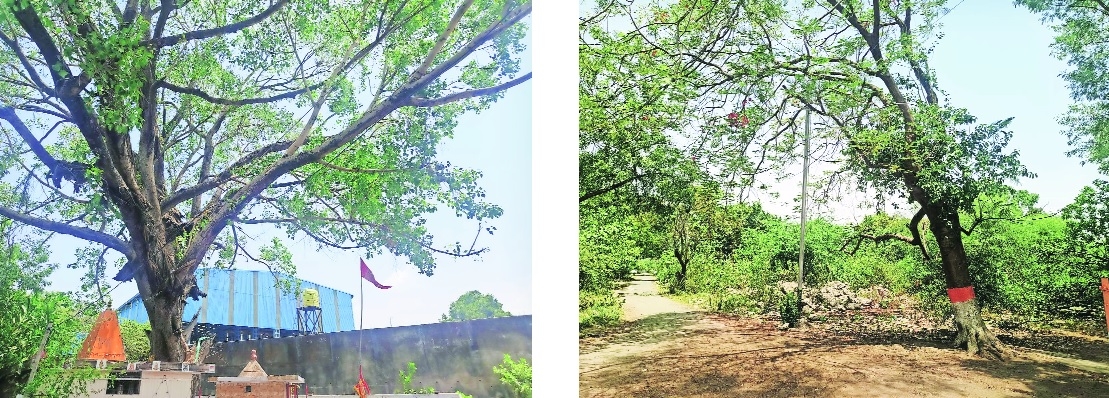
(Left) The big and mature green trees under threat due to proposed expansion of Motibagh workshop. (Right) The green cover in the premises of Punjabi colony.
Staff Reporter :
Once counted among the greenest cities in the country for its dense urban tree cover, Nagpur is steadily witnessing the shrinking of its green canopy due to rapid infrastructure development. Another such concern is now emerging at the Punjabi Line Railway Quarters near Kamptee Road, where expansion plans for the historic Motibagh Railway Workshop have raised fears over the possible loss of mature trees and green spaces.
The Motibagh Workshop of South East Central Railway (SECR), originally established during the British India era under the Bengal Nagpur Railway (BNR), was initially developed as a Narrow Gauge Workshop. Over time, it evolved into a major maintenance and repair hub for modern Linke Hofmann Busch (LHB) coaches. Railway authorities are now planning to increase the workshop’s annual maintenance capacity to 324 coaches as part of phased expansion and modernisation plans.
According to railway officials, the latest proposal submitted to the Railway Board includes utilisation of land occupied by the Panjabi Line railway quarters.
“The quarters in the Punjabi Line colony are in a dilapidated condition and they will be demolished. The area will be used for the expansion of the workshop,” said N Vishwalal, Chief Workshop Manager of Motibagh Workshop.
Environmentalists point out that a similar expansion exercise around a decade ago had already caused significant ecological damage. During the south-side expansion of the workshop and demolition of the Gorkha Chawl RPF Colony area in Punjabi Line, nearly 70 fully matured trees were reportedly cut down.
Among them were several massive Peepal trees believed to date back to the Bhonsale era, along with old Neem, Banyan, Mango, Bija and Karanj trees.
Residents claim that despite the large-scale tree cutting undertaken then, compensatory plantation and visible environmental compliance measures remain largely absent even after a decade.
The Punjabi Line colony still contains
nearly 100 mature trees, including several heritage Peepal and Banyan trees believed to be more than 300 years old. Locals say the green cover plays a crucial role in maintaining temperature balance in the densely populated area.
“I have seen these trees since childhood.
The thought that they may be cut down is heartbreaking,” said a senior citizen residing near the colony.
The area is also known to support bird species such as Alexandrine Parakeets, Rose-ringed Parakeets, Rosy Starlings and Yellow-footed Green Pigeons. Residents have additionally alleged that dumping of construction debris near tree bases may already be damaging root systems.
Environmentalists argue that Indian Railways already possesses vacant land near Kalamna Railway Station adjoining the Nagpur–Howrah main line, which could be explored for future expansion without damaging valuable green cover.
Railway officials, however, clarified that the proposal is still awaiting approval and no final decision regarding tree cutting has been taken so far. Citizens and environmental groups are now preparing to approach the Maharashtra Pollution Control Board and National Green Tribunal, demanding environmental assessment, transparency and sustainable alternatives before any irreversible ecological damage occurs.