QUAD ramps up Indo-Pacific surveillance
Date :27-May-2026
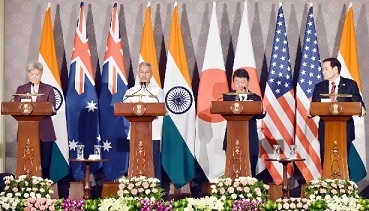
NEW DELHI :
THE QUAD grouping on Tuesday expanded cooperation in critical minerals and energy while unveiling new measures to boost maritime surveillance and port infrastructure across the Indo-Pacific against the backdrop of China’s growing military posturing in the region.
The new measures were announced following a meeting of the grouping’s Foreign Ministers here, chaired by External Affairs Minister S Jaishankar and attended by US Secretary of State Marco Rubio, Australian Foreign Minister Penny Wong, and Japanese Foreign Minister Toshimitsu Motegi.
We affirm our support for a free and open Indo-Pacific that allows countries to develop resilience and strengthen capacity to determine their own paths. To that end, we concur on further enhancing cooperation and advancing concrete initiatives to deliver tangible benefits to the region, the Ministers said in a joint statement.
The QUAD Foreign Ministers called for uninterrupted flow of global commerce through the Strait of Hormuz, criticised Iran’s imposition of tolls on commercial shipping in the region and voiced serious concern over the situation in the East China Sea and the South China Sea.
“We reiterate our strong opposition to any destabilising or unilateral actions, including by force or coercion, that threaten peace and stability in the
region,” the Ministers said in
the statement, sending a message to China.
“We express our serious concerns regarding dangerous and coercive actions, including interference with offshore resource
development, the repeated obstruction of freedom of navigation and overflight, and the dangerous manoeuvres by military aircraft and coast guard and maritime militia vessels,” they said. “We are seriously concerned by the militarisation of disputed features,” they said.
The India-led Quad, comprising India, Australia, Japan and the United States, also announced plans to mobilise up to $20 billion in combined Government and private sector investment to strengthen critical minerals supply chains and reduce dependence on concentrated global sources.
In his media statement, Jaishankar announced a critical minerals framework an Indo-Pacific energy security initiative under broader QUAD agenda to confront major challenges facing the region.
Jaishankar said a free and open Indo-Pacific has many dimensions and facets and the QUAD meeting took stock of the progress in many of them.
We believe strongly that economic resilience should be promoted and supply chains should be strengthened, he noted, adding the deliberations also touched upon current energy and fertiliser availability and that of critical minerals. Jaishankar on Tuesday held talks with his Australian counterpart Penny Wong in Delhi as the two leaders explored ways to boost bilateral cooperation, with the EAM asserting that there have been a number of ‘positive developments’ when it comes to the India-Australia ties. Jaishankar and Wong held bilateral discussions in the evening as part of the 17th India-Australia Foreign Ministers’ Framework Dialogue, following Quad meeting here.
“In the coming days, whether it is economic activity, energy trade or maritime commerce, the Indo-Pacific will become even more important to the world. The responsibilities of the QUAD will grow commensurately, and we must prepare for that,” he said.
The External Affairs Minister said countering common threat of terrorism also figured in the talks.
“There must be zero tolerance for terrorism, and nations subject to terrorist attacks have the right to defend themselves,” he said.
In his media statement, Rubio said the QUAD meeting decided to launch an Indo-Pacific Maritime Surveillance Cooperation Initiative
It will leverage each of our country’s maritime surveillance capabilities in the Indo-Pacific, he said.
Rubio also announced the expansion of the Indo-Pacific Maritime Domain Awareness Initiative among the QUAD nations.
The US Secretary of State also said the QUAD has decided to roll out a new initiative to boost port infrastructure in the Pacific Islands.
“The reason why maritime security is so important, beyond the fact that current events remind us of what can happen when maritime security is impeded, is the fact that 60 per cent of global maritime trade passes through the Indo-Pacific,” Rubio said.
He argued that it is a vital national interest not just to the four QUAD countries, but to countless countries around the world.
“The second initiative: we’re going to be partnering on issues of port infrastructure, in response to insufficient port capacities in the Pacific Islands,” he said.
“We’re announcing plans to work with Fiji to advance that country’s port infrastructure. It’ll be the first time that the QUAD partners work together on a port infrastructure project,” he said.
The Australian Foreign Minister said the QUAD recognised efforts towards a diplomatic resolution to ensure freedom of navigation in the Strait of Hormuz.
We recognise the importance of maintaining the principle of freedom of navigation and our opposition to any tolling proposition, she said referring to Iran’s plan to demand fees for transiting the Strait.
We are working together to strengthen cooperation against scam centres, particularly in Southeast Asia, Wong said.
The Australian Foreign Minister said the Quad will coordinate on maritime surveillance efforts initially in the Indian Ocean.