5 months, just 5 MD raids: What is NDPS Cell doing?
| Date :28-May-2026 |
By Dheeraj Fartode :
At a time when drug-trafficking networks, particularly those linked to mephedrone (MD), continue to spread across Nagpur and nearby districts, the functioning of
the city police’s specialised anti-narcotics wing - the NDPS Cell - has come under
the scanner.
Data accessed by The Hitavada shows that between January and May this year, the NDPS Cell carried out only five MD-related raids. More importantly, the branch failed to register a single MD seizure case in March and May. The numbers have raised serious questions about the unit’s effectiveness, especially when local police stations, rural police, and even central agencies like the Directorate of Revenue Intelligence (DRI) have been regularly busting larger narcotics rackets.
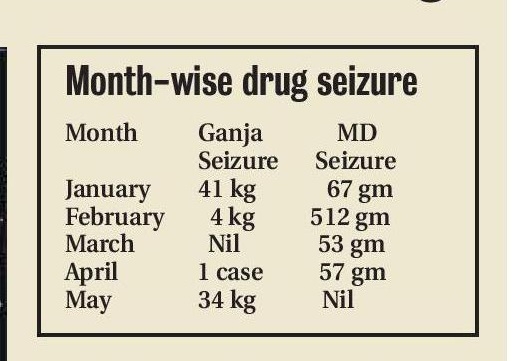
The monthly figures tell a worrying story. In January, the NDPS Cell registered one ganja seizure case of 41 kg. During the same month, only one MD-related case was recorded, with seizure of 67 grams.
The branch also carried out four gambling raids, one e-cigarette-related action and three liquor cases.
In February, the unit registered one ganja case with seizure of 4 kg of ganja and one MD case of 512 grams of MD. One liquor-related case was also registered during the month.
March saw no ganja seizure at all. The branch registered just one MD case and seized 53 grams of MD.
In April, the NDPS Cell booked one
ganja case and two MD-related cases
which involve a combined seizure of
57 grams.
Besides this, the branch also registered one gambling case and two liquor-related offences.
What has raised eyebrows further is the performance in May. Despite repeated reports of MD circulation in several parts of the city, the branch failed to register even a single MD seizure case.
The only narcotics-related action taken during the month was one ganja case involving seizure of 34 kg of ganja. Apart from that, the branch carried out four hookah parlour cases and one e-cigarette-related action.
The low number of MD seizures becomes even more significant when compared with actions taken by local police stations and other enforcement agencies. Over the past few months, several police stations in Nagpur city and rural areas independently busted MD supply chains and arrested peddlers with sizeable quantities of narcotics.
Sources within the Police Department claim that while local units are actively developing intelligence and conducting operations, the specialised anti-narcotics branch has failed to create the kind of deterrence expected from a dedicated NDPS enforcement unit.
“The branch is not producing impactful results. The fear of NDPS Cell action among peddlers appears to be missing,” said a source familiar with anti-narcotics operations.
When contacted, Police Inspector Gajanan Gulhane, who heads the NDPS Cell, defended the branch’s performance.
He said strict action taken last year had already landed several major MD suppliers behind bars.
According to PI Gulhane, most MD suppliers operating in Nagpur have links to Mumbai and Indore, while some supply chains are connected to Rajasthan’s Jhalawar, Dagar and Jawra regions. Ganja, he added, mainly comes from Odisha.
He also pointed to severe staff shortages within the branch. At present, the NDPS Cell is functioning with only three officers and seven staff members. According to him, a specialised anti-narcotics unit should ideally have at least 15 personnel to function effectively.
However, critics argue that manpower shortage alone cannot explain the absence of MD cases in key months, especially when narcotics activity continues to surface through operations conducted by other police units.
It also raises a question mark about whether the NDPS is adequately equipped with operational strategy to tackle the growing narcotics network.