More than a dancer: Shovana Narayan on learning, curiosity, and life
| Date :28-May-2026 |
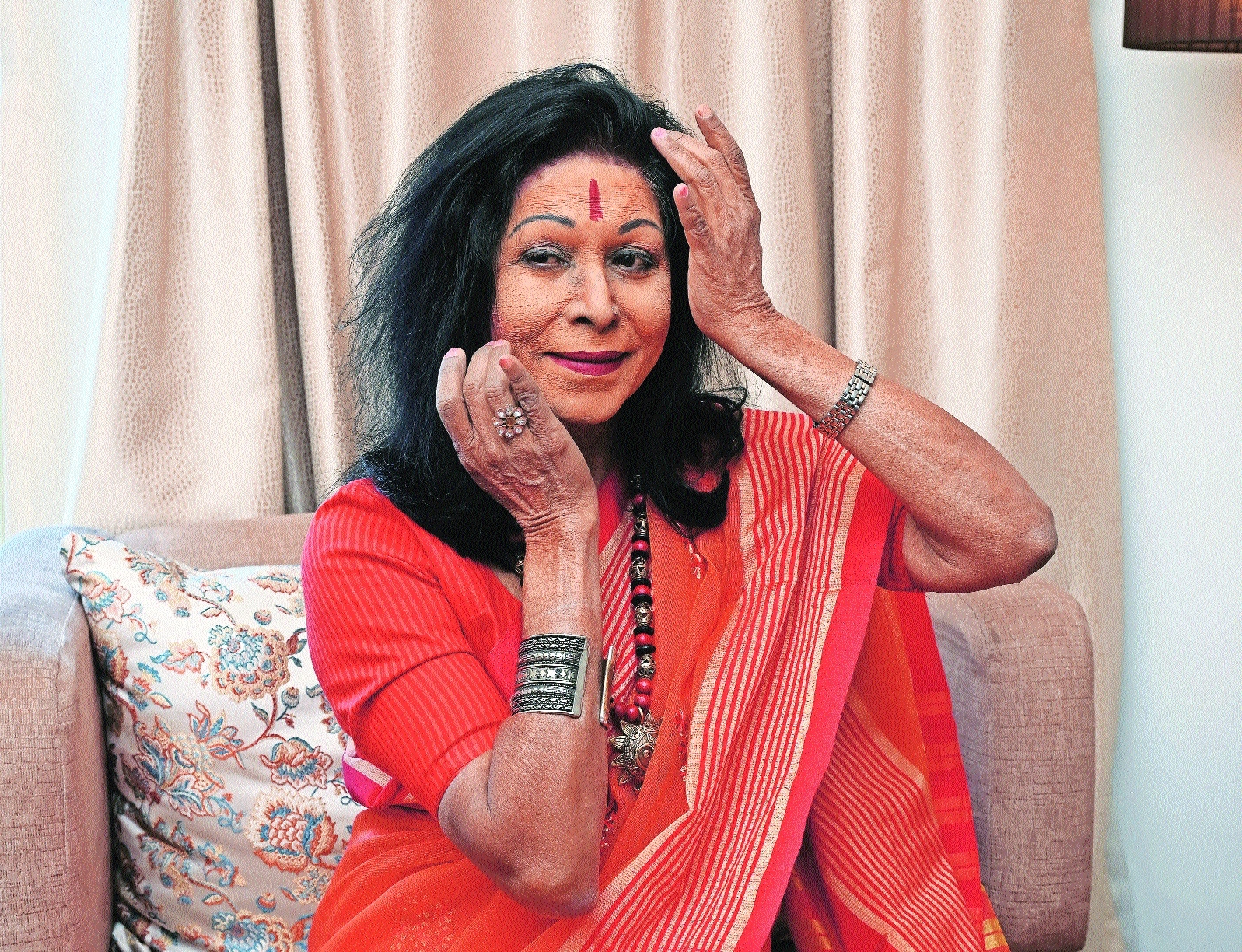
Shovana Narayan, in conversation with ‘The Hitavada’. (Pic by Anil Futane)
By Reema Mewar :
A conversation with Shovana Narayan does not progress in straight lines. Questions often begin with dance and end somewhere entirely different – in philosophy, education, curiosity, relationships or reflections on life itself. There is an unmistakable energy in the way she speaks. Not the kind that comes from dramatic gestures or grand declarations, but the kind that comes from genuine engagement. One thought leads to another, one memory opens the door to a larger idea, and one answer often returns with another question hidden within it.
Even while speaking about the traditional guru-shishya parampara, Padma Shri Kathak exponent Narayan repeatedly shifts the focus away from rigid structures and towards something far more human - Connection.
“Learning should never be a one-way transmission of knowledge, where a guru simply imparts and a student quietly receives. Curiosity leads to inventions. There should never be any sort of blind surrender or unquestioned hierarchy. A student does learn from a teacher, but a teacher also constantly learns from students,”
she explained.
This idea of curiosity shapes much of her understanding of teaching. In conversations around classical arts, there is often
concern that modern classroom systems and shorter formats of learning have diluted the traditional guru-shishya bond. Narayan, however, sees the issue differently. To her, the format itself is not the problem.
“Learning depends as much on the receiver as on the giver.
If a vessel has holes in it, it cannot retain water. A guru may give everything, but a student may not retain it. Equally, a student may arrive eager and willing, but a teacher may fail to provide the essence. For me, learning has never been confined to physical movement or technical perfection. Dance cannot exist merely as a sequence of practiced steps. It has to be accompanied by something deeper.”
As she speaks about her own approach to teaching, it becomes evident that philosophy, introspection and emotional understanding naturally flow into her classes. “Much of this came from discussions at home, particularly with my mother, and from a personal journey of searching and self-reflection that gradually evolved over the years. I have never tried to separate dance from the rest of my life.”
And perhaps this is where the conversation begins moving beyond dance altogether.
Because while Narayan is widely known for her contribution to Kathak, another aspect of her personality emerges just as strongly during the interaction, that of a deeply academic and intellectually driven individual.
She speaks of studies with the same enthusiasm with which she speaks of dance.
Throughout her academic life, she consistently remained among the top students in her class. Physics and Mathematics fascinated her because, as she says, she enjoyed anything logical. She completed her BSc (Honours) and MSc in Physics and went on to pursue a PhD in Solid State Physics, and was a CSIR Junior Fellowship holder before eventually joining the Audit and Accounts services in 1976.
For many people, this would have meant a shift away from artistic pursuits. But Narayan never approached life as a choice between passion and profession. “There was never a question of me quitting dance. Dance was not something separate from me; it became my life, my breath, my soul. I simply knew I could not live without it.” Thus, both journeys unfolded together. Even while balancing a demanding career in public service and an equally intensive life in dance, she continued studying and completed two MPhils -- one in Public Administration and another in Defence and Strategic Studies.
“I like to use my brain, and dance is in my heart,” she says.
The statement perhaps explains her life better than any lengthy description could. There never appears to have been a conflict between intellect and art, discipline and creativity, profession and passion. For her, they seem to have strengthened one another. As the conversation draws to a close, she returns to what appears to be one of her strongest beliefs -- the importance of depth.
For young artists, her advice is direct and uncomplicated. “There are no shortcuts in life, and one cannot expect instant success. Whatever you do, do it with depth, dedication and sincerity.”
The second lesson is even more personal. “Youngsters must carve their own path.
Always remember Rabindranath Tagore’s ‘Ekla Chalo Re’. Even in a crowd, one ultimately travels alone.” Perhaps that thought also captures her own journey.
A life spent balancing scholarship and art, public service and performance, tradition and individuality -- moving alongside many people, yet steadily walking a path that was entirely her own.