16,447 saplings planted against 2,618 trees felled by Nagpur Metro
| Date :07-May-2026 |
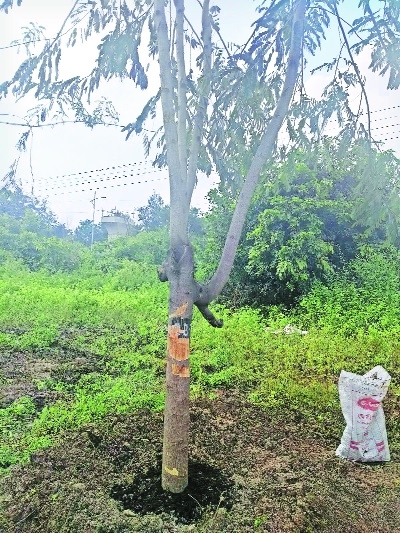
Sapling planted by MahaMetro seven years ago survives.
Staff Reporter :
The focus, the department says, has been on native species: Neem, Kadamba, Peepal and Jamun
Nagpur Metro Rail Corporation Limited (NMRCL) felled a total of 2,618 trees for construction of Metro infrastructure under Phase I, against which the latter planted 16,447 trees under compensatory plantation in different parts of the city, revealed a Right to Information (RTI) data.
The Garden Department of Nagpur Municipal Corporation (NMC) allowed the project proponent to fell 2,618 trees coming under their project. Against tree felling, the civic body asked Nagpur Metro to do compensatory plantation as per the Maharashtra (Urban Areas) Protection and Preservation of Trees Act, 1975. The official claimed that more than 90 per cent of trees planted during Phase I have survived, while survival rates for Phase II plantations are yet to be assessed as the saplings are still recent.
The Garden Department also asked the project proponent to perform geo-tagging of all sapling planted, with location mapping, and compliance reports linked to multiple project phases and permissions.
“We attempted to minimise tree cutting by design adjustments and pruning, reporting that 427 trees were retained despite having permission to fell them,” the official stated.
Phase 1 plantation was concentrated at Little Wood on Hingna Road and its extension near Amravati Road, developed as large green clusters to offset tree loss along the corridor. Whereas Phase II plantation sites include Maharashtra Animal and Fishery Sciences University (MAFSU), areas behind the Automotive Metro Station office, Station Headquarters at Kamptee Cantonment, Yerakheda Nagar Panchayat, and the Veterinary College premises at Seminary Hills. Separate project figures given by Metro officials about Phase II up to December 2025 show that 1,869 trees were cut, 2,316 trees were planted as compensatory afforestation, and plantation of 12,218 trees is currently underway.
Compensatory afforestation norms applicable during early phases of the project typically required a 1:5 plantation ratio under urban tree regulations in Maharashtra. As per the Maharashtra (Urban Areas) Protection and Preservation of Trees (Amendment) Acts of 2021 and 2023, the focus has shifted towards higher plantation ratios and in case of heritage tree felling, the compensation must be equal to the age of the tree. Along with this, there should be geo-tagging and survival-based accountability to place greater scrutiny on long-term ecological outcomes rather than only numerical compliance.
Metro takes climate-adaptive steps, introduces median plantation
Median plantations using shrubs and bougainvillea and vertical gardens along metro structures were introduced as climate-adaptive measures suited to Nagpur’s extreme heat. These installations, according to Metro officials, have remained stable despite harsh summer conditions.
Nagpur Metro’s Horticulture Department follows a monitoring process to ensure plantations actually take root. Each sapling is planted at five feet, and assessed every six months: if a tree has not survived, it signals either inadequate nourishment or bacterial infection, and they take corrective action for the same. The focus, the department says, has been on native species. Neem, Kadamba, Peepal, and Jamun form the core of what is being planted, chosen for their compatibility with the city’s soil and climate rather than for aesthetics alone.