Parking crisis in Nagpur A city running out of space
| Date :13-Jun-2026 |
By Dheeraj Fartode :
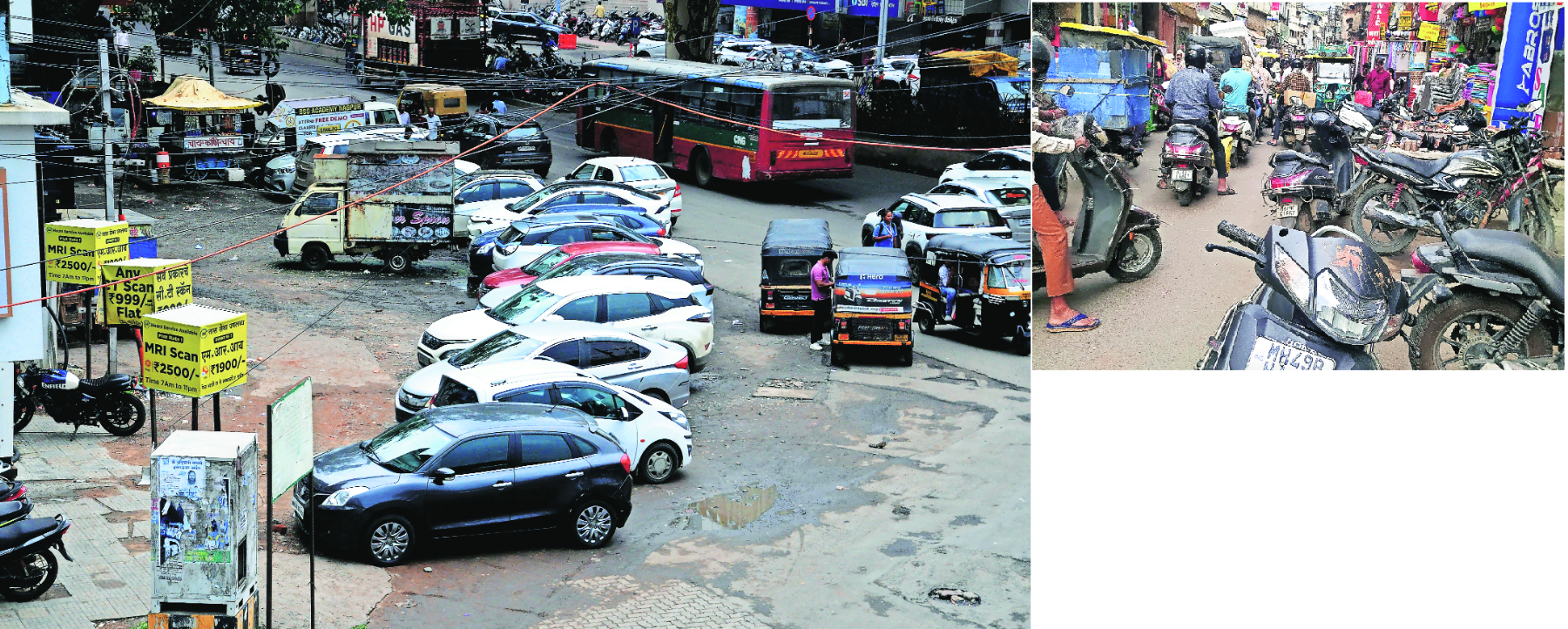
Nagpur, once known for its relatively wide roads and planned development, is now grappling with a growing parking crisis that is steadily choking traffic across the city. Rapid urban expansion, a sharp rise in vehicle ownership, commercialisation of residential areas and weak enforcement of parking rules have together pushed the city into a difficult situation. In many areas today, roads resemble parking lots more than public streets.
As congestion continues to worsen, citizens are increasingly questioning what the Nagpur Municipal Corporation (NMC) and Traffic Police have actually achieved despite repeated drives, challans, court observations and smart traffic initiatives.
Over the past five years, Nagpur has expanded rapidly with the Metro project, MIHAN development, Smart City works, and large-scale construction in areas such as Wardha Road, Hingna Road, Besa, Beltarodi, Wanadongri and Manish Nagar. But while the city kept growing outward, parking infrastructure failed to grow with it.
Vehicle ownership has increased dramatically. It is now common for middle-class families to own two or three two-wheelers along with one or two cars. In older residential colonies and even newer apartment complexes, parking spaces are nowhere close to meeting actual demand.
The result is visible everywhere - vehicles lined up on both sides of roads which leaves little room for smooth movement.
In many localities, roads originally designed as four-lane stretches now effectively function as two-lane roads because of roadside illegal parking. Areas such as Dhantoli, Ramdaspeth, Sitabuldi, Dharampeth, Congress Nagar, Besa and Manish Nagar witness daily congestion caused by indiscriminate parking and encroachments.
Residents say the city is facing a serious mismatch between the number of vehicles on the road and the space available to accommodate them.
“Every year the number of vehicles increases, but the roads remain the same. Half the road is occupied by parked vehicles,” said Chaitanya Ghate, a resident from Manish Nagar.
The issue has repeatedly come under the scanner of the Nagpur Bench of the Bombay High Court. During recent hearings, the court expressed strong displeasure over illegal parking, encroachments and unauthorised commercial activities occupying public roads. The judges questioned why authorities were failing to enforce parking rules despite clear regulations and repeated complaints from citizens.
The court also observed that weak implementation by both NMC and Traffic Police was contributing to the worsening traffic situation.
One of the major concerns highlighted by citizens and urban planners is the lack of proper parking planning in
several buildings and commercial areas across the city. In many commercial establishments, mandatory parking areas have allegedly been enchroached upon or converted into shops, offices, storage spaces or additional commercial units. As a result, residents and visitors are left with no option but to park vehicles on public roads.
Though Development Control Regulations 2000 clearly mandate parking provisions in residential and commercial buildings, enforcement on the ground appears inconsistent.
As per civic norms, residential buildings above a specified size must provide dedicated parking spaces, while commercial establishments are required to maintain parking for visitors and customers. Yet violations continue openly in several areas.
Urban planning experts believe this lack of long-term vision is one of the primary reasons behind the present crisis.
The changing size of vehicles has added another layer to the problem. A decade ago, compact hatchbacks and scooters dominated Nagpur’s roads. Today, larger SUVs and multi-vehicle households occupy far more space than earlier. Apartment complexes originally designed for one vehicle per family are now struggling to accommodate two, three, or even four vehicles per household.
The impact is now visible in everyday life.
Daily commuters face delays because of roadside parking, especially during peak office and school hours. Congestion near markets, hospitals, schools, coaching centres and commercial complexes has become routine. In several localities, ambulances and fire brigade vehicles reportedly struggle to pass through narrow lanes blocked by parked vehicles.
Residents of Mahal, Itwari, Dharampeth say even basic movement has become difficult. “Earlier, children used to play freely on these roads. Now every lane is packed with parked vehicles,” said Rahul Deshmukh, a resident of Dharampeth.
Over the years, the Traffic Police has carried out several enforcement drives through challans, CCTV surveillance, anti-encroachment operations, and digital monitoring systems. Official figures show that more than 78,000 illegal parking cases were registered in 2024 alone, with hundreds of challans issued every day.
Authorities also launched the
“Footpath Freedom Drive” and conducted anti-encroachment operations in crowded areas such as Sitabuldi, Railway Station Road, and VCA Square last year. Intelligent Traffic Management Systems (IITMS), automated traffic signals and digital challan systems were introduced under Smart City initiatives as well.
However, these drives offer only temporary relief. Hawkers, encroachments and illegally parked vehicles often return within days after enforcement action ends.
Questions are also being raised over NMC’s role in controlling unauthorised commercialisation of residential buildings and ensuring parking compliance before approving building permissions.
The city urgently needs stricter implementation of building norms, proper audits of commercial establishments, expansion of multi-level parking infrastructure and stronger enforcement of no-parking zones.
Urban planners also stress that temporary drives alone cannot solve the issue. They say Nagpur needs long-term mobility planning that takes future vehicle growth into account.
According to them, road widening by itself will not be enough if illegal parking and unauthorised constructions continue unchecked.
Citizens fear that unless city planners and authorities act decisively now, the city could soon face traffic and parking problems similar to larger metros where daily commuting has become exhausting and unpredictable.