Parking crisis in Nagpur No parking, no registration: A rule canhelp end city’s roadside parking chaos
| Date :15-Jun-2026 |
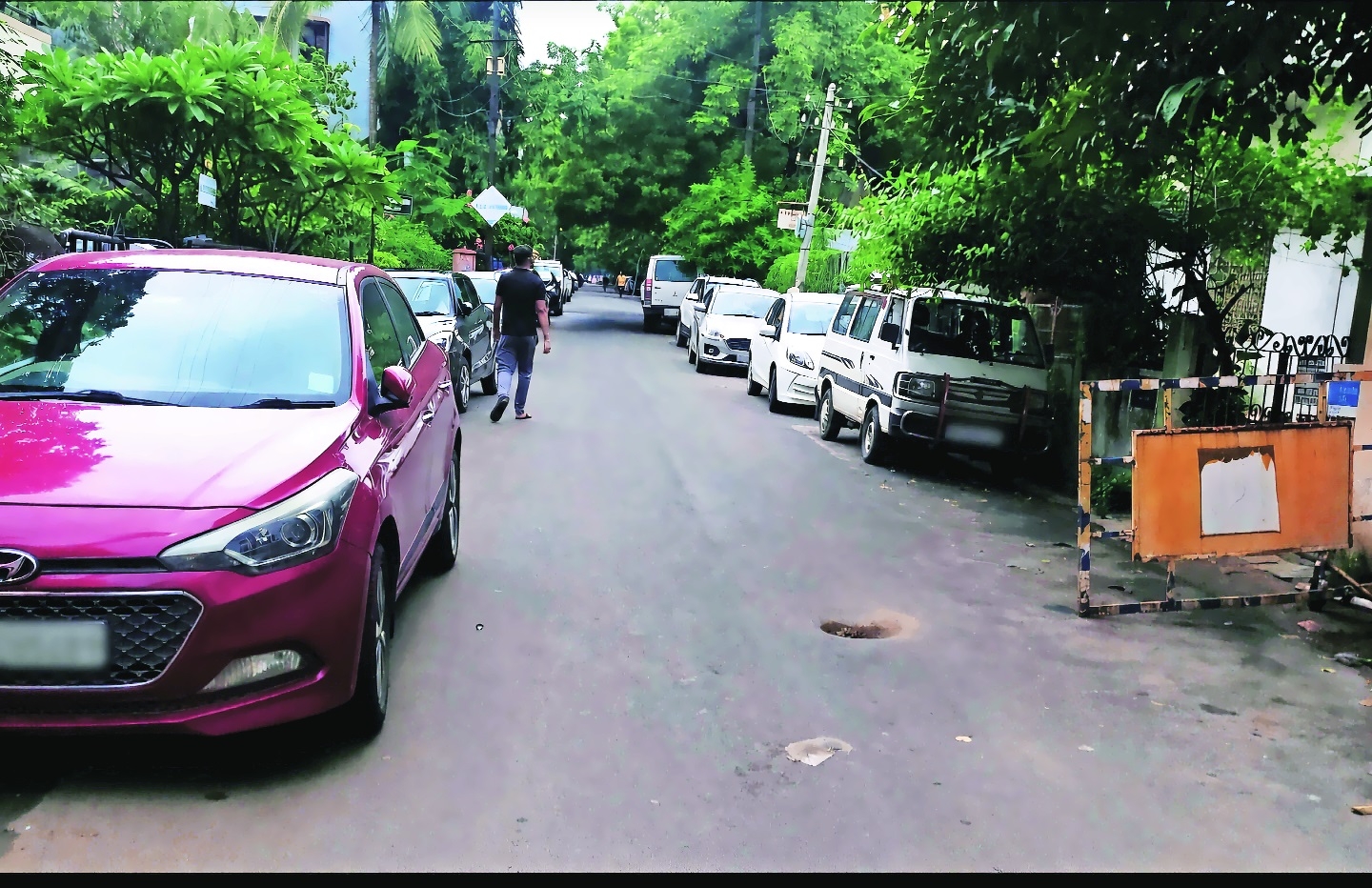
Cars spill over across the narrow lane of a residential colony,
leaving little space on the road. (Pic by Satish Raut)
By Simran Shrivastava
and Saniya Chakraborty :
According to Motor Vehicles Act, 1988, there is no requirement of furnishing proof of a parking space for pvt vehicles buyers
The Hitavada campaign - 3
Cars and two-wheelers parked along roadsides have become an everyday challenge in many parts of city which is reducing road space and adding to congestion. While commercial vehicle owners must provide proof of parking before registration, no such requirement exists for private vehicles. This has prompted a renewed debate over the need for stricter registration norms for registration of private vehicles in city.
According to experts, one of the key reasons behind the city’s growing traffic and parking problems is that people can buy vehicles without showing where they will park them. The result is visible in almost every locality. Cars and two-wheelers are routinely parked on roadsides outside apartments, housing societies, layouts and even in slum areas which leaves less space for traffic and pedestrians.
What makes the situation more striking is that such a requirement already exists for commercial vehicles. Owners of commercial vehicles must submit details of a designated parking space before registration is approved. Without it, the vehicle cannot be registered.
Experts question why the same rule does not apply
to private vehicle owners.
“If authorities insist on a parking certificate before registering a new four-wheeler, only those with proper parking facilities will be able to own one. It could go a long way in reducing roadside parking and improving traffic flow,” said a traffic safety expert.
The scale of the issue is reflected in vehicle registration figures. Yet, not a single private vehicle registration currently requires the owner to prove access to a parking space.
Kiran Bidkar, Regional Transport Officer, Nagpur City, said that existing rules require private vehicle buyers to submit only three documents at the time of registration - a sale certificate from the dealer in Form 21, the manufacturer's pollution compliance certificate in Form 22, and proof of address.
“Proof of parking space or a No-Objection Certificate from a housing society is not among the mandatory requirements,” Bidkar said. He added that neither the Motor Vehicles Act, 1988, nor the rules framed under it contain such a provision for private vehicles, even though commercial vehicle owners have long been required to show parking availability.
The consequences are visible across the city. In many areas, footpaths are already occupied by vendors, forcing pedestrians onto roads. Add vehicles parked on both sides, and many internal roads become heavily congested, especially during evening hours.
“Every evening, our lane turns into a parking lot. During emergencies, even ambulances would struggle to get through,” said Rajesh Wankhede, a resident of Manish Nagar.
Some vehicle owners say they have few alternatives.
Priyanka Deshmukh, a resident of Narendra Nagar, said renting a separate parking space is beyond the reach of many middle-class families.
“Parking rentals are expensive. Not everyone can afford an additional monthly expense,” she said.
Aditya Pande, an IT professional, said the lack of reliable public transport leaves many residents dependent on personal vehicles.
“My office timings don’t match public transport schedules, so I bought a car even though I don’t have dedicated parking,” he said.
Experts also point to broader administrative failures. Several commercial establishments are alleged to have encroached upon or misused parking spaces approved in their building plans. Questions have also been raised over enforcement by the Town Planning Department of the Nagpur Municipal Corporation (NMC).
Bidkar said RTO flying squads participate in joint anti-encroachment drives conducted by the NMC. However, most enforcement actions are currently focused on food trucks and food vans rather than illegal roadside parking by private vehicles.
Unless authorities address parking at the registration stage itself, the city’s roads could become even more congested. “Everyone can see the problem,” one expert remarked.