Nagpur grows, but Aapli Bus connectivity fails to keep up
| Date :17-Jun-2026 |
By Simran Shrivastava :
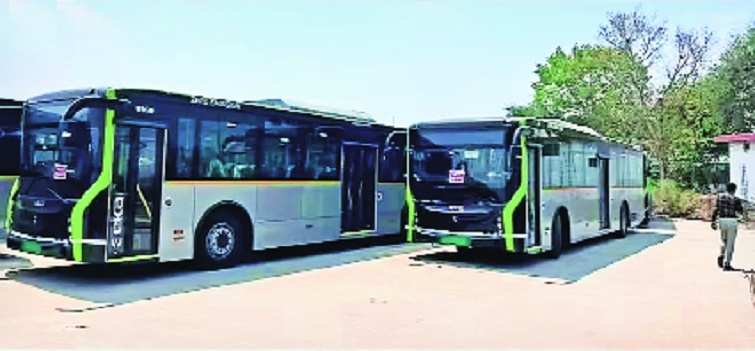
Nagpur is rapidly growing as a major industrial, educational and healthcare hub, attracting thousands of commuters every day. However, while the city continues to expand, its public transport network has not kept pace with changing travel needs. Several important destinations, including industrial areas, hospitals, transport hubs and commercial centres, still lack direct Aapli Bus connectivity. As a result, many residents are left with little choice but to depend on private vehicles, shared auto-rickshaws or multiple bus changes to reach their destinations.
Information provided by NMC’s Aapli Bus service reveals major gaps in connectivity on some of the city’s busiest and most critical commuter routes, raising questions about whether public transport is keeping up with Nagpur’s growth.
Industrial workforce
left without options
after 10 pm
The largest issue appears in Nagpur’s industrial zones. No Aapli Bus services currently operate beyond 10 pm in Wathoda, Hudkeshwar and Butibori, according to the official response. The absence is most pronounced in Butibori MIDC, Vidarbha’s largest industrial cluster, where manufacturing activity continues through the night and thousands of employees report for evening and overnight shifts.
Kalamna wakes up before the buses
While industrial workers face a
night-time transport vacuum, traders and labourers at Kalamna Market encounter the opposite problem. The city’s largest agricultural wholesale market comes alive around 4 am, when produce begins arriving and trading activity gathers momentum. Yet the first scheduled Aapli Bus reaches the market only at about 8.10 am. By then, much of the morning rush has already unfolded. Farmers, porters and commission agents are outside the reach of regular bus services during the busiest part of their workday.
Airport, Railway Station still
awaiting direct link
Passengers travelling between Dr Babasaheb Ambedkar International Airport and Railway Station must currently piece together journeys using Metro services, feeder buses or private transport.
The issue drew attention earlier this year during a disruption in app-based taxi services at the airport, when many passengers struggled to find reliable onward transport. Officials attributed the absence of this service to space constraints within the railway station premises.
Healthcare access strong in parts,
uneven elsewhere
Government Medical College and Hospital and Mayo Hospital are connected by multiple routes, including a service introduced specifically for GMCH. However, transport officials acknowledged that usage remains low because buses cannot enter the hospital campus owing to the lack of a designated stopping point. AIIMS Nagpur enjoys comparatively robust connectivity, with around 80 daily trips operating on the Sitabuldi-AIIMS and Pardi-AIIMS corridors. However, patients and attendants travelling from Kamptee have no direct bus service and must change buses during the journey. Connectivity also tapers off in the evening, with the final service from Sitabuldi departing at 8 pm.
Campuses fare better than
workplaces
Educational institutions appear to be among the strongest beneficiaries of the existing network. Rastrasant Tukadoji Maharaj Nagpur University is served by seven routes, while VNIT receives nearly 90 daily bus trips across multiple corridors. IIM Nagpur’s MIHAN campus is also accessible through services operating on the AIIMS route.
Aapli Bus officials said several routes now being sought by commuters had existed earlier but were discontinued after failing to attract adequate passenger numbers, according to Yogesh Lunge, Administrative Officer, Transport Department, Nagpur Municipal Corporation (NMC). He said route rationalisation exercises are conducted every 15 days to a month and that services may be reconsidered if demand rises.