Parking crisis in Nagpur Pvt vehicles surge, parking shrinks
| Date :17-Jun-2026 |
By Kabir Mahajan
and Reema Mewar :
- Vehicle registrations crossed 31 lakh in 2026 as commuters increasingly turned to private vehicles for convenience and time efficiency
- Citizens cite poor last-mile connectivity, irregular buses timings and impractical short-distance travel as reasons for avoiding public transport
Registered vehicles in city in 2026; up from 24.9 lakh in 2022
T
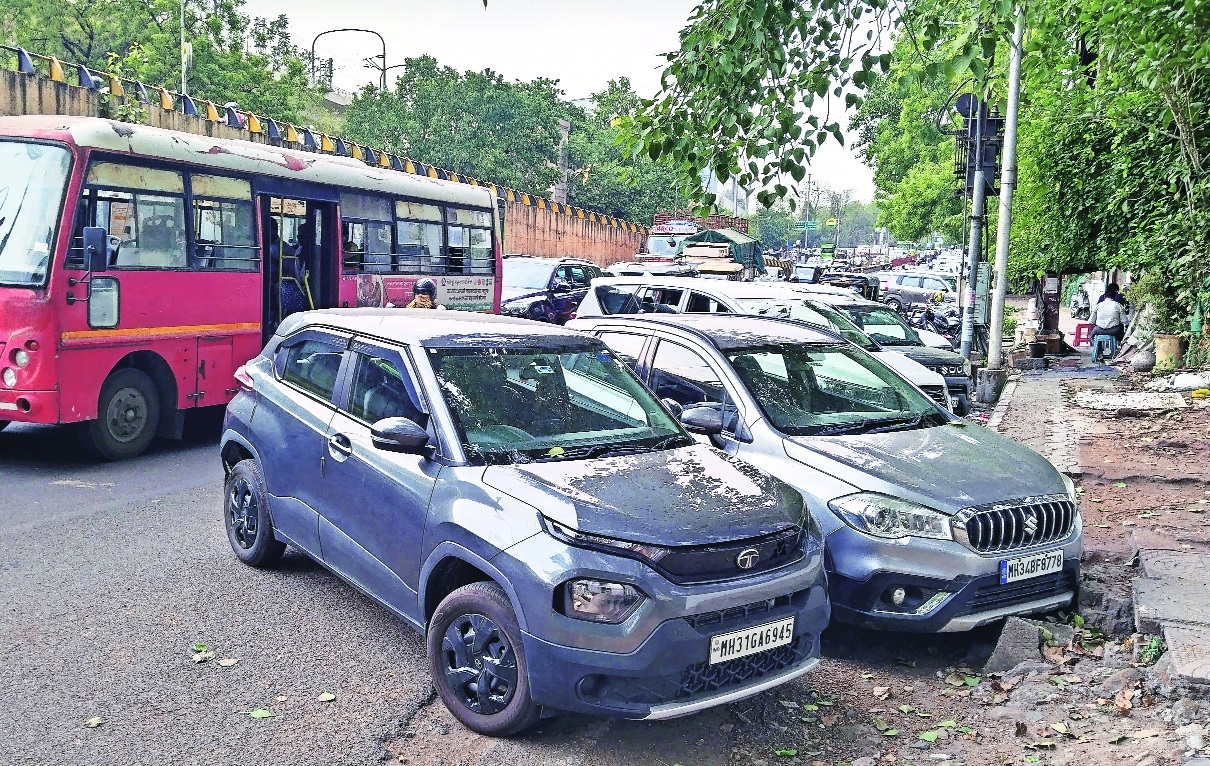
he city’s worsening parking congestion is closely tied to its growing dependence on private vehicles and the comparatively low usage of public transport. Over the past few years, the city has witnessed a sharp increase in the number of personal vehicles on roads as residents increasingly prefer private transport for convenience and time efficiency.
According to transport data, the total number of registered vehicles in the city increased from nearly 24.9 lakh in 2022 to 31.26 lakh in 2026 which marked an addition of more than 6.3 lakh vehicles within four years. Two-wheelers alone grew from around 15.6 lakh to 17.66 lakh during the same period.
The increasing number of vehicles has intensified traffic congestion while simultaneously putting immense pressure on already limited parking infrastructure in commercial areas such as Sitabuldi, Shankar Nagar Square, Medical Square, Janata Square, and Itwari, where roadside parking narrows roads and slows traffic movement.
Citizens say one of the primary reasons behind the growing preference for private vehicles is the inconvenience associated with public transport, especially for short-distance travel. Harshita Nayak, a college student, said she had once used public buses to travel to her college located around 4.5 kilometres away from her residence, but the experience proved excessively time-consuming. “I had to change two buses, and a journey that should ideally take 15 to 20 minutes would stretch to nearly 45 minutes. Public transport is convenient for long distances, but for short distances, it is not time-effective,” she said. However, she added that smaller buses that only ply on shorter routes within the city could help citizens save time.
A similar concern was raised by Prayag Manwani, a resident of Jaripatka, who pointed out the lack of last-mile connectivity in the city’s metro rail system. He said that unless both the starting point and destination are located close to metro stations, travelling through public transport becomes inconvenient and expensive. “Auto drivers standing near metro stations often charge high fares for short distances and refuse shared fares if you try to negotiate. Unless metro connectivity improves at both ends, people will continue using their own vehicles,” he said. Several metro stations lack sufficient space for commuters to park their vehicles and continue their journey through metro services, discouraging citizens from integrating public transport into their daily commute. Regulated e-rickshaws and auto-rickshaws operated by Nagpur Municipal Corporation (NMC) at bus stops and metro stations could significantly improve last-mile connectivity. Reliable services with fixed fares would encourage more passengers to depend on public transport rather than personal vehicles.
While acknowledging the issue, a senior official from the Transport Department of NMC said that currently 653 buses are operating across the city. According to the official, buses are available at intervals of 10 to 15 minutes on routes such as Pardi, Kamptee, Hingna, Kalmeshwar, Wadi and the Outer Ring Road. “The department continuously encourages citizens to use public transport as it reduces traffic congestion, pollution and chances of road mishaps,” the official said, adding that extending operational timings till 10.30 pm and increasing bus stops across routes are also under consideration to improve connectivity.
Public transport in urban cities is not a luxury but a basic necessity and a fundamental civic service for taxpaying citizens.
Yet, transport infrastructure is often approached from a profit-and-loss perspective rather than as an essential public utility meant to ensure accessibility and mobility.
Citizens already pay taxes for core services such as transport, healthcare and education, many of which continue to struggle with inadequate infrastructure and planning, even as funds are repeatedly directed toward decorative or poorly-planned projects with little long-term civic value. Sustainable solutions require proper planning, stronger bus frequency, integrated last-mile connectivity through regulated autos and e-rickshaws, and consultation with experienced urban planners rather than short-term, ad-hoc measures.