Red or Green? Nagpur’s signals will now decide on their own
Date :17-Jun-2026
By Reema Mewar :
First batch of junctions to connect to Traffic Management Centre in July; city-wide AI-based traffic management system takes shape
Waiting endlessly at a red signal even when there are hardly any vehicles may soon become a thing of the past in Nagpur. The city is set to get smart traffic signals that can automatically change from red to green or green to red based on the number of vehicles at a junction.
The technology, known as the Intelligent Integrated Traffic Management System (IITMS), will help manage traffic more efficiently and reduce unnecessary delays on busy roads. As part of the city's ambitious Rs 200 crore IITMS project, the first batch of 35 smart junctions is expected to be connected to a central command centre from July 2026.
The project is being jointly implemented by the Nagpur Municipal Corporation (NMC) and Nagpur Traffic Police to create 171 smart signals.
Rajendra Rathod, Executive Engineer (NMC) said, “Smart traffic infrastructure has already been installed and is operational at 52 junctions across the city. Many of these are currently functioning as regular traffic signals, but some have been placed on blinking yellow mode as per Traffic Police requirements. Work is also underway at another 102 junctions, and most of the remaining installation work may be completed within the next three months.”
TMC for real-time traffic updates
A Traffic Management Centre (TMC) is also being established within the Smart City Command and Control Centre. Once operational, the facility will allow authorities to monitor traffic conditions in real time, manage signal operations and initiate automated enforcement. Rathod said, around 35 junctions will initially be connected to the command centre once it becomes functional in July.
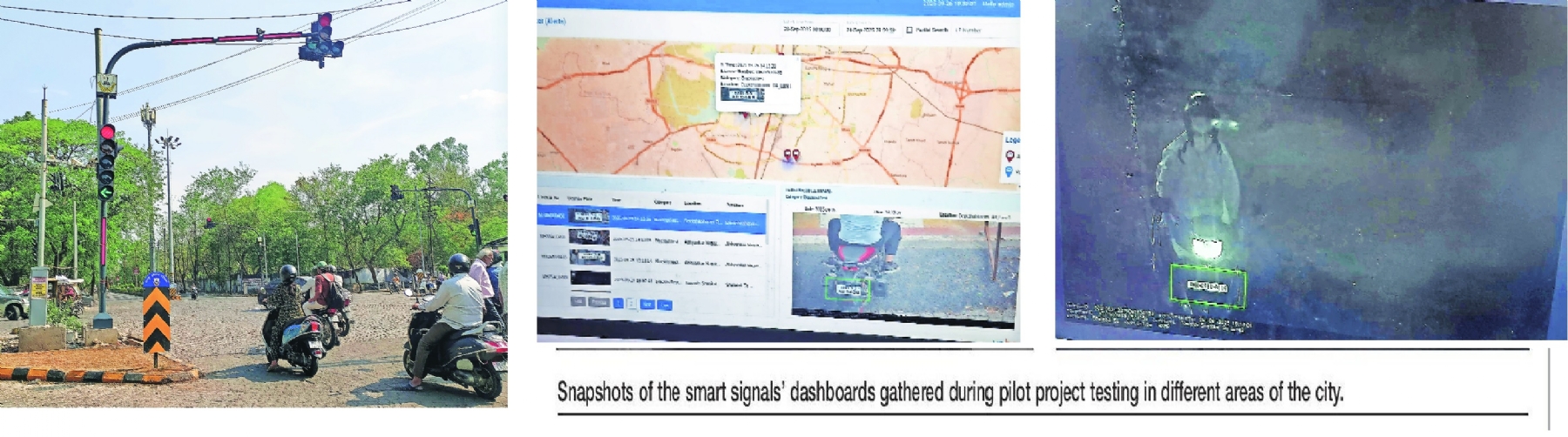
The project builds upon a pilot conducted at ten major city junctions -- LAD Square, Bajaj Nagar Square, Kachipura Square, Deekshabhoomi Square, Laxmi Nagar Square, Shraddhanandpeth Square, Alankar Talkies Square, Ajit Bakery Square, VNIT Square and Shankar Nagar Square. “The pilot project demonstrated the system’s ability to detect overspeeding vehicles, helmetless riders, triple-seat riding and registration plate violations,” a concerned official commented.
“The system also identifies standard High Security Registration Plates (HSRP) along with improperly displayed or non-compliant number plates.”
“Each square under the project is being equipped with intelligent monitoring tools, including Automatic Number Plate Recognition (ANPR) cameras and evidence cameras, capable of recording violations such as red-light jumping, wrong-way driving, seat belt violations, mobile phone usage while driving and other offences.” he explained. The project also includes the installation of large digital display boards that can be used to issue traffic advisories, safety messages and emergency alerts.
Traffic simulation software ‘PTV Vissim’ to monitor traffic flow
Perhaps, the most significant aspect of the project is its focus on data-driven traffic planning. Officials said, the city is using ‘PTV Vissim’, a microscopic traffic simulation software, to analyse traffic movement across the network.
The microscopic traffic simulation software will help authorities view stimulations on the impact of road closures, evaluate diversion plans, identify congestion hotspots and even determine flyover placements for optimal locations.