Parking crisis in Nagpur Lack of sincere effort to resolve the problem
| Date :18-Jun-2026 |
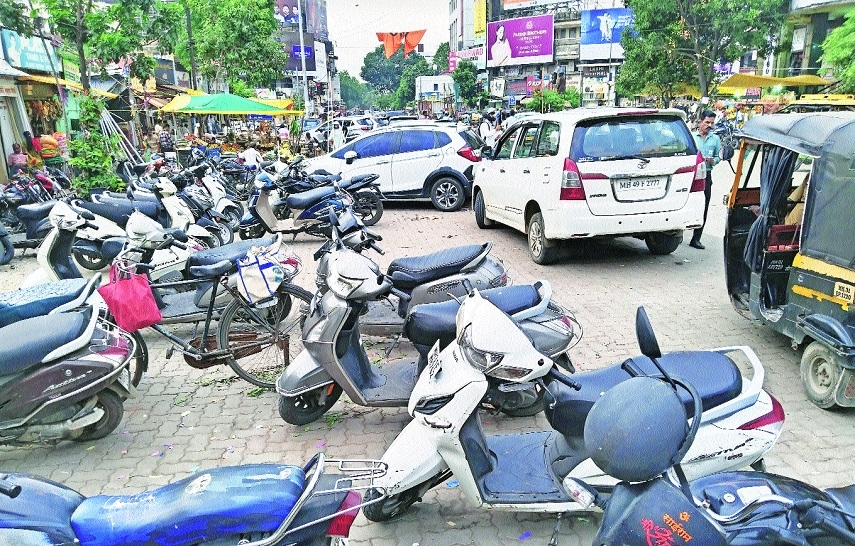
The mess on the road stretch from Laxmi Bhawan square to Ram Nagar square in Gokulpeth. (Pic by Anil Futane)
By Vijay Phanshikar :
Nagpur, city’s parking crisis is a classic reflection of what appears to be happening in most Indian cities on that front -- no sincere effort to resolve the problem at any level, at all levels. Probably, the leadership of Indian cities is yet to wake up fully to the problem that is threatening to bounce out of hands. This is the actual story of Nagpur -- just as it is the story of almost any other city of whatever size and shape in India.
‘The Hitavada’ has never flinched in raising the issue of very serious parking crisis in Nagpur. And the oft-repeated question that ‘The Hitavada’ has asked is: Where is the space?
To this question, there has never been a sincere response from the authorities (collectively). Much to the contrary, ‘The Hitavada’ has felt that various agencies in the city have kept playing ‘passing the buck’ game all along.
‘Not me -- him’ -- is how most agencies appear to say, trying to duck the responsibility.
Yes, of course, the honourable High Court at Nagpur did direct the authorities to resolve the parking woes of the city on a priority basis. Such directions, too, were given on quite a few occasions -- with no solution forthcoming.
That does not surprise anybody, though. For, when the situation is so complex, it also deserves a complex and well-meditated response. But what the agencies have done is offer only a confused response.
So, one fine morning, the Police decide to start picking up wrongly parked vehicles -- two-wheelers or four-wheelers -- from the streets. That becomes a perennial campaign -- with no solution in sight, with no correction in people’s parking habits.
The reason is obvious: Such a campaign would be useless if it is not an integral part of a bigger plan of organised
action by the authorities. And the city has seen how useless this campaign of picking up wrongly-parked two-wheelers or jamming wheels of four-wheelers is.
There is a parallel example of how badly implemented ideas backfire. It is in the form of the so-called Anti-Encroachment Drive of the Nagpur Municipal Corporation. Even a street urchin in the city knows that this campaign is a massive
flop show. For, there is not
one single spot in the city
where encroachments have
not reappeared in some time after those were demolished and removed.
This also is the story of the campaign against wrongly parked vehicles.
Unfortunately, the city’s administrators (collectively ) either do not understand why they fail, or they do not want to think about it methodically and seriously. Habitually, they approach the issue in a piece-meal manner, and end up achieving nothing:
That is the reason why the system of paid parking does not make much difference in the city;
That is also why the city’s collective leadership has not made any sincere effort to create better paid-parking facilities in enough numbers around the city;
That is why there is no effort whatsoever on the part of any agency to effect parking discipline among the people so that more vehicles could be accommodated in a methodical manner ... !
When the honourable High Court intervened for the first time many, many years ago, a hope rose from the ground that some solution would emerge.
That did not happen -- because (one is sorry to say this!) -- the different agencies did not take the High Court’s directions on the issue seriously. In fact, all the agencies should have been pulled up for the contempt of court on this count.
That, too, did not happen.
Of course, there were a few meetings, all right. But nothing came from those deliberations since the issue was never considered comprehensively. Only piece-meal solutions were offered, and those did not solve the problem. Much to the contrary, those so-called solutions increased the complications all the more.
In all these intervening years, the city’s administration never took the issue seriously. It allowed huge buildings to come up, but did not make any effort to insist upon creating multi-storied parking facilities in enough numbers in market places or crowded areas. In fact, even as every sky-scraping building comes up, parking woes in the area increase menacingly. Had the Nagpur Municipal Corporation and other agencies insisted upon the builders also to create multi-level parking facilities as part of regulation, then the problem would have been sorted out at least to some extent. That has not happened.
The reason is obvious: Nobody wants to bell the cat.
If only the city’s agencies had insisted upon creating paid parking facilities -- on the ground or in multi-level buildings -- as part of regulation, then some sensible response could have been available to us.
‘The Hitavada’ has often insisted that the parking woes of the city could be solved if a collective, no-nonsense response were given to the challenge. Now also, as it halts this current campaign temporarily, the expectation is:
1. Conscious and systematic effort is made to instill among people certain sense of discipline while parking their vehicles;
2. Paid-parking facilities are made available on a war-footing;
3. Shuttle services ferrying people from parking areas to the market etc are made available all over the city;
4. Half-baked campaigns such as picking up wrongly-parked vehicles are conducted as part of the bigger drive so as to have their full and correct effect.
5. To improve public transport on a war-footing, particularly buses, since it will have better mobility than Metro.
The idea behind ‘The Hitavada’ campaign is to insist upon seeking holistic solution. That is the simplest of expectations.