State gets 37 pc less rain in June first half
| Date :18-Jun-2026 |
Staff Reporter :
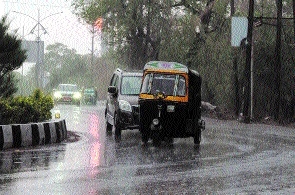
Although the State is experiencing scattered pre-monsoon showers, the southwest monsoon is yet to officially hit the region, leaving Madhya Pradesh with a substantial precipitation deficit during the first half of June. Between June 1 and 17, the State received 37 per cent less rainfall than its long-period average. This prolonged dry spell has hit eastern Madhya Pradesh the hardest, where recorded rainfall plummeted to a stark 59 per cent below normal. In comparison, western Madhya Pradesh experienced a relatively milder but still significant deficit, tracking at 20 per cent less than its regional long-period average for the same timeframe.
Isolated showers offer brief respite: According to official meteorological data, Seoni in eastern Madhya Pradesh recorded the highest cumulative rainfall in the State with 22.6 mm, followed closely by Sheopur in the west which registered 20.4 mm. Other notable areas receiving rain included Betul with 16.6 mm, Rewa with 13.0 mm, Satna with 12.0 mm, and Mandla with 11.6 mm. Meanwhile, capital city Bhopal remained dry during the early hours but registered 14.0 mm of rainfall during the daytime interval, while Rajgarh recorded a combined total of 15.5 mm across both tracking periods.
Mercury climbs ahead of anticipated temperature rise: Khajuraho emerged as the hottest location with a maximum temperature of 41.4°C, with Datia following closely at 41.2°C and Nowgong registering 41.0°C. Other major cities also continued to experience warm conditions, as Gwalior recorded a maximum of 39.8°C, Umaria reached 39.6°C, Tikamgarh hit 39.5°C, and Jabalpur touched 39.3°C. Looking ahead, the Weather Department has forecast a gradual rise in temperature by 2°C to 3°C across the region over the next two days.
A complex grid of synoptic systems govern the skies: The weather currently observed across the state is being influenced by a complex web of interacting atmospheric conditions, even as multiple synoptic weather systems align to pave the way for a stronger monsoon progression. While the Northern Limit of Monsoon (NLM) currently maintains a steady line through Harnai, Solapur, Hyderabad, Bhadrachalam, Koraput, Phulbani, Ranchi, Jamui, and Muzaffarpur, regional atmospheric dynamics are shifting. Over the next four to five days, conditions are turning highly favourable for the further advance of the southwest monsoon into more parts of Telangana, Odisha, Jharkhand, and Bihar, as well as parts of neighbouring Chhattisgarh, which is expected to gradually impact the weather patterns over Madhya Pradesh.
Troughs and cyclonic circulations battling for dominance: A primary driver behind the
localised weather and moisture distribution across the State is a persistent atmospheric trough that runs from East Uttar Pradesh to south Coastal Andhra Pradesh. This major system cuts directly across East Madhya Pradesh, East Vidarbha, and Telangana, extending up to 1.5 km above mean sea level. This structural feature acts as a conduit for moisture, explaining why eastern Madhya Pradesh has seen sporadic pre-monsoon activity despite recording a steeper overall deficit than the western half of the state.
Adding to this regional instability is an upper-air cyclonic circulation positioned over East Vidarbha and adjoining South Chhattisgarh at 5.8 km above mean sea level, which continues to churn and pump moisture into the surrounding boundaries.
Northern disturbances hold the key to the next surge: Simultaneously, the northern and western belts of the subcontinent are under the active influence of strong extratropical systems that are preventing a uniform stabilisation of summer patterns. The seasonal heat trough at mean sea level remains firmly established from Punjab to Bihar, running directly across Haryana and Uttar Pradesh. Further complicating the regional dynamics is a Western Disturbance persisting as a cyclonic circulation over north Pakistan and its neighbourhood at 3.1 km above mean sea level, coupled with a middle tropospheric trough running along Longitude 72°E to the north of Latitude 32°N.
These northern systems have triggered a chain reaction closer to the state, including an induced cyclonic circulation over south Punjab and its neighbourhood extending up to 1.5 km, alongside another cyclonic circulation lingering over Northwest Uttar Pradesh between 3.1 and 5.8 km above mean sea level. As these systems interact with the northern plains, a fresh Western Disturbance is also projected to affect Northwest India starting June 18. The convergence of these northern cyclonic flows against the persistent southern trough is expected to dictate wind patterns and trigger isolated thunderstorms across MP as the monsoon prepares for its next inland surge.