The revival of Pali and Prakrut, from Ashoka’s edicts to online classrooms
| Date :19-Jun-2026 |
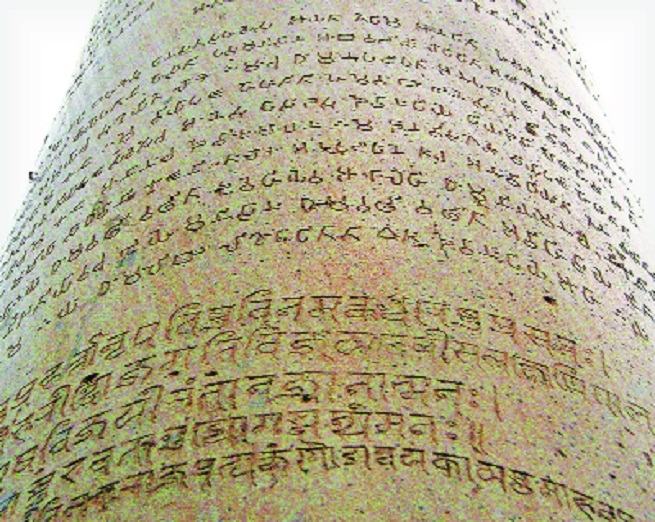
An Ashokan pillar edict written in Ashokan Prakrit language using Brahmi script.
By Kunal Badge :
On a rainy evening during Varshavas, while most students in the city are busy preparing for competitive examinations or learning new digital skills, another group is often seen gathered in community halls, Viharas and online classrooms to study languages that flourished more than two thousand years ago.
Pali and Prakrit, two of India’s oldest literary traditions and accorded Classical Language status by the Government of India, are witnessing a quiet revival in the city. Every year, special classes conducted during the four-month Varshavas period attract students, professionals, homemakers and senior citizens. Many others join free online sessions conducted by local scholars and organisations.
A city where old
languages still thrive
The growing interest reflects city’s unique place in India’s intellectual and Buddhist landscape. Yet teachers say learners are no longer approaching Pali and Prakrit solely from a religious perspective.
“Many young people come with historical curiosity,” says a Pali teacher from the city. “They want to read original texts, understand Ashoka’s inscriptions, explore ancient literature and connect with India’s knowledge traditions.”
While Pali is closely associated with Buddhism, its literary contribution extends far beyond religion. The Tripitaka, preserved in Pali, is among the world’s largest collections of ancient literature and contains discussions on ethics, governance, psychology, philosophy, education and social conduct.
The Tripitaka comprises the Vinaya Pitaka, dealing with monastic discipline; the Sutta Pitaka, containing teachings and discourses; and the Abhidhamma Pitaka, which explores philosophy and human consciousness. Many scholars see striking similarities between these ancient discussions and modern studies of ethics, mindfulness and behaviour.
The language of emperors and
ordinary people
Prakrit is equally significant. Rather than a single language, it was a family of related Indo-Aryan languages spoken by ordinary people across ancient India.
Historian A L Basham noted in ‘The Wonder That Was India’ that by the Buddha’s time, common people communicated through Prakrit languages that were far simpler than Sanskrit. This explains why Emperor Ashoka’s famous rock and pillar edicts were written largely in Prakrit, they were intended for the public, not just scholars.
“Prakrit is the voice of everyday India from more than two thousand years ago,” says another Nagpur-based instructor. “If Sanskrit helps us understand elite traditions, Prakrit helps us understand society,” he added.
Why Buddhism and Jainism embraced these languages
The accessibility of these languages made them ideal vehicles for spreading ideas. Jain scriptures were composed largely in Ardhamagadhi Prakrit, while Theravada Buddhist teachings were preserved in Pali. Even after Buddhism declined in India, Pali continued to flourish in Sri Lanka, Myanmar, Thailand, Laos and Cambodia.
Preserving a
living legacy
Students today study Pali and Prakrit for reasons ranging from history and archaeology to linguistics and philosophy. The recent Classical Language recognition has further boosted interest, while digital classes and online study groups have made learning easier than ever before.
In a city known for education, social reform and cultural movements, City’s continued enthusiasm for Pali and Prakrit demonstrates that ancient languages are not merely subjects of the past. They remain living repositories of knowledge, helping a new generation understand India’s history, literature and civilisation through the words in which they were originally expressed.