Fresh drilling uncovers larger critical minerals system in Mahasamund distt
| Date :02-Jun-2026 |
By Mukesh S Singh
RAIPUR,
DGML eyes India’s
first Nickel-Copper-
PGE mine as Quad
and India-US
partnerships
sharpen focus on
resource security
■ Mineralisation
confirmed across
430 metres and
beyond 200-metre
depth, with drilling
indicating possible
continuation across
a 1.3-km target zone
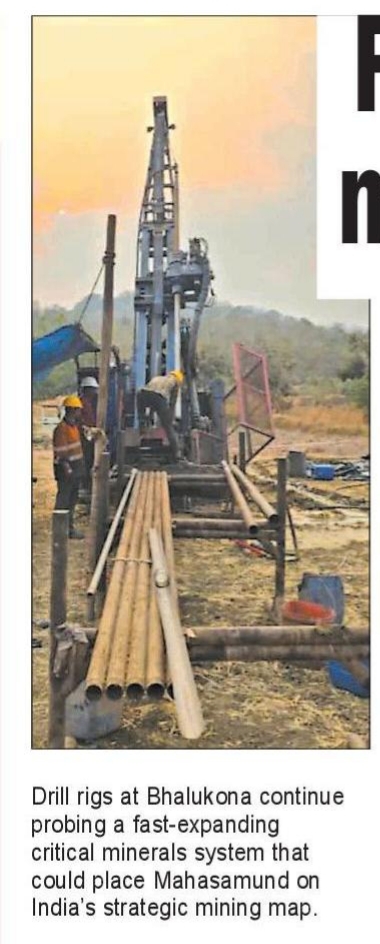
FRESH drilling at the Bhalukona
critical minerals prospect in
Mahasamund district has sig-
nificantly expanded the scale of
a nickel-copper-platinum group
elements (PGE) discovery, poten-
tially positioning Chhattisgarh
at the centre of India’s emerging
critical minerals strategy amid an
intensifying global race for
resource security.
Speaking exclusively to ‘The
Hitavada’ over telephone from
Bengaluru on Monday noon,
Deccan Gold Mines Limited
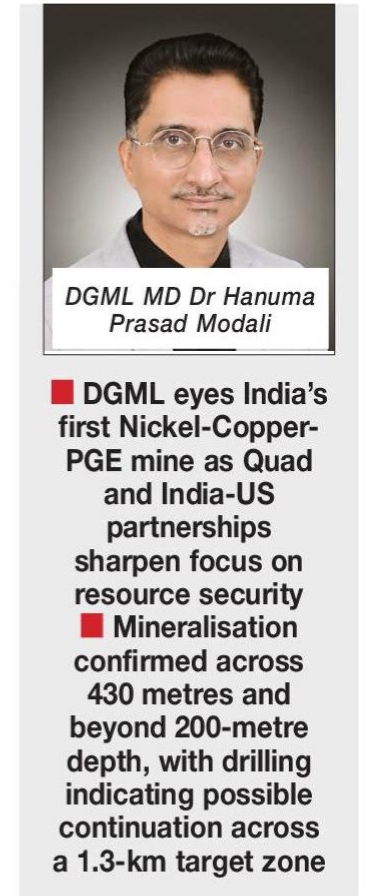
(DGML) Managing Director Dr
Hanuma Prasad Modali said the
latest results had substantially
strengthened confidence in the
scale, continuity and commer-
cial potential of the Bhalukona
mineralised system. Deccan Gold
Mines Limited (DGML) , India’s
only listed gold and critical
minerals mining company,
believes the discovery could
eventually evolve into the coun-
try’s first Nickel-Copper-PGE
mining project.
The development traces its ori-
gin to April 1, 2025, when Deccan
Gold Mines Limited (DGML)
secured a 30 sq km Composite
Licence for the Bhalukona-
Jamnidih block in Basna Tehsil
of Mahasamund district.
The
licence was among the first crit-
ical minerals licences granted in
India following the Centre’s
strategic push to accelerate
domestic exploration of miner-
als considered vital for clean-
energy technologies, electric
mobility, advanced manufac-
turing and long-term national
resource security.
The latest drilling programme
has confirmed a broad corridor
of potentially economic nickel,
copper and palladium mineral-
isation with localised platinum
occurrences extending across a
strike length of approximately
430 metres and to depths exceed-
ing 200 metres. Importantly, the
mineralised corridor remains
open, with ongoing drilling indi-
cating possible continuation
across a much larger target zone
extending up to 1.3 kilometres.
The results build upon Deccan
Gold Mines Limited’s May 18,
2026 announcement that first
confirmed significant nickel-
copper-PGE sulphide minerali-
sation at Bhalukona.
Taken
together, the drilling outcomes
are reinforcing the project’s
potential to emerge as one of
India’s most significant critical
minerals discoveries in recent
years. Deccan Gold Mines
Limited has completed approx-
imately 1,200 metres of core
drilling through nine exploration
drill holes spread across the
prospective corridor.
Assay results from additional
drill holes are still awaited. Key
intersections reported include
15 metres grading 0.31 per cent
Nickel Equivalent (NiEq) in drill
hole BJD-02, 36 metres grading
0.23 per cent NiEq in BJD-03 and
Six
metres grading 0.39 per cent NiEq in BJD-04, with high-grade
zones returning up to 1.29 per cent NiEq. Microscopic geological
studies have confirmed the presence of pentlandite, chalcopyrite
and pyrrhotite sulphides, widely regarded as important indica-
tors of potentially significant nickel-copper sulphide systems. The
drilling programme has also confirmed widespread sulphide min-
eralisation containing nickel, copper and platinum group elements,
including palladium and platinum.
Dr Modali said the discovery
had emerged at a pivotal moment when critical minerals were
becoming central to economic competitiveness, energy transi-
tion and resource security worldwide. He pointed to the growing
focus of the Quad nations and the India-US Critical Minerals
Partnership as evidence of the strategic importance of securing
reliable and diversified mineral supply chains. Appreciating the
support extended by the Central and State Governments, local
authorities and communities, Dr Modali said Deccan Gold Mines
Limited was accelerating exploration activities to define a mine-
able resource and move towards mining lease applications at the
earliest. Low-impact geophysical surveys, soil sampling and tar-
get-generation programmes will continue during the monsoon
period, while aggressive drilling is scheduled to resume after the rains.