US-Iran talks ‘called off’
| Date :20-Jun-2026 |
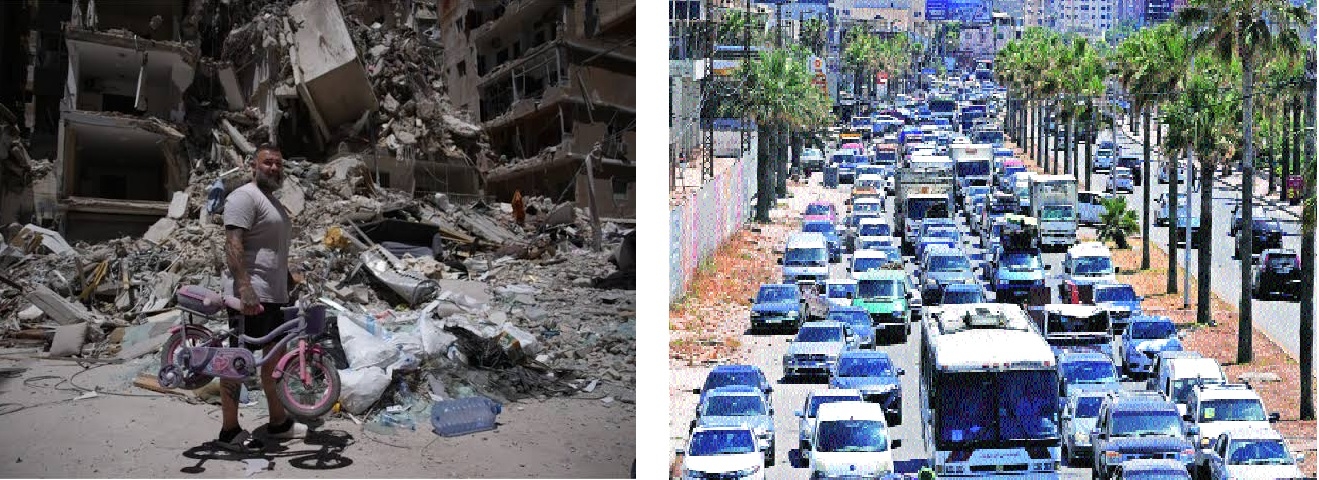
A man holds his daughter’s bicycle as he searches for his belongings in the rubble of a shop damaged in an Israeli strike in the southern port city of Tyre, Lebanon on Friday. (R) Displaced people fleeing Israeli strikes sit in traffic on a highway leading to Beirut in the southern port city of Sidon. (AP/PTI)
JERUSALEM :
- Talks called off due to intense fighting between Israel and Hezbollah in Lebanon in which 21 people and four Israel soldiers were killed
- Iranian officials didn’t travel to Switzerland, insisting that fighting in Lebanon must stop before the talks
- US Vice President Vance also cancels trip citing logistical issues
TALKS between the US and Iran were called off on Friday after intense fighting between Israel and Hezbollah in southern Lebanon, three officials said, raising questions about a nascent agreement to end the war in Iran.
Iranian officials didn’t travel as planned to Switzerland, insisting that the fighting in Lebanon must stop before the talks can take place, according to the officials, who spoke on condition of anonymity to discuss the ongoing mediation to try to get the talks rescheduled. US Vice President JD Vance also cancelled his trip.
Israel’s military struck targets in southern and eastern Lebanon overnight, and Hezbollah reported intense fighting. Lebanon’s Health Ministry said at least 21 people were killed, and Israel said four soldiers died.
The conflict between Israel and Iran-backed Hezbollah is the most precarious part of the Iran deal. Neither Israel nor the militant group signed the agreement - but it is supposed to end their fighting, and Iran has signaled its willingness to risk renewed war in the region for the sake of its interests in Lebanon and its most important regional ally.
Mediators are now scrambling to reschedule the meetings, which were supposed to begin addressing how to restrict Iran’s nuclear programme - the core issue over which Israel and the US went to war on February 28.
The US push to quickly begin high-stakes talks with Iran hit a snag just two days after the signing of an agreement that opens a 60-day window for negotiations on Iran’s nuclear programme and getting oil traffic moving through the Strait of Hormuz back to prewar levels.
Vice President JD Vance had been prepared to make an overnight flight on Friday to meet with his Iranian counterparts at a mountainside resort in the tiny Swiss village of Obburgen and begin the technical talks.
His staff and a small pack of journalists had even gathered at Joint Base Andrews outside Washington in anticipation of the trip. Meanwhile, dozens of
White House officials, advance staffers and more media gathered in Switzerland to prepare for Vance’s anticipated arrival.
But then abruptly on Thursday evening the trip was called off - at least for the time being.
The White House issued a statement explaining Vance - who has been tapped by President Donald Trump to lead the negotiations - and his delegation were prepared for talks, but they were unable to finalise plans and the Vice President would remain in Washington. “The logistics of these negotiations have never been simple or predictable,” the statement noted.
The talks are also supposed to bring about a permanent end to the conflict.
The interim deal has already reopened the Strait of Hormuz to international shipping, after Iranian attacks and threats all but stopped the flow of oil and natural gas through the waterway.
A new Iranian authority charged with overseeing the strait issued guidance Friday calling on ships to register with it even as transits are currently free - signalling Tehran’s intent to likely start charging.
The Israeli military said strikes were ongoing on Friday after four of its soldiers, including a Lieutenant Colonel, were killed in an attack on a tank in a village near the southern Lebanese city of Nabatiyeh. An explosive drone attack wounded another five, it added.
Israel then launched multiple strikes against “Hezbollah infrastructure sites” in Nabatiyeh and other areas, according to a military statement, which accused the militant group of “blatant ceasefire violations.”
Later, the military said it also struck targets in the Beqaa Valley in eastern Lebanon, with Lebanese media saying the village of Douris was hit.
“Israel will not tolerate attacks on our soldiers or on our territory, and it will exact a very heavy price from Hezbollah for these attacks,” Netanyahu said in a statement Friday.
Hezbollah acknowledged targeting Israeli tanks and said its attacks were in response to what it called Israel’s own violation of the ceasefire. It said the attacks came after Israeli forces attempted to reach the northern side of Ali al-Taher hilltop, a strategic point that overlooks Nabatiyeh and that Israeli troops have been trying to capture.
In southern Lebanon, many were forced to flee their villages due to the Israeli attacks.
“The situation is lawless, we couldn’t stay,” said Mustafa Zain, who had his six daughters in a pickup truck as he was leaving Akaar through Tyre.
The fighting threatens to unravel the newly signed deal. Beyond ending the hostilities in Lebanon, the agreement calls for ensuring Lebanon’s “territorial integrity and sovereignty.”
It does not say whether that means Israel would withdraw from the large swaths of southern Lebanon it has occupied since Hezbollah joined the war in its early days by firing rockets and drones at northern Israel.
Iran has insisted Israel pull back, while Israeli Prime Minister Benjamin Netanyahu said on Thursday that forces would remain in a “security zone” of southern Lebanon as long as “Israel’s security needs require it.”
Israel’s actions in Lebanon have created a rift between Israel and the US, with Trump becoming increasingly critical of his close ally Netanyahu. Netanyahu is also facing increasing criticism at home - and from other quarters.