Logging off, showing up: Youth find community through hobbies
| Date :21-Jun-2026 |
By Reema Mewar
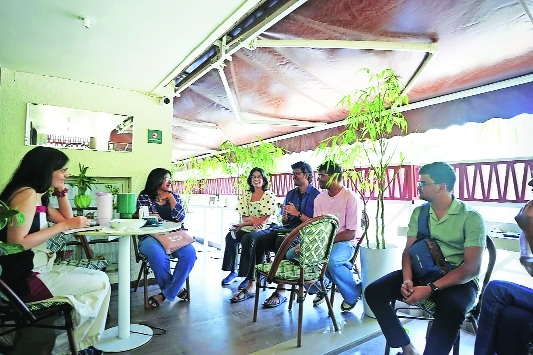
Even as technology and digital media penetrate deeper into everyday life, it would be wrong to assume that the city’s youth are entirely reliant on their devices for entertainment and social connection. Over the past few years, several offline hobby communities have emerged across Nagpur, catering to every niche imaginable -- from reading and embroidery to stand-up comedy, creative writing, improv, poetry and even cosplay. While each community revolves around a different interest, they are united by a common purpose: bringing people together in a shared physical space.
“I have seen that post COVID-19, people have started to appreciate human connection. They crave spaces where they can connect with people offline,” said Samiran Ghodmare, who facilitates Nagpur Reads. According to him, the pandemic served as a reminder of the value of face-to-face interaction. Even a year or two before COVID-19, it was becoming increasingly rare to see children playing outdoors. However, once social distancing norms were relaxed, many children began stepping out of their homes again to play and engage with others their age.
Ghodmare believes that in many ways, these modern hobby communities recreate a sense of togetherness that was once common in rural Indian communities.
“There used to be a tradition in villages where elders would gather in one spot and talk, children would play nearby, and communities would organise activities and movie screenings. We have taken the foundation of that concept and implemented it in a more modern way, and in a manner that appeals to a variety of interests,” he said.
Some of these communities are free, while others charge a nominal fee. However, participation ultimately depends on interest rather than cost. “If someone does not enjoy reading, even a free reading community will not be to their liking. Similarly, if someone enjoys embroidery, they would not mind paying a small fee as long as they are having a good experience,” said Ghodmare. Nagpur Reads, which he curates, operates free of cost and has attracted a steady following, largely due to the simplicity of its concept -- people gathering in a public space simply to read together.
Ghodmare also points to a generational shift in how friendships are experienced. Many people now in their twenties grew up without constant digital access to their peers. Interactions were limited to occasional phone calls and in-person meetings, making time spent with friends feel more valuable. Today, however, children and teenagers often have near-constant access to their social circles through personal devices.
“I know a lot of people in their twenties like these communities because they give them a chance to relive their school days -- engaging in hobbies with friends without any pressure or competition,” he said.
Building on a similar concept, Rashtrasant Tukadoji Maharaj Nagpur University (RTMNU) has extracurricular hobby clubs, technical societies, and cultural groups which are managed directly by individual affiliated colleges. These too serve a variety of interests, including dance, music, theatre, literary/debate clubs, coding, robotics, web designing, and Artificial Intelligence (AI), yog, athletics, National Service Scheme (NSS), National Cadet Corps (NCC), and Rotaract Clubs.
Beyond providing a social outlet, many communities have also become spaces where participants can nurture and improve their creative abilities. For many beginners, they offer a supportive environment in which to experiment, learn and grow without fear of judgement. Meharpreet Gandhi, who curates the creative writing community First Draft Club, said she has observed a noticeable increase in participants’ confidence over time. “After attending a few sessions, people become more confident about their writing skills and slowly start to improve.
Everyone is there to learn and enjoy, so there is no pressure to be the best. Moreover, people learn so much from each other,” she said.
In an age where AI can generate stories, poems and essays within seconds, Gandhi believes that the creative process remains deeply human. While discussions around AI and writing frequently emerge during community sessions, she feels excessive reliance on such tools can hinder originality and personal expression, both of which are essential to creative growth. “We have a strict no-AI policy in our sessions because writing is as much about the process as it is about the final piece. The struggle to find the right words, the self-reflection, the revisions and even the mistakes are all part of what makes writing meaningful. AI can generate text, but it cannot replicate a person’s experiences, emotions or unique voice. Writing is deeply personal and cathartic, but AI robs this essence.”
For others, hobby communities offer something even more personal: a place where they can openly embrace interests that may not always be understood by those around them.
Bhagyashree Ahire, member of a recently formed cosplay community in the city, said the group has given her a space where she feels comfortable expressing herself.
“There was a time when anime and K-pop were considered cringe, and people who enjoyed them were looked down upon by their peers. I was one of them, and even until recently, I was not comfortable sharing these interests with others, even though they have become much more mainstream now,” she said. “However, the cosplay community is sort of like paradise for me,” she added with a laugh. “No one judges me for having an interest in anime, and I can express my creativity through the clothes I wear, my makeup, hairstyles and character portrayals.”
As the hobby communities continue to grow, they appear to be fulfilling needs that go beyond the activities themselves. Whether through reading in a park, sharing a poem, learning a new craft or dressing up as a favourite fictional character, these spaces offer something increasingly valuable -- genuine human connection, creativity and a sense of belonging.n