Distinctive death rituals, beliefs of Bastar’s tribes
| Date :22-Jun-2026 |
By Dr Abhinav Mishra :
In Bastar’s tribal communities, death does not sever family bonds. The body perishes, but the soul is believed to return home, protect descendants or punish breaches of tribal law.
These beliefs were studied in 2018 by Vinay Kumar of the Department of Ancient Indian History, Culture and Archaeology at Banaras Hindu University, Varanasi. Verrier Elwin had earlier documented the funerary customs of Bastar’s tribes in his 1945 paper ‘Funerary Customs in Bastar State’.
Bastar’s tribes believe the soul is immortal and therefore accept death with relative equanimity. An elderly person’s death may even bring happiness, as the departed can become a deity worshipped by descendants. Such deities include Muttal Amma, Chirpi Dev, Jalani Budhi, Kesarpalin, Gangadai, Ambalin and Kodaibudi.
Among the Murias, children, smallpox victims and those
killed by a tiger or lightning are traditionally buried, while others are cremated. The body is laid east to west so the rising sun’s first rays touch the head. Unnatural deaths have separate rites, notably Mati Uthana for a tiger victim.
Death is believed to defile the house, village and ghotul, the youth dormitory, which remains closed until cremation.
During the procession, a clan woman scatters rice over the body, while family members carry the deceased’s personal belongings, including pottery, tools, weapons or a drum, to be placed alongside it.
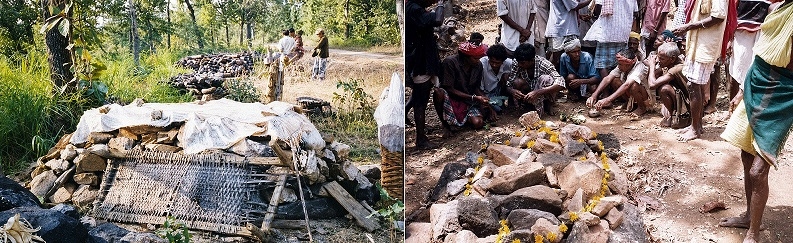
After the body is laid on the pyre, women place earth and saja leaves beside it, while the widow’s bracelet is broken with a stone. The deceased’s belongings are covered with saja leaves, and stones mark the site for a later memorial, beneath which some belongings and an iron ring believed to ritually “entrap” the soul may be buried.
Funeral songs are sung only when an elderly person dies. The ‘amur pata’ or ‘hamurpata’, meaning death song, includes the mournful ‘kilanapata’ and the joyful ‘giradapata’. Close women relatives sing the former, while the deceased’s daughter’s children sing the latter. The anal pata, the soul song, affirms immortality and accompanies the departed’s symbolic return. The most striking rite is Jiu Uthani, performed about 12 days after death, often on a weekly market day. Relatives gather as chelik (young men) and motiari (young women) dance to drums. Rice is left in a room, and marks later found on it are read as footprints of the returning soul.
In another version, relatives enter a nearby pond or river to catch a living creature. The first to succeed is considered especially loved by the deceased and receives an extra drink. A caught fish is placed in a pot, covered with a new sari, anointed with turmeric and oil, and carried by a married woman to the deceased’s ritual pot, symbolizing the soul’s return through the fish. Siraha, guniya and baiga may also conduct ritual tests or invoke the deceased to uncover hidden circumstances surrounding a death. Together, these rituals show that death marks not an end, but a continuing bond between the departed, the family and the spiritual world.