Exhibition explores mother-child motif across epochs, geographies
Date :24-Jun-2026
NEW DELHI
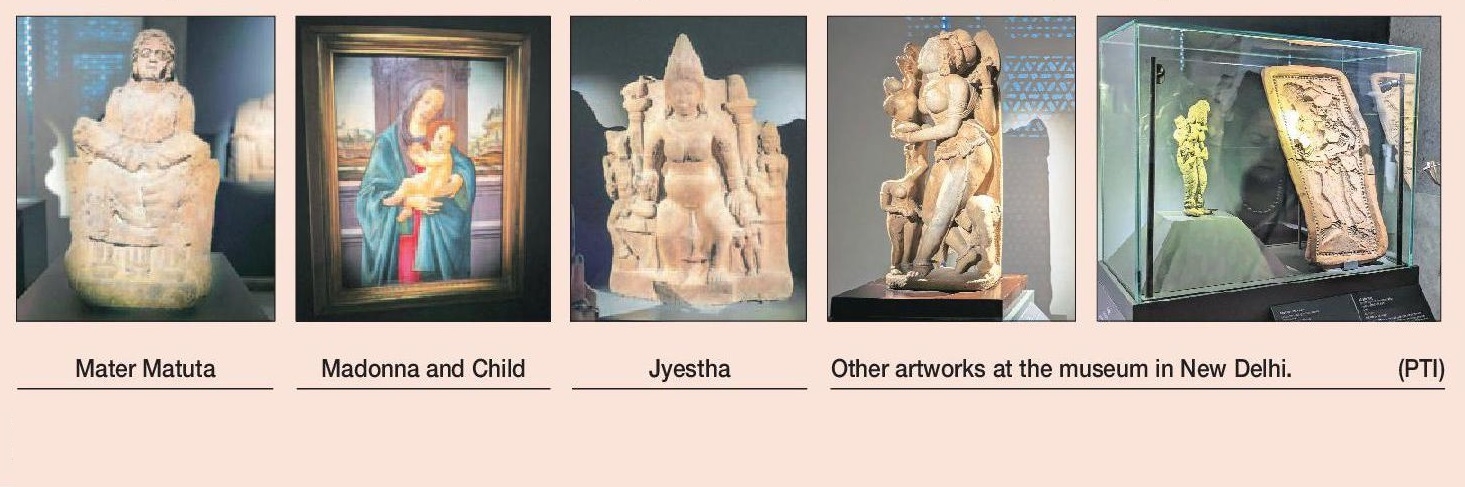
THE over-three-foot figure of Mater Matuta from Italy, made in the 4th century BC with a child in her lap, evokes a feeling similar to the tiny 7-centimetre Harappan mother-and-child figure from around 2500 BC.
Similarly, the image of Skanda Mata from 6th century AD Udaipur, carrying a child on her hip, is not markedly different from Sandro Botticelli’s evocative “Madonna and Child” from 15th-century Florence.
Separated by centuries, geography and context, a collection of 27 objects at “One Mother, Many Mother Tongues” exhibition at Humayun’s Tomb Museum here explores the enduring image of the mother and child. Organised by the Italian Embassy Cultural Centre, the exhibition brings together a range of figures and images of the mother and child. “These statues are iconic and representative of diverse traditions of motherhood.
The image can sometimes look the same, but if you think about it and you study it a little more, you’ll realise that it is actually communicating a different religion or a different sub-cult,” Naman Ahuja, art historian said. The 2 images across India and Central Asia, share a formal resonance in their “frontal stillness, the seated authority, and above all the centrality of the maternal body as a generative and symbolic locus”.
The exhibition draws from diverse Indian traditions, including yoginis, saptamatrikas, and the non-religious matrika (mother) figures from 1st century BC to 3rd century AD. “At some temples, the matrikas are developed into a fixed set of either seven (saptamatrika), eight (ashtamatrika or even up to 64 yoginis), the wall text reads.
While Botticelli in “Madonna and Child” establishes “a delicacy of gesture and restrained tenderness that intensifies the sacred dimension”, several protective matrikas like Jyeshtha from 8th century AD TN and goat-headed mother goddess from 1st century BC project a fiercely protective figure for children.
Through sculptures, paintings, and visual juxtapositions, the exhibition demonstrates how the archetype of the mother and child evolves “without ever dissolving, adapting itself to the symbolic languages of different cultures”.
While the exhibition recognises the universal narrative of “motherhood as an originating act”, it also aims to ask if “motherhood is the only rubric under which the feminine is granted agency”.
“Are all ancient images of the feminine made only because they are one or another kind of mother goddess? Do we have enough examples that celebrate the baby girl or are all those swaddled babies boys? What forces in society promoted these depictions of little boys with their mother goddesses?” asked Ahuja.
He invited the viewers to note that “not all the images subscribe to the cliche of the benign, playful or compassionate role that we give women as mothers”.
“These mothers don’t just give birth physically to babies, but they are yoginis, they are dasamahavidyas who also give birth to ideas, they give birth to speech, they give birth to cognition,” he said.
The exhibition will come to an end on August 16.