Silent exodus of native bees, but Tiny Stingless bees hold on
| Date :25-Jun-2026 |
By Simran Shrivastava :
Tiny stingless bees find shelter in city’s ageing buildings
As Nagpur expands and green spaces steadily give way to concrete, many of the city’s native bees are quietly losing their homes. Yet, in a remarkable example of adaptation, one tiny pollinator has managed to survive by taking refuge in an unlikely place - the cracks and cavities of old buildings.
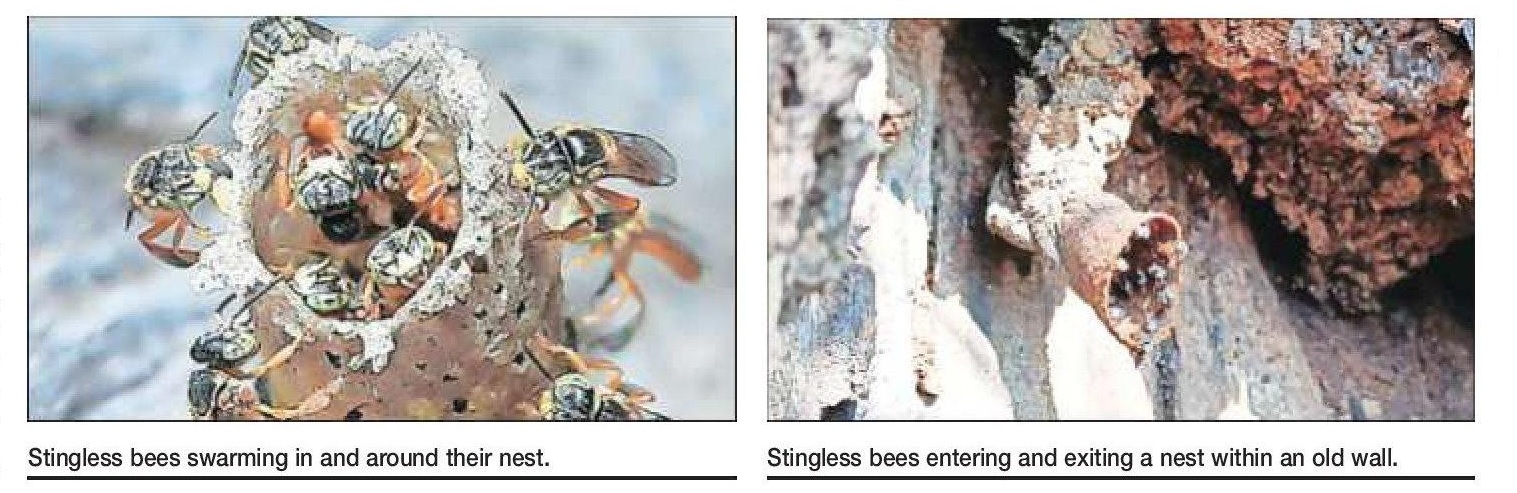
The General Post Office, the Old Government Building, temple walls and ageing compound walls scattered across the city have something in common. Tucked away inside their crevices are colonies of stingless bees, almost invisible to the human eye but vital to the ecosystem.
An ongoing doctoral study has found that these bees are among the few native pollinators successfully coping with rapid urbanisation. The picture is not as encouraging for several other species.
Ground-nesting bees such as digger bees and many sweat bees depend on exposed soil, which is becoming increasingly scarce in built-up areas. Carpenter bees, mason bees and leafcutter bees, meanwhile, rely on mature trees, dead wood and natural cavities for nesting. With older trees disappearing and greenery shrinking, their numbers have been declining across the urban core.
As the city continues to spread, suitable habitats for these species are becoming harder to find. Stingless bees, however, appear to have adopted a different strategy. Rather than depending entirely on forests and green patches, they have learned to use cracks in old walls, wooden cavities and ageing structures as nesting sites, allowing them to persist even in densely populated areas.
The research is being carried out by Devyani S Wardhe, a research scholar at the Post Graduate Teaching Department of Rashtrasant Tukadoji Maharaj Nagpur University, under the guidance of Dr Sharyu V Ghonmode, Professor and Entomologist at Science College, Congress Nagar.
Belonging to the genus Tetragonula of the Meliponini tribe, stingless bees are smaller than a grain of rice and, as their name suggests, do not possess a functional sting. Despite their size, they play a vital role in pollination and biodiversity conservation.
Unlike honey bees that build exposed combs, stingless bees prefer dark, enclosed spaces.
Researchers observed colonies nesting inside tree hollows, wooden cavities and cracks in old walls.
The study also highlights how pollinators respond differently to urbanisation. While giant honeybees (Apis dorsata) have adapted by building open nests on tall structures and buildings, stingless bees have survived by staying hidden within cavities in trees and ageing structures.
Researchers believe the findings could help shape conservation strategies and encourage meliponiculture — the rearing of stingless bees for honey production and pollination services - as a sustainable livelihood option for communities in and around Nagpur.