Wait for monsoon over but Ranjhi residents grappling with water woes
| Date :26-Jun-2026 |
Staff Reporter :
JABALPUR’S Ranjhi area is facing one of its worst water crises
in recent years as the water level in Pariyat Reservoir continues
to fall sharply, disrupting regular supply to thousands of households. The situation has become
so severe that residents in several localities are spending hours
waiting for water tankers, while
many families are unable to
secure enough water even for
daily needs.
Pariyat Reservoir, which supplies water to more than a dozen
overhead tanks catering to Ranjhi
and adjoining areas has witnessed a significant decline in
water storage. The shortage has
directly affected localities such
as Ranjhi, Gokulpur, Bilpura,
Maanegaon and Madai, where
residents alleged irregular or negligible water supply.
The Jabalpur Municipal
Corporation administration
claims that around 50 tankers
are being deployed and nearly
200 trips are being made daily to
supply drinking water in affected areas. However, residents
alleged that tanker supply
remains inadequate and many
localities are either receiving
insufficient water or no tanker
service at all.
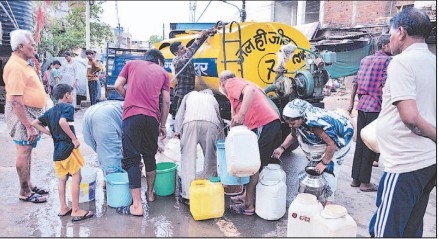
Long queues of
women, children and elderly residents carrying buckets and containers have become a common
sight across the area.
In several localities, people
said water pressure has dropped
drastically due to excessive
extraction through pumps, leaving many households without
supply. Residents complain that
even after waiting from morning till evening, they often manage to collect only one or two
buckets of water. The shortage
has also triggered disputes at
tanker distribution points as desperate families compete for limited supplies.
The crisis has sparked protests
by local residents and politicalleaders, who have demanded
immediate measures to ensure
equitable water distribution.
With monsoon rains yet to provide substantial relief, concern
is growing that the situation
could worsen in the coming
weeks. For thousands of residents in Ranjhi, the drying up
of Pariyat Reservoir is no longer
just a civic issue. It has become
a daily struggle for survival,
underlining the urgent need
for sustainable water management and contingency
planning.