Clean, safe, divine Simhastha is our top priority: CM Yadav
| Date :28-Jun-2026 |
Staff Reporter :
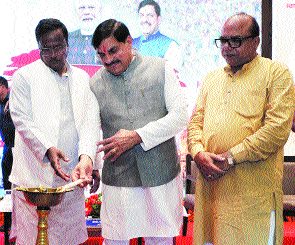
Chief Minister Dr Mohan Yadav declared that the Simhastha, held every twelve years, stands as the largest religious gathering globally, serving as a historic confluence of rich Indian culture, ancestral heritage, deep faith, and ancient spiritual traditions. Yadav emphasised that bathing in the holy waters of the Kshipra River during this sacred festival cleanses past sins, noting that the state administration is moving rapidly to ensure the 2028 edition is grand, divine, and spiritually elevating. He called for absolute dedication and teamwork from all administrative wings, declaring that collective efforts would set a monumental benchmark for public management in 2028.
Addressing a major administrative training workshop in Ujjain titled “Experiences of Simhastha-2016, Resolve of 2028,” the Chief Minister formally inaugurated the event and reminded officials that this event is a sacred anchor for millions of devotees rather than a mere administrative task. Yadav instructed administrative, police, healthcare, municipal, and technical agencies to work in perfect synchronisation, asserting that teamwork remains the fundamental key to executing such a massive endeavour safely and seamlessly.
He defined the primary baseline of the event as a clean and healthy Simhastha, urging planners to prioritise robust crowd monitoring, emergency healthcare response, and rapid relief structures.
To accommodate the historic inflow of international and national pilgrims, the state government has mobilised developmental works exceeding twenty-five thousand crore rupees across Ujjain and neighbouring districts. Yadav noted that once these ongoing multi-sector works reach completion, the ancient city of Ujjain will reclaim the historic grandeur reminiscent of the era of Emperor Vikramaditya, creating a new epoch of religious and economic growth. Planners project that over forty crore devotees will visit Ujjain during the month-long carnival, requiring arrangements for nearly four crore pilgrims to participate in the sacred bath every single day.
Drawing from his personal experience as a scout and guide volunteer in the 1980 Simhastha and his participation in the 1992 organising committee, Yadav stated that the state will soon constitute specialised local and state-level planning committees. These bodies will include experienced citizens, religious leaders, and experts from diverse walks of life to gather grassroots feedback and implement pragmatic suggestions.
He stressed that previous editions have shown that addressing past challenges collectively is key to future success, prompting the current round of intensive workshops with retired and active public officials who managed the 2016 event.
Ensuring safety and convenience at the bathing sites remains a critical engineering focus, with the state spending seven hundred and seventy-eight crore rupees to build twenty-nine kilometres of new concrete ghats along both banks of the Kshipra River. Additionally, one hundred and twenty crore rupees are being spent to upgrade seven point eight kilometres of existing permanent ghats, a measure designed to prevent soil erosion
and keep the river’s water level uniformly distributed. The execution of the Severkhedi-Silarkhedi water project will ensure a constant, clean, and uninterrupted flow of water in the Kshipra River during the entire duration of the religious fair. High-speed road networks are being developed to connect Ujjain with neighbouring towns and borders to facilitate smooth transit for vehicles coming from other states.
The nearly finished six-lane highway connecting Indore and Ujjain has been built at an estimated cost of one thousand six hundred and ninety-two crore rupees, forming the backbone of the transit network. Other major road corridors include the five thousand and seventeen crore rupee Ujjain-Jaora highway, the two thousand nine hundred and thirty-five crore rupee Indore-Ujjain greenfield highway, and multi-crore expansions connecting Maksi, Jhalawar, and Garoth. To prevent municipal gridlocks and preserve traffic flow along the inner city corridors during the peak pilgrim influx, the state has allocated eight hundred and fifty-three point four six crore rupees for bridge building. This infrastructural layout includes twenty-two new bridges, consisting of seventeen bridges stretching across the river channels and five major railway over-bridges designed to eliminate conventional bottlenecks.
These structures are accompanied by the construction of a dedicated Simhastha bypass road costing over seven crore rupees to divert interstate commercial traffic away from central religious sites. To ensure foolproof security, real-time crisis response, and automated crowd control, a centralised digital command centre is being built at a cost of one hundred and thirty-nine crore rupees. This security facility will run on artificial intelligence platforms, integrated CCTV feeds across the municipal boundaries, and predictive crowd-mapping software to prevent stampedes. Security personnel, fire safety units, and medical first responders will receive integrated disaster management training to co-ordinate rescues through this central operations room.
The Central Government and railway ministry have approved major modernisations for seven regional stations, including Ujjain, Nayi Kheri, Chintaman, Pawasa, Mohanpura, Pingleshwar, and Vikram Nagar, to accommodate incoming train travellers. Furthermore, a total of two hundred and thirty-six special trains will run exclusively during the festival to provide uninterrupted rail connectivity.
The operationalisation of the Fatehabad rail track and Nagda bypass tracks will further ease railway congestion, allowing direct trains to navigate the Ujjain junction without causing regional delays. Recognising the transit needs of international delegates and high-profile visitors, the administration has commenced construction of a new airport over four hundred and fifty-seven acres of land along the Ujjain-Dewas highway. To supplement this aviation infrastructure, four modern helipads are being constructed in the Sadawal locality at a cost of Rs 13.45 crore. The workshop concluded with presentations from administrative figures, including Ujjain Division Commissioner Ashish Singh, District Collector Roshan Kumar Singh, and Additional Director General of Police Rakesh Gupta.