Baiga Ethnobotany, A generations-old tradition of healing
| Date :29-Jun-2026 |
Dr Abhinav Mishra :
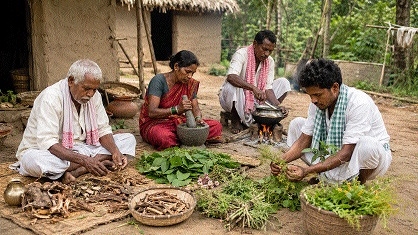
For the Baigas, a Particularly Vulnerable Tribal Group (PVTG) of Chhattisgarh, the forest is both a source of livelihood and a repository of ethnobotanical knowledge, preserving generations-old healing traditions based on plant remedies.
This rich medicinal tradition has been documented by Dr Ramesh Kumar Ahirwar and Diptesh Kumar Bhoi of the Department of Botany, Guru Ghasidas University, Bilaspur. Far more than a list of useful plants, it is a detailed body of knowledge governing which plant part to use, how to prepare and administer it, and what precautions to observe.
The Baigas draw remedies from every plant form, from herbs and woody shrubs to climbers and large trees. Their pharmacopoeia includes neem, sal, motha, gudhal, ashwagandha, tendu, mohua, bel, bhelwa, palash, amla, harra, bahera, bakain, dahiman, ashoka, nirgundi, giloy, tulsi, satavar, chirchita, aankphuti, kaner, chhota gokhru, ghamra, talmakhana, tikhur, amba haldi, adrak, ratanjot, arbi, ber and several other medicinal plants.
Bark is the most commonly used plant part, though roots, leaves, fruits, flowers, seeds, whole plants, rhizomes, tubers, stems and latex also feature in Baiga remedies. Most are prepared as pastes, decoctions or infusions and either consumed or applied externally.
Baiga remedies are highly specific, with particular plant parts matched to particular ailments. Chirchita root is applied as a chest paste and also boiled into a decoction for pneumonia, bronchitis and asthma.
Neeli Neeli root paste is used for cancer and diabetes, talmakhana whole-plant paste for kidney stones, and mango bark paste for inflammation of the eardrum, liver trouble, heatstroke and bladder complaints.
Bhelwa root decoction and satavar tuber decoction are used for cancer, with satavar also linked to tuberculosis and women’s ailments. Aankphuti latex is applied to swelling, ghamra whole-plant paste to diarrhoea and liver complaints, and chhota gokhru root paste to epilepsy, leucoderma and gastric ulcers. Bakain bark is boiled for asthma and its raw fruit used for urinary infection, while dahiman bark paste is used for jaundice, tikhur rhizome decoction for bronchitis, and ginger paste with honey or lukewarm water for nausea and headache. The use of single plants for several unrelated conditions reflects the broad medicinal value attributed to them in Baiga healing traditions. Timing and caution are integral to Baiga remedies. Some are taken on an empty stomach, after meals or at bedtime, often with dietary restrictions. Plants such as kaner, bhelwa and aankphuti are used under experienced supervision, while certain remedies are avoided for children, pregnant women and people with chronic ailments. Strong agreement among Baiga community members on remedies for ailments ranging from fractures and arthritis to tuberculosis, diabetes and neurological conditions shows that this medicinal knowledge is widely shared, not confined to a few traditional healers. While tendu, mohua, bel and neem remain widely available, medicinally important trees such as dahiman, ashoka and bakain are scarcer. Their decline could threaten both access to traditional remedies and the generations-old knowledge associated with their use. Preserving these plants is therefore not only an ecological necessity, but also essential to safeguarding the Baigas’ living heritage of healing.