A significant attempt to clarify debates about Mardhekar’s aesthetics
| Date :03-Jun-2026 |
By Dr Surendra Darekar :
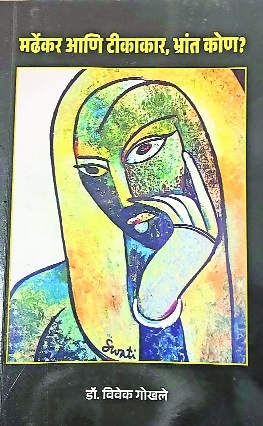
DR. VIVEK Gokhale’s book on the aesthetic and philosophical debates surrounding B S Mardhekar and his critics places me, as a reviewer, in a somewhat uncomfortable and confused position. I find myself in a state similar to that of the eleven critics discussed in the book, such as M P Rege, R B Patankar, D B Kulkarni, Madhav Achwal, and others. Despite reading the book repeatedly and marking it heavily with underlinings and marginal notes, I am still unable to arrive at a firm or final conclusion about it. This uncertainty itself reflects the complex nature of aesthetic debate in Marathi literary criticism.
I recall a story by G A Kulkarni about a traveller and a merchant in a desert. The merchant offers a precious jewel in exchange for water but the traveller questions its value, arguing that in such an isolated place there is no authority to confirm whether it is truly a gem or just coal. This story reminds me that in aesthetics there is often no absolute standard of judgment.
In a similar way, Gokhale’s discussion of Mardhekar and his critics appears to exist in a space where interpretations compete, and certainty is difficult to establish.
Gokhale’s main argument is that Mardhekar made a significant and original contribution to Marathi aesthetics by expanding its scope beyond literature to include all fine arts such as music, painting, and sculpture. He attempted to construct a unified theory of aesthetics applicable across artistic disciplines. However, many earlier critics failed to fully recognise this broader vision, largely because they did not engage with Mardhekar’s complete works. Instead, they often relied on partial readings or selective interpretations, which led to misunderstandings.
As I observe the situation described in the book, I also notice a deeper issue in Marathi criticism: the problem of authority and bias.
Critics often seem more interested in strengthening their own positions than in genuinely understanding the thinker they critique. This tendency has led to a culture of criticism where personal stance sometimes dominates objective analysis. Even Mardhekar himself, as Gokhale points out, became a victim of such authority-driven interpretations. I also recall Dr Sudhir Rasal’s observation in Literary Culture that Marathi criticism has at times neglected its own theoretical tradition, resulting in a large number of unsupported and flattering reviews.
In this context, I feel that the second revised edition of Gokhale’s book is an important intervention. It encourages readers to re-examine Mardhekar’s aesthetic thought seriously and systematically.
Gokhale’s approach appears logical and structured, influenced by his background in mathematics and economics. He tries to reconstruct Mardhekar’s aesthetic philosophy by organising scattered questions and arguments from his writings into a coherent framework.
When I consider the critical responses discussed in the book, I find differing strengths and limitations. M P Rege’s analysis appears logically sharp and capable of exposing contradictions, but at times I feel it lacks empathetic engagement with Mardhekar’s ideas. R B Patankar sometimes appears to force philosophical contradictions by applying Western concepts which leads to interpretive fallacies. Other critics like Prabhakar Padhye also participate in this debate, often reinforcing either supportive or opposing positions, which turns the discussion into polarised camps.
From my perspective, one of the most important insights in Gokhale’s work is the shift in Marathi criticism from descriptive appreciation to theoretical analysis.
This transformation began with Mardhekar’s Soundarya and Sahitya and was further developed by critics like Rege, Patankar, Kelkar, Rasal, Patil, Malshe, and Nemade. Gokhale’s contribution lies in re-examining this tradition with greater logical clarity and methodological rigour.
Gokhale’s book is a significant intellectual effort that attempts to clarify long-standing debates about Mardhekar’s aesthetics and his critics. At the same time, the subject is highly complex and does not allow for easy conclusions. My overall impression is therefore one of cautious appreciation combined with continued uncertainty, which is itself an honest response to a deeply layered and unresolved aesthetic debate.
02kjun6.wri Kaushik
Dr Vivek Gokhale’s book release on June 3
Staff Reporter
Veteran litterateur, critic and researcher Dr Vivek Gokhale penned three books will be released on June 3 at Shrimant Baburao Dhanwate Sabhagruha, Rashtrabhasha Sankul, Shankar Nagar.
Three books -- ‘Sangitachaya Sangati’, ‘Saudaryavedh - Vaad, Vivad Va Vivek’ and ‘Mardhekar Aani Tikakar - Bhrant Kaun?’ will be released during the event.
Chandrakant Channe, veteran painter will preside over the event. Dr Vujaya Dabir, renowned speaker from Amravati; Suresh Deshpande, veteran poet; Prakash Edalabadkar; Anil Shende and Vishakha Mangade will deliver speeches during the event.
The books are published by Sunidhi Publishers, Pune, which highlights Dr Gokhale’s diverse writings on many aspects of literature, music and criticism.
The event will be moderated by Vrushali Deshpande. Prof Dr Sadhana Shiledar and Avinash Kale of Sunidhi Publishers have appealed to literature lovers, scholars, students, and enthusiasts to attend the programme.
---------