Sensitive spiders leaving Nagpur due to stressful environment
| Date :03-Jun-2026 |
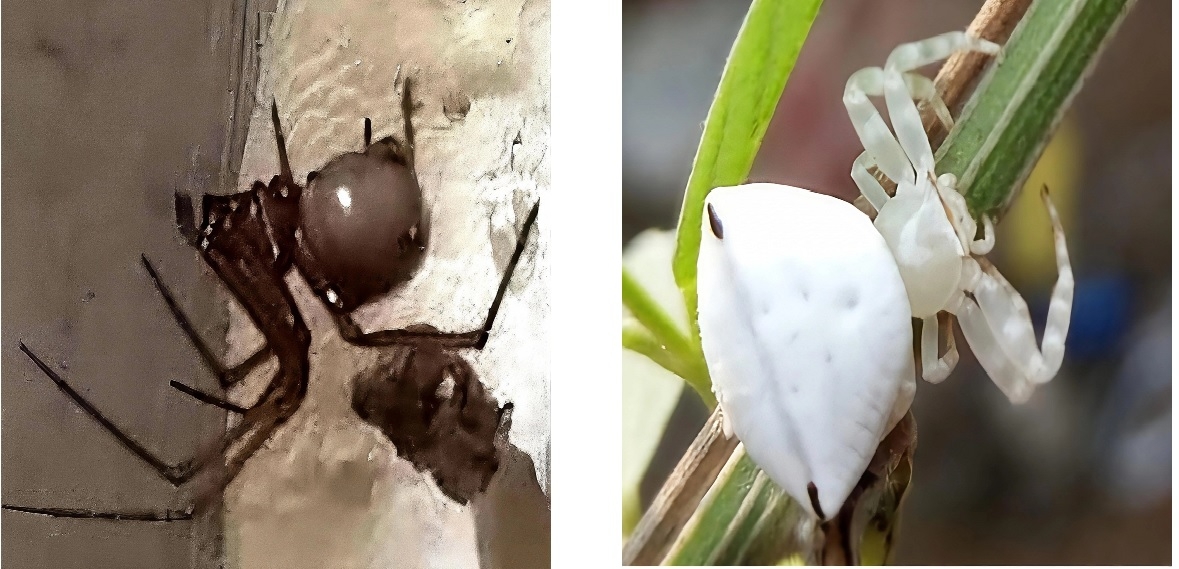
Achaearanea riparia (Family- Theridiidae) Misumenoides formosipes (Family- Thomisidae)
By Simran Shrivastava :
Urban areas had fewer species, and the ones that remained were almost entirely the tough, adaptable kind that can live inside buildings and tolerate pollution. The more sensitive species had retreated, or vanished
With Nagpur turning into an urbanised metro city, the sensitive spider species are vanishing from the city limits and moving towards rural areas. This phenomenon is an indicator of the stressful environment of Nagpur which is harmful not only for sensitive spider species but also for the human beings.
The finding came to fore in the study conducted by the researchers. “As the city gets more and more urbanised, spider species which were earlier common have now gotten limited to rural areas such as Mouda, Kamptee, and Ramtek tehsils while other spiders which are more common in urban areas can be found in city limits,” stated the study. Overall, the number of spider species has reduced starkly across the city.
Researchers who surveyed four locations across the district say the findings raise an important question: what kind of an environment are we building?
The study was conducted by Sonu Gopichand Thawkar,
Research Scholar, Post Graduate Teaching Department Rashtrasant Tukadoji Maharaj Nagpur University, working under the supervision of Dr Sharyu Vasant Ghonmode, Professor, Shivaji Science College, Congress Nagar. They surveyed spiders across Nagpur city, Kamptee, Mouda, and Ramtek. Mouda and Ramtek, with their farmland, forest patches, and open grasslands, supported a far richer variety of spider species than the city and Kamptee. Urban areas had fewer species, and the ones that remained were almost entirely the tough, adaptable kind that can live inside buildings and tolerate pollution. The more sensitive species had retreated, or vanished.
Two spiders dominated the urban areas: Pholcus phalangioides, the long-legged cellar spider that hangs in the corners of most Indian homes, and Plexippus paykulli, a small jumping spider with sharp eyesight and quick reflexes. “Both thrive wherever humans live. Their dominance in the city is less a sign of abundance and more a sign of how much has been lost around them,” Thawkar lamented.
In the forests of Ramtek, researchers found Cyrtophora citricola, a spider that weaves an elaborate tent-shaped web between branches and leaves. In the fields of Mouda, Scotophaeus blackwalli, nocturnal ground hunter was recorded often. Neither species belongs in a city, and neither was found in one.
Species from genera including Neoscona, Oxyopes, and Thomisus, all of which need open fields, shrubs, and undisturbed earth, were also confined to rural sites. “Sensitive species have declined, while adaptable species appear to be more common in disturbed habitats,” Ghonmode remarked.
The study also recorded a range of other species across the district. Among them was Scytodes thoracica, the spitting spider, which immobilises its prey by firing a venomous, glue-like thread before it can escape. There was Leucauge decorata, a small green orb-weaver that strings its web near water. There was Arctosa cinerea, a wolf spider that hunts along riverbanks, and Misumenoides formosipes, a crab spider that sits motionless inside flowers and waits for visiting insects, building no web at all. Gnaphosa lucifuga and Achaearanea riparia were also documented.
This is a district that still holds remarkable diversity, but only where the land has been left alone.
Population of Spiders indicates environmental changes. Scientists treat them as a reliable measure of ecosystem health because they respond quickly to environmental disturbance. A location with rich spider diversity is, almost without exception, a location with a functioning, balanced habitat. A location where only a few adaptable species remain is one under stress.