NHRC holds meeting on heat wave and its mitigation in urban areas
Date :05-Jun-2026
NEW DELHI :
DEVELOPING ward-level heat vulnerability and resilience maps using remote sensing, AI and other technology, institutionalisation of dedicated action plans and officers, and expansion of urban green cover are among a slew of recommendations made by a core group of the NHRC on heat wave and its mitigation in urban areas.
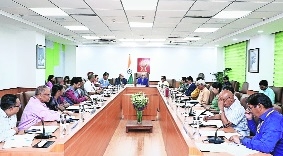
National Human Rights Commission (NHRC) Chairperson Justice V Ramasubramanian (retd), chairing a meeting of its Environment and Climate Core Group on ‘Heat Wave and its Mitigation in Urban Areas’ on Wednesday, flagged that unliveable rural conditions and growth of ‘concrete jungles’ in cities have further contributed to rising temperatures and heat wave-related challenges.
The damage caused to the environment over the decades “cannot be reversed” and the focus must be on mitigating its impact, he was quoted as saying in a statement issued by the NHRC on Thursday. It is not possible for us to put the clock back, the NHRC chief emphasised.
He underlined that the destruction of water bodies and forests is the “primary cause” of increasing heat stress, as he advocated for stronger protection of existing natural ecosystems, stricter regulation of construction around water bodies and actionable recommendations focused on sustainable urban development.
Justice Ramasubramanian said the industrial revolution contributed so much to climate change and the consequent heat wave that “we started realising it after it really impacted our lives”.
He added that if one reads about the Gandhian economy, he never contemplated the industrialisation of the entire country.
He had thought that every village should be self-reliant, but the “reverse” happened, resulting in migration from villages to urban areas, according to the NHRC chairperson.
He further flagged the recurring annual discourse on pollution in winters and heatwaves in summers, that’s been going on for some time now, “without any visible effects” of mitigation efforts to protect human lives from the impact of these crises.
Some of the key suggestions that emerged from the discussion included, developing “ward-level heat vulnerability and resilience maps using GIS, remote sensing, AI, land surface temperature and social vulnerability indicators, supported by localised forecasting, early warning systems and a composite ‘heat vulnerability index’”, the statement said.
Institutionalisation of heat action plans and their implementation across all States, districts and cities through dedicated “heat officers”, integrated governance dashboards, regular monitoring and inter-departmental coordination, as well as improving heat wave mortality and morbidity surveillance through a unified, scientifically validated reporting and data management system, were also among the suggestions.
Two of the other key recommendations include protecting vulnerable populations through occupational heat-safety standards, social protection measures, community cooling centres, accessible public green spaces and targeted interventions for migrants, gig workers, women, children, older persons and persons with disabilities and strengthening of heat-health preparedness through specialised heatstroke management units, trained healthcare personnel, emergency cooling equipment, ambulances and integration of heat-health education into medical and public health curricula.
Besides, it was also suggested by the group to “mandate heat-resilient and climate-sensitive urban design”, including passive cooling, cool roofs, reflective materials, retrofitting of existing buildings, ventilation corridors and climate-responsive building standards” and to also expand nature-based solutions by increasing urban green cover, native tree plantations, urban forests, green corridors, wetland buffers, and restore rivers, lakes, wetlands and other blue-green infrastructure.
Promoting sustainable water management through rainwater harvesting, groundwater recharge, wastewater reuse and protection of urban water bodies and catchment areas; regulation of waste heat emissions, introduction of heat-resilience ratings for buildings and residential complexes and strengthening the enforcement of environmental, building and urban planning regulations through periodic compliance audits, were among other recommendations.
Strengthening public awareness and risk communication through multilingual, accessible and community-based outreach, including voice-based alerts for digitally excluded populations; and mainstreaming heat resilience into city master plans, development plans, municipal budgets and climate action strategies, backed by dedicated funding and institutional support at all levels of Government, have also been suggested, among other measures.
The Commission said it will further deliberate on these suggestions to finalise its recommendations to the Centre and State Governments.
The NHRC chairperson also said the evolution of human rights initially focused on civil, political, social, cultural and economic rights after the First World War and the Second World War, while environmental rights remained “largely overlooked”.
Although the Universal Declaration of Human Rights (UDHR) was adopted in 1948, serious discourse on environmental rights began around 1970 following growing awareness of environmental degradation and major ecological disasters, he said.