Shaping Futures: Dr Rajesh Pande, VC of RBU
| Date :07-Jun-2026 |
By Aasawari Shenolikar
RBU students today have access to broader academic choices, specialisations that extend well beyond traditional engineering disciplines and innovative methods of teaching, they are not only technically sound, but have an edge, confidence, purpose and courage to adapt to an uncertain future.î
“IN THE present
times, universities are not
places where you
enter to be
awarded a degree that will help
you get a job. Today, they are
institutions which are being
challenged everyday - to reinvent, to innovate as today’s
student is not looking for textbook education. He is seeking
novelty, originality, exposure
to industries, entrepreneurship, global opportunities. And
well, the requirement doesn’t
stop here - what the student
also wants is an atmosphere
where his emotional wellbeing is taken care of, and he
is imparted lessons in confidence as well so that he is ready
to survive and thrive in a rapidly changing world,” states Dr
Rajesh Pande,Vice-Chancellor
of Rambdeobaba University
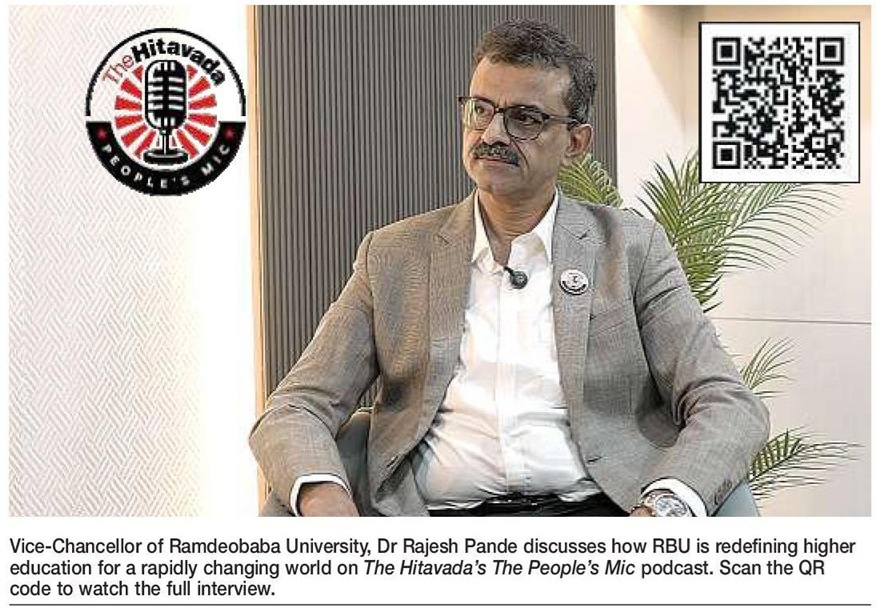
(RBU), who in a candid conversation with Vikas Vaidya,
Principal Correspondent The
Hitavada, on The Hitavada’s
The People’s Mic podcastclearly spells out the rapid transformation that has taken place
in the education scenario within the last few years.
Dr Pande’s journey that spans
more than three decades - as
an academician, researcher,
mentor and administrator -
mirrors the evolution of Indian
education. And, today after
having personally seen generations of students pass through
classrooms, he can aver that
“education has transformed
from conventional teaching to
holistic talent development
where students are looking for
an ecosystem and not just an
institution.”
His vision, his acumen and
his contributions have played
a great role in the evolution of
Shri Ramdeobaba College of
Engineering and Management
(RCOEM) into a full-fledged
University that attracts students from all over the country, and even abroad, and
enjoys a high ranking in private college surveys.
“The transition into a
University marked a new chapter and this has brought greater
freedom, bigger ambitions, and
naturally greater expectations
- both from students and parents,” says Dr Pande. During
this transition, great care was
taken to ensure that the principles laid down by the founder,
Mr Banwarilal Purohit, were
not diluted.
“It was in 1984 that Mr
Banwarilal Purohit laid the
foundation of the college, the
concept of which was to impart
quality education with ethical
values. The seeds were sown
then, and those associated with
the University are carrying this
legacy forward even today.
The
ecosystem developed by
Purohitji of imbibing culture
and values forms the core of
this institution,” states Dr
Pande, fondly recalling how
this has played a role in his
journey as well.
When talking of higher education, the conversation naturally veers towards employability. Parents and students,
while researching for colleges
of their choice, more often than
not, look for the placements.
“This is where our University
scores big time,” says Dr Pande,
adding, “Because our students
today have access to broader
academic choices, specialisations that extend well beyond
traditional engineering disciplines and innovative methods of teaching, they are not
only technically sound, but
have an edge, confidence, purpose and courage to adapt to
an uncertain future. That is
how capable we make them.”
To help maximum number of
students, RBU has introduced
many new options where the
thrust is on Innovation
Economy, where research is
encouraged, “because technology is the driver of change.
These changes are for the benefit of our students.”
Keeping in sync with world
class universities, RBU, under
his able leadership, and with
complete support from the
management, believes in
investing in personality development, leadership training,
internships and industry projects. “Learning is not relegated to classrooms and textbooks. It is practical oriented,
and happens in labs, workshops, hackathons, start up
cells and interacting in real
time with entrepreneurs,
backed back by industries and
government support,” he
states. He cites the connect
with industry giants like SAP
and IBM which are involved
directly with programmes of
the University. “Education, in
the present times, can go no
longer operate in isolation from
the realities of industry, technology, and society. RBU, after
its transition to University status offers more flexibility, interdisciplinary learning and
research-driven education,” he
explains.
As the college has transformed into a University, the
institution has only grown. But
this has brought about certain
challenges too.
“Parents ask about affordability, and are sometimes
sceptical about the fee structure. It’s a fair question, but
you have to look at the bigger
picture. When the University’s
stress is on quality education,
it means investing in infrastructure, technology, research
facilities, industry collaborations and student support systems - all these factors come
into play. We are giving them
the best - the challenge lies in
striking the right balance
between accessibility and
excellence.”
Commenting on how learning has changed over the years,
Dr Pande states, “Learning is a
continuously evolving process
of improving in all segments,
and how to learn is more
important than what is taught.
In this fast changing world of
education too, the one who
wins is the one who is adept at
self-learning. The most important skill set is the ability to
learn, and words like unlearn,
relearn, upskilling, reskilling
are no longer mere words - they
are important for the sustainable growth of a student.”
RBU has not only introduced
many new programmes but
have made the entire mentor
-mentee and the communication between student and faculty more cohesive. “At RBU,
we are a family, and our aim is
to help each one achieve
his/her dream.”
Another question that naturally arises is about scale. With
student intake increasing significantly over the years, can
quality be maintained? Can
personal attention continue?
Can the learning experience
remain meaningful? To all these
questions, Dr Pande answers
in the affirmative. “Our statistics speak for themselves,” he
states proudly, adding that each
student at RBU receives meaningful academic and professional guidance.
Dr Pande is understandably
proud of the innovation that
has happening at RBU under
the many Schools that have
been introduced offering many
new courses. “Innovation starts
when fear of failure ends. Our
approach today is that in a student’s life, failures are mandatory, for he learns from his mistakes. We give students the liberty to fail, try again, and come
up with multiple solutions for
a problem.” He cites the example of Padma Shri Satyanarayan
Nuwal, Chairman Solar Group
whose vision and innovative
approach have led to the
tremendous success of solar
industry led by him.
In the present times, digital
technology is the primary technology. And because of the continuous evolving nature, business modules have changed,
disruptions have happened,
and because of all this there has
been a profound implication
on the Indian education system. Rote learning has given
way to conceptual learning,
and today’s student is brilliant
because he has the ability to
grasp and adapt to this change.
On a lighter note, he shares
that today’s faculty learns from
students.
“The faculty needs
to be in sync with the needs of
the students’ and we at RBU
are constantly interacting and
learning from our students,”
he stated.
As Dr Rajesh Pande continues to lead Ramdeobaba
University through this period
of transformation, one gets the
sense that the institution’s
vision extends beyond producing engineers or professionals. The larger goal appears
to be creating individuals who
are prepared not just for their
first job, but for a lifetime of
learning.
And maybe that is the true
measure of a University.
Not how many students
enter its gates But how different they are
when they walk out of them four
years later.
There is infinite scope, innumerable opportunities and sky
is the limit for the students.
“RBU gives them the platform
for all this,” Dr Pande states.
For more on RBU’s inclusiveness policy, RGSTC scheme that
has greatly benefited the students, the seed money of nearly Rs 1 crore that has been spent
for the promotion of start-ups,
the induction of NVIDIA -
DGXB200 - AI supercomputer
that is the first in Central India
which will bring about an
unprecedented transformation
in the learning and innovative
approach of the students, follow Dr Rajesh Pande’s podcast
on our YouTube channel
@TheHitavada1911.