Dalli Rajhara, once known as ‘land of springs’
Date :08-Jun-2026
By Ajay Agrawal
BALOD :
WHILE the district administration continues to promote
initiatives such as the Neer Chetna Abhiyan, Jal Jeevan Mission and several other water conservation and supply schemes, the ground reality in Dalli Rajhara presents a starkly different picture. The town, which contributes substantial revenue through its iron ore mines, is currently grappling with a severe drinking water crisis.
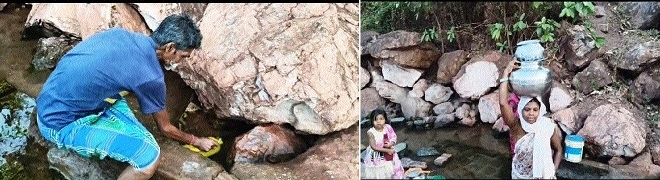
The situation has become so critical that residents in several wards are relying on water naturally seeping from the ground near the Jharan Temple area for drinking and cooking purposes.
Meanwhile, a Rs 31-crore water augmentation project remains incomplete even after six years. Owing to delays and alleged negligence on the part of public representatives, officials and contractors, the project’s cost
has reportedly escalated to
Rs 43 crore.
Residents of Wards 10, 12, 14, 15, 18 and 19, among others, complain that municipal taps fail to provide an adequate water supply. Many allege that contaminated water is being supplied through pipelines that pass through drainage channels and have developed leaks due to poor installation and maintenance. As a result, residents are compelled to consume unsafe water. In Wards 10, 12 and 18, people reportedly collect water from natural seepage points near Jharan Temple and carry it home for daily use.
Municipal Council President Toran Sahu said the project cost has been revised from Rs 31 crore to Rs 43 crore.
He stated that additional funds have been sanctioned to reconstruct pipelines damaged during National Highway construction and expressed hope that the project would be completed within the next year.
Former Municipal Vice-President Santosh Devangan criticised both the Bhilai Steel Plant (BSP) management and the municipal administration, alleging that while residents of the old market area bear the brunt of mining-related pollution, dust,
traffic congestion and frequent accidents involving mine trucks, development benefits have largely been concentrated in the New Market and Chikhlakasa areas. According to Devangan, BSP has laid an extensive pipeline network to supply filtered water to New Market and Chikhlakasa but has shown reluctance to extend similar facilities to the old market area despite it being the most affected by mining activities. He said this perceived discrimination has generated widespread resentment among local residents.
Former Congress Municipal Vice-President Ravi Jaiswal said that Dalli Rajhara, once known as the ‘Land of Springs’, now faces the irony of its residents struggling for drinking water. He claimed that the crisis affects not just a few wards but all 27 wards of the town. Jaiswal warned that the Congress party would launch an agitation if the water augmentation project is not completed at the earliest.
The administration, meanwhile, has stated that if residents are indeed relying on seepage water for drinking purposes, alternative arrangements will be made.
Officials also indicated that reports would be sought from the concerned departments regarding the delay in completion of the water supply project. Residents continue to ask that how long will Dalli Rajhara, a town that contributes significantly to government revenue, remain deprived of basic amenities and adequate drinking water, and when will the long-delayed water augmentation project finally become a reality?