BRICS has strength to shape future of global mobility: Gadkari
| Date :12-Jul-2026 |
Staff Reporter :
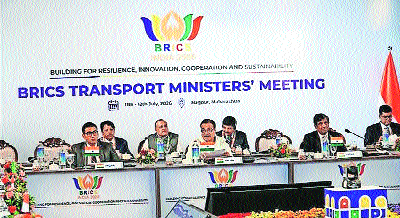
“The collective strength of BRICS presents a unique opportunity to shape the future of global mobility through innovation, partnership and shared responsibility,” said Nitin Gadkari, Union Minister for Road Transport and Highways
on Saturday. He was speaking at the inaugural session of the 3rd BRICS Transport Ministers’ meeting under India’s BRICS Chairship in city.
Gadkari, in his address, welcomed Transport Ministers, Heads of Delegation, senior officials and representatives from the 11 BRICS member nations. He described the meeting as an important milestone in strengthening transport cooperation among emerging economies.
Gadkari said India’s BRICS Chairship, guided by the theme ‘Building for Resilience, Innovation, Cooperation and Sustainability’, reflects the country’s ‘Humanity First’ approach inspired by the philosophy of Vasudhaiva Kutumbakam, the world is one family. He noted that BRICS represents nearly half of the world’s population and has the potential to lead the development of cleaner, safer, smarter and more efficient transport systems while promoting sustainable economic growth.
Highlighting India’s infrastructure transformation, the Union Minister said the country has developed the world’s second-largest road network and significantly expanded its access-controlled expressways and
multimodal connectivity. He cited projects such as the Delhi-Dehradun Economic Corridor, Sonamarg Tunnel and over 10,000 km of Greenfield Expressways as examples of infrastructure development combined with sustainability and technological innovation. He also highlighted the Hybrid Annuity Model as an effective mechanism for attracting private investment.
Gadkari added that Indian Railways has undergone rapid modernisation through near-complete electrification of the broad-gauge network, expansion of Vande Bharat services, progress on the Mumbai-Ahmedabad High-Speed Rail Corridor and projects such as the new Pamban Bridge.
He also referred to the Maritime Amrit Kaal Vision 2047, digital initiatives including e-Navik and e-Samudra, and the Green Shipping initiative as major steps towards improving maritime infrastructure.
On sustainable mobility, Gadkari highlighted the deployment of electric buses, the Green Urban Mobility Scheme, the UDAN regional connectivity programme and the PM Gati Shakti National Master Plan, which integrates multimodal infrastructure and reduces logistics costs.
Calling for stronger cooperation among BRICS nations, Gadkari said common challenges such as infrastructure financing, congestion, emissions, road safety and last-mile connectivity require collective solutions. The Union Minister reaffirmed India’s commitment to knowledge sharing, capacity-building, technological collaboration and joint research in green hydrogen, electric mobility, alternative fuels, digital transport systems and sustainable multimodal infrastructure. He expressed confidence that the deliberations in Nagpur would lead to practical, innovative and people-centric transport solutions for the future.