Stray dogs' sterilization drive falls short, as canines reproduce twice as fast
| Date :13-Jul-2026 |
Staff Reporter :
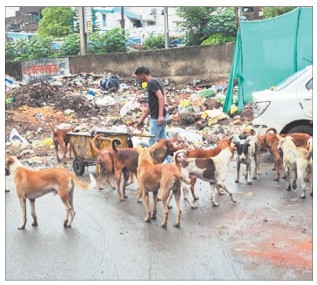
THEongoing monsoon season has triggered a worrying surge in stray dog sightings and canine aggression across the regional capital, placing public safety under immense strain. Government health facilities, including JP Hospital and Hamidia Hospital, are registering a heavy influx of dog bite victims, with between 150 and 160 cases reported every week. Local residents in older settlements as well as newly developed peripheral neighborhoods like Kolar, Katara Hills, Baghmughalia, and Ayodhya Bypass report that stray dogs are forming aggressive packs that actively chase pedestrians, commuters, and playing children. Sterilisation drive heavily outpaced by rapid breeding statistics With the city’s total stray dog population estimated at approximately 1.5 lakh, the Bhopal Municipal Corporation’s current containment measures remain heavily outpaced by the rapid reproduction cycle of the animals. While the civic body manages to sterilise approximately 24,000 to 25,000 dogs annually—averaging nearly 70 operations per day—the local birth rate remains more than double that speed, with roughly 60,000 new puppies born every year. Mathematical projections indicate that over a 3.5-year period, the city will witness the birth of 2.10 lakh puppies while the existing municipal setup can only sterilize 85,000 dogs, causing the stray canine population to balloon to 2.5 times its current size if the operational capacity is not expanded. To address the crisis, municipal veterinary teams are executing permanent surgical interventions under the Animal Birth Control rules and Supreme Court guidelines rather than employing elimination tactics. In female dogs, the ovaries and uterus are surgically removed, while the testes of male dogs are extracted to permanently block the production of testosterone and other reproductive hormones.
Breeding season dynamics trigger temporary packs and resident safety alarms The sudden concentration of aggressive canine packs on city streets is heavily tied to the onset of the active breeding season, which temporarily alters typical animal behaviors. While stray dogs generally forage individually, the presence of even a few unsterilised female dogs in a residential colony can attract anywhere from 15 to 20 unneutered males, creating large and highly volatile packs. Municipal officials emphasise that while approximately 40% to 50% of the capital’s stray dog population has already undergone sterilisation, the presence of even a minor fraction of intact dogs is sufficient to trigger aggressive, pack-oriented confrontations during this seasonal cycle. Multi-center infrastructure expansion proposed to bridge widening deficit Faced with the widening gap between the canine birth rate and sterilisation output, the municipal administration has drafted a major expansion plan in alignment with Central Government directives. Guidelines issued by the National Centre for Disease Control recommend the establishment of one Animal Birth Control center for every 10 municipal wards, translating to a requirement of 9 centers for Bhopal’s 85 wards. The city currently operates only 3 sterilisation facilities, with a 4th center currently under construction in the Adampur area. The municipal body has submitted a formal proposal to the Central Government to fund the expansion to 8 centers, which would triple annual sterilisation capacity to 75,000 operations, allowing the city to completely outpace the birth rate and stabilise the stray dog population within 5 years. Speaking to The Hitavada, ABC Centre state coordinator Dr PP Singh emphasised the critical need for this upgrade. “We are operating at maximum efficiency with our current resources, but a decentralised, multi-center approach is the only sustainable solution against the current birth rates. Once the Central Government approves our proposal for the additional facilities, we will have the logistical framework required to hit our target of 75,000 annual operations and bring the canine population under permanent control,” he stated.