Government unveils Rs 1.9 lakh crore semiconductor, mobile manufacturing push
| Date :16-Jul-2026 |
NEW DELHI :
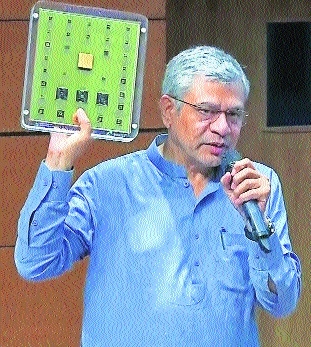
THE Union Cabinet on Wednesday approved two major manufacturing initiatives with a combined outlay of nearly Rs 1.9 lakh crore (USD 22 billion) to expand India’s semiconductor ecosystem, scale up mobile phone production and strengthen its position as a global electronics manufacturing hub.
The Government approved the Rs 1.27 lakh crore Semicon 2.0 programme to accelerate semiconductor design and manufacturing capabilities, alongside the Rs 62,500 crore Mobile Phone Manufacturing Scheme (MPMS) aimed at increasing domestic production, boosting exports and deepening local value addition in the mobile phone industry.
The semiconductor programme builds on the first phase of the India Semiconductor Mission and will focus on six key areas - chip design, semiconductor equipment and materials, fabrication facilities, advanced packaging and testing, research and development, and talent development.
“We will be self-reliant in the production of indigenous chips by the end of this programme,” Minister for Electronics and Information Technology Ashwini Vaishnaw said at a news briefing.
The Government expects the new scheme to attract investments of around Rs 4 lakh crore and lead to semiconductor production worth Rs 2 lakh crore during the scheme period.
The Union Cabinet also approved a Rs 62,500 crore Mobile Phone Manufacturing Scheme to provide production-linked incentives to manufacturers over five years from fiscal year 2026-27 to 2030-31, Vaishnaw said. Incentives will range from 2.25 per cent to 5 per cent on eligible mobile phone sales, with additional support for domestic sourcing of key components and for Indian companies investing in product design and research.
2 highway projects for Varanasi of Rs 25,500 cr
The Union Cabinet on Wednesday approved two highway projects for Varanasi, entailing a total investment of nearly Rs 25,500 crore.
The Cabinet Committee on Economic Affairs (CCEA), chaired by Prime Minister Narendra Modi, approved the development of a 43.218-kilometre link connecting NH-31 and the Varanasi Ring Road along the River Varuna to decongest Varanasi city in Uttar Pradesh.
The project comprises a 6/4-lane predominantly elevated corridor, including the main carriageway, flyovers, loops, ramps, and service roads, and will be implemented by the NHAI under the Hybrid Annuity Model (HAM) at a total capital cost of Rs 10,998.32 crore, I&B Minister Ashwini Vaishnaw informed.
The CCEA also approved the development of a corridor between National Highway-19 and the Varanasi Ring Road with riverbank connectivity along the River Ganga for the decongestion of Varanasi city, the Minister said while
briefing the media about the various Cabinet decisions.
2 railway projects covering 4 districts in Odisha, Jharkhand
The Cabinet Committee on Economic Affairs, chaired by Prime Minister Narendra Modi, on Wednesday approved two Railway Ministry projects with a total estimated cost of approximately Rs 3,907 crore.
The doubling of the Paradeep-Haridaspur section and the construction of a fourth railway line on the Rajkharsawan-Dangoaposi section are the two projects approved by the committee. “The increased line capacity will significantly enhance mobility, resulting in improved operational efficiency and service reliability for Indian Railways. These multi-tracking proposals are poised to streamline operations and alleviate congestion,” a Government press note said.
National Investment Policy to add urea capacity
The Government on Wednesday announced a new National Investment Policy for Urea (NIPU-2026) to set up 8-9 new gas-based plants with a production capacity of 10 million tonne to make the country self-reliant in the most widely consumed fertiliser.
The policy, approved in the Union Cabinet meeting, headed by Prime Minister Narendra Modi, will encourage new investments in the urea sector to set up gas-based urea manufacturing units in the country.
The new investment framework is an extension of the 2012 New Investment Policy (NIP) with revisions.
Briefing the media after the meeting, I&B Minister Ashwini Vaishnaw said the urea demand is rising five per cent annually and the policy approved today aims to create additional urea capacity of 10 million tonne.