ICAR-DWR pioneers biological control of S molesta using ‘Cyrtobagous salviniae’, The work earned ICAR-DWR the prestigious ICAR Best Technology Award
| Date :16-Jul-2026 |
By Shivanjali Verma :
Salvinia molesta (S molesta) is a destructive aquatic weed that forms thick, suffocating mats across water bodies. These mats block sunlight, choke out oxygen, destroy local biodiversity and ruin the livelihoods of fishing communities.
Now, the ICAR-Directorate of Weed Research (ICAR-DWR), Jabalpur, has successfully deployed a biological control technology that is reclaiming India’s freshwaters from one of the world’s most aggressive invasive plants, the water fern, Salvinia molesta.
While traditional mechanical cleanup is incredibly expensive and temporary, ICAR-DWR pioneered a self-sustaining solution introducing a tiny, highly host-specific weevil named Cyrtobagous salviniae.
This pioneering work earned ICAR-DWR the prestigious ICAR Best Technology Award and received national recognition through Down To Earth magazine.
Dr P K Singh, Principal Science and Head PME/ITMU, ICAR-DWR Jabalpur told ‘The Hitavada’, “Infestation severely affects fisheries, aquaculture, irrigation systems, drinking water sources, inland navigation and wetland ecosystems, posing a major challenge to sustainable water
Contd from page 1
resource management and national initiatives such as Jal Jeevan Mission.”
He added that conventional management practices, such as mechanical removal and chemical herbicide application, are expensive, labour-intensive, provide only temporary relief and are often unsuitable for fisheries and drinking-water ecosystems.
Here, ICAR-DWR, Jabalpur has pioneered the biological control of Salvinia molesta using the highly host-specific weevil Cyrtobagous salviniae.
This eco-friendly, self-sustaining, and cost-effective technology can achieve up to 100% suppression of the weed under favourable conditions without causing adverse environmental impacts. Adult weevils of Cyrtobagous salviniae feed on the leaves, buds and rhizomes of S molesta, causing extensive damage, ultimately causes the weed mats to collapse, decay, and decompose naturally.
Dr Singh informed that the Directorate has successfully restored nearly 4,000 hectares of Salvinia-infested water bodies across Madhya Pradesh, Maharashtra, Chhattisgarh and Haryana, while routinely mass-producing and supplying Cyrtobagous salviniae for large-scale field deployment, contributing to the sustainable management of over 2,000 hectares of additional infested aquatic ecosystems.
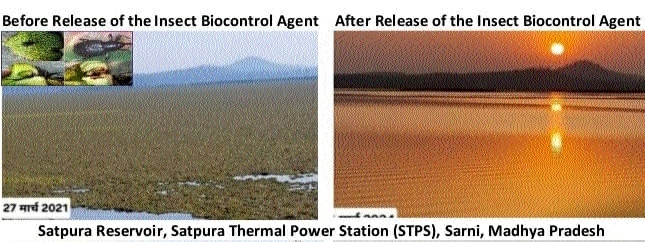
Dr Singh said that the demonstrated success of this technology has earned the confidence of the Madhya Pradesh Power Generating Company Limited (MPPGCL), which entrusted ICAR–DWR, Jabalpur with a consultancy project for the biological management of Salvinia molesta in the 2,900-acre Satpura Reservoir at the Satpura Thermal Power Station, Sarni, Betul (Madhya Pradesh). Unlike conventional mechanical removal, which was estimated to cost nearly Rs 15 crore and require up to five years for repeated operations, the ICAR-DWR biological control technology offers a sustainable, self-perpetuating and economically viable solution.
Following the release of the host-specific weevil Cyrtobagous salviniae, significant suppression of Salvinia molesta was achieved within 5–6 months, while complete weed control and restoration of open-water conditions were accomplished within 15–18 months at an intervention cost of Rs 49 lakh.
The effectiveness of ICAR-DWR’s biological control technology has been successfully demonstrated across diverse agro-climatic regions of the country. Successful restoration has been achieved in Hatti Lake, Lanjhada Lake, Erai Dam, Ghodped and Jinona Lake in Maharashtra; Pachmarhi Lake, Satpura Reservoir, Lonia Lake, Murvari Pond and Giduraha Pond in Madhya Pradesh; Talpuri Lake in Chhattisgarh; and a reservoir in Jhajjar, Haryana. Collectively, these demonstrations have restored more than 4000 hectares of heavily infested water bodies.
Through continuous mass production of the biological control agent, technology dissemination and strategic partnerships with State Departments and fisheries agencies, ICAR-DWR is facilitating large-scale adoption of this eco-friendly technology for sustainable aquatic weed management, ecological restoration, enhanced fisheries productivity, water security and improved rural livelihoods across the country.