Metro fuelling Nagpur’s new growth axis, real estate sees upto 20% rise
| Date :16-Jul-2026 |
By Simran Shrivastava :
TOD is shaping the new development, as developers tap into old single storeyed houses to shape the new skyline in city
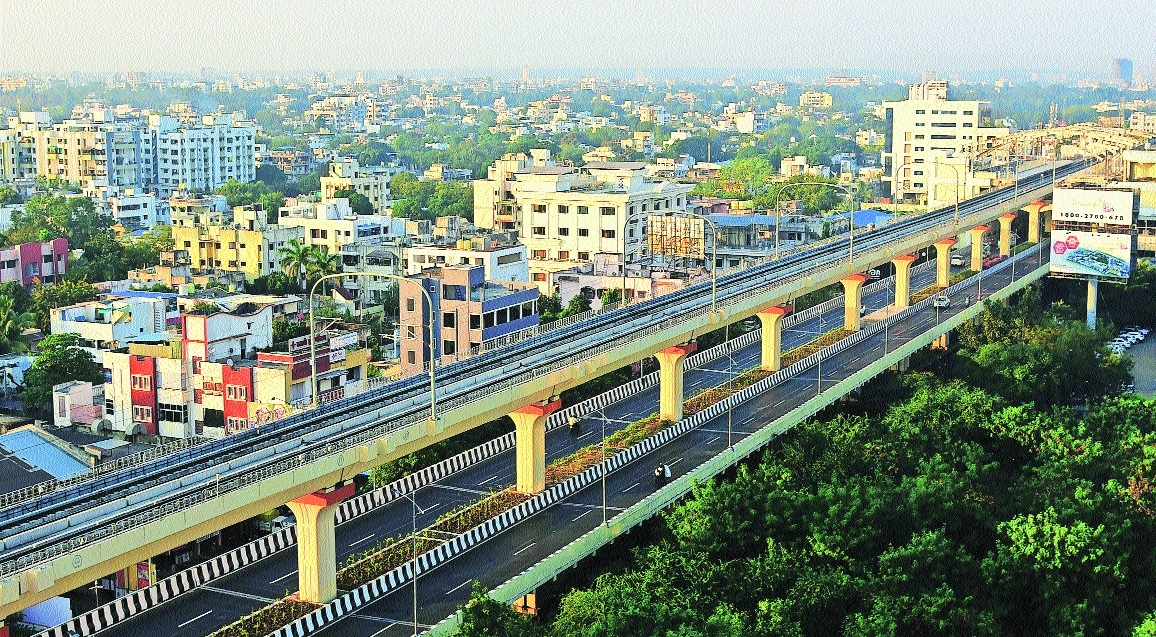
Nagpur’s Metro is starting to influence more than travel. The rise of new development along side metro corridor is promising the way Nagpurians would be living and also travelling in future. New residential projects are moving closer to stations, commercial activity is on upswing along Metro and developers are using Metro connectivity as their biggest selling point. Same is influenced by Transit-Oriented Development (TOD), it provides extra FSI, upto 4 on payment of fixed premium depending upon plot size. So one can now sees the changing skyline in city, especially adjoining the metro corridor, with towering structures signifying the city’s growth.
TOD policy is now moving in right direction, its intention is to promote higher-density development within 500 metres on either side of Metro corridors so that more people live and work close to stations.
The TOD policy, it was notified by the Maharashtra Government in 2017 and next operationalised through detailed regulations, covers a one-kilometre-wide strip along Metro corridors. It allows eligible developments to avail additional Floor Space Index (FSI), increasing the permissible limit from the base FSI to as much as 4, subject to plot size, road width and approvals from planning authorities such as the Nagpur Municipal Corporation (NMC). The objective is to encourage compact, mixed-use and high-density development around mass transit systems while generating additional ridership for the Metro,” an official shared.
President of The Confederation of Real Estate Developers’ Associations of India (CREDAI) Vijay Dargan explained that property values within 500 metres to one kilometre of operational Metro stations have appreciated by around 10 to 20 per cent, and highest is observed along the East-West corridor.
Sitabuldi, Zero Mile, Lokmanya Nagar, Jaiprakash Nagar and Airport are the major beneficiaries along the East-West corridor, while Khapri, Automotive Square, Gaddigodam and Congress Nagar have gained along the North-South corridor. Sitabuldi has strengthened its position as the city’s premier commercial destination after becoming the Metro interchange, while Khapri and the MIHAN belt have evolved into a mixed residential, commercial and warehousing hub. “Automotive Square has sprung as a new growth centre for North Nagpur, whereas Gaddigodam is attracting affordable housing, hostels and paying guest accommodation because of its Metro and railway connectivity,” Dargan added.
Developers are responding. Nagpur, once dominated by G+4 buildings, is now witnessing G+12 to G+22 residential towers around locations such as Sitabuldi, Lokmanya Nagar and Airport. Mixed-use projects with retail, parking and residential components are becoming common, while several branded developers that earlier had a limited presence in Nagpur are launching Metro-oriented projects with station proximity as their principal marketing proposition.
Inquiries for projects within one kilometre of Metro stations have increased by around 15 to 20 per cent, according to the real estate sector.
Despite the momentum, challenges are there. Real estate sector identifies last-mile connectivity as the biggest hurdle in unlocking the full potential of Metro-led development. Limited feeder services, inadequate parking facilities, congestion on approach roads near some stations and lower Metro usage in parts of South Nagpur continue to restrict adoption.
Attention is now shifting to Phase II. With Metro expansion under way towards Hingna, Wadi, Prajapati Nagar, Wasudev Nagar, Kapsi and Kanhan, the real estate sector expects another growth cycle.