Once favourite, now under fire: The story of Conocarpus trees
| Date :16-Jul-2026 |
By Simran Shrivastava :
Experts say replacing matured plantations should be a gradual exercise instead of a sudden campaign
Promoted as the perfect tree for plantation drives earlier, Conocarpus alias Button Mangrove is now facing criticism from environmentalists and ecologists. Known for its fast growth, low maintenance and ability to survive in dry conditions, the tree was planted along roads and public spaces to quickly increase green cover. However, experts, now, say that while Conocarpus may make a city look
greener, it does little to improve its ecological health.
The turning point came with a report submitted in August 2025 by the Supreme Court-mandated Central Empowered Committee, which described the species as ‘ecologically unsuitable’ and warned that its continued spread threatens biodiversity, groundwater, civic infrastructure and public health.
Nagpur has followed the changing scientific consensus. Fresh plantations have almost ceased across the city.
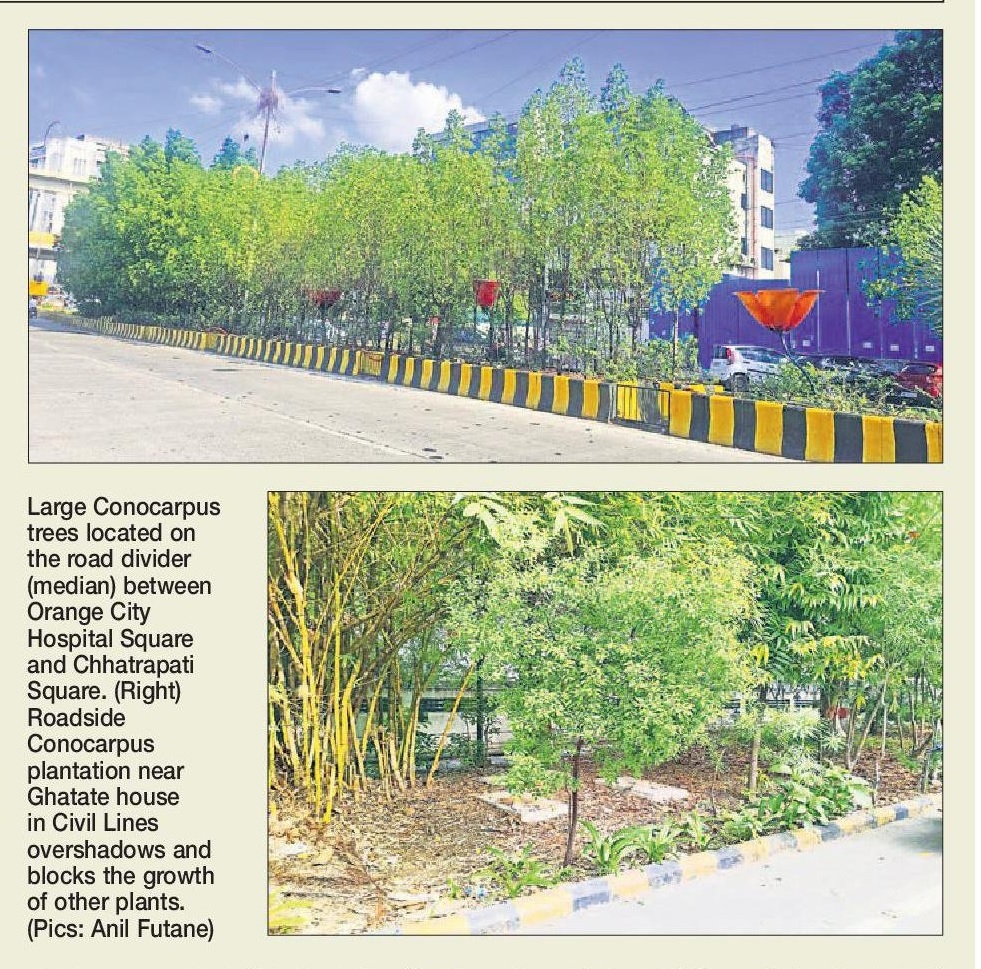
The dilemma, however, lies here: Thousands of mature Conocarpus trees continue to stand along Wardha Road near Khapri, Chhatrapati Square, Jaripatka Wadi Road, the Manewada-Tukdoji Putla Krida Square corridor, medians near Mandal Murti Square, the Ambazari stretch and several institutional campuses.
The question confronting the city now is: What should be done with the trees already occupying public spaces?
Biodiversity expert Dilip Chinchmalatpure shared that indigenous trees have evolved over centuries alongside local birds, butterflies, bees and insects. In contrast, Conocarpus contributes little to this food web.
Environmentalist Prachi Mahurkar shared that its popularity stemmed from administrative convenience. “It grows quickly, survives easily and requires very little maintenance. But it has almost no role in the local system. During flowering, its pollen is considered highly allergenic, while native birds and insects hardly utilise it because it is not indigenous,” she explained.
“There should be no fresh plantation. But mature trees must first be scientifically evaluated before any decision regarding removal is taken,” shared Chinchmalatpure.
Its pollen has been linked by researchers and environmental groups with respiratory allergies and asthma, where authorities also cited damage caused by its aggressive root system to underground water pipelines and sewage networks. Ecological concerns extend underground as well.
Chinchmalatpure explained that Conocarpus performs comparatively poorly as an urban carbon sink when compared with indigenous species, while its vigorous roots can interfere with underground civic infrastructure carrying water pipelines, fibre-optic cables, electricity lines and drainage networks.
“Dense canopies further reduce sunlight reaching the ground, while roots absorb moisture and nutrients, gradually suppressing grasses, herbs and naturally regenerating native shrubs,” he added. The result is a biologically simplified landscape where one exotic species dominates and urban biodiversity declines.
Environmental activist Anasuya Kale
also advocated scientific evaluation rather than indiscriminate felling and recommended collaborative studies with biodiversity experts.
Success earlier was measured by the number of saplings planted and survival percentages achieved. Far less attention was paid to ecological function. How many butterflies, birds, pollinators or native plants those plantations actually supported.