Rs 2.50 enzyme helps cut dairy feed costs
Date :16-Jul-2026
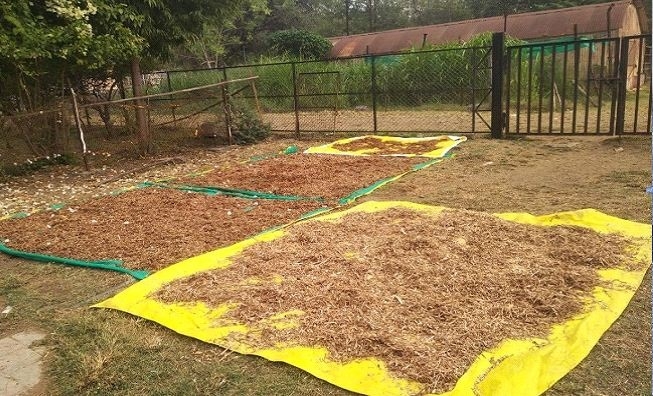
The low quality straw feed, sprayed with enzyme, left under
the sun.
By Rohit Pawar :
Costing just Rs 2.50 per animal per day, the spray-on enzyme boosts milk production and cuts feed costs
With fodder prices rising steadily and dairy farming becoming increasingly expensive, scientists in Nagpur have developed a simple enzyme technology that can transform low-quality crop residues such as wheat, paddy and cotton straw into nutritious cattle feed comparable to better-quality roughages like tur and gram straw. Costing just Rs 2.50 per animal per day, the spray-on enzyme boosts milk production, cuts feed costs and reduces the need to burn crop residue, making it both farmer-friendly and environment-friendly.
The technology has been jointly developed by the Maharashtra Animal and Fishery Sciences University (MAFSU) and Visvesvaraya National Institute of Technology (VNIT), Nagpur. It makes use of crop residues that are often discarded or underutilised because of their poor nutritional value.
The liquid fibre-degrading enzyme is sprayed on dry crop residues and the treated fodder is ready for feeding after about four hours. The process is simple, requires no special equipment and can be easily adopted by small and marginal dairy farmers. The enzyme breaks down tough plant fibres, allowing livestock to digest the feed more efficiently and absorb more
nutrients.
Dr Atul Dhok, Head of the Department of Animal Nutrition at Nagpur Veterinary College, who has been associated with the research, said “The technology has been commercialised by VNIT under the brand name ‘Vimozyme’ and is now available in the market. It is gradually gaining acceptance among farmers because of its ease of use, affordability and proven results.”
According to him, the enzyme helps economise milk production by improving feed efficiency and reducing dependence on expensive fodder.
Studies conducted by MAFSU showed that goats fed enzyme-treated feed recorded significantly higher body weight gain, while dairy cattle produced more milk than those fed untreated straw. Researchers also found improved nutrient digestibility, better reproductive performance and lower methane
emissions from animals fed
enzyme-treated diets.
Apart from improving farmers' incomes, the technology also supports cleaner farming practices. By converting low-value crop residues into valuable cattle feed, it reduces the need to burn agricultural waste, helping cut air pollution.
Researchers have also developed a solid form of the enzyme for easier storage and transport, and believe wider adoption of the technology can make dairy farming more profitable and
sustainable.