Regulatory clash over AAI height norms puts over 1,000 flat owners near airport in limbo
| Date :17-Jul-2026 |
Business Reporter :
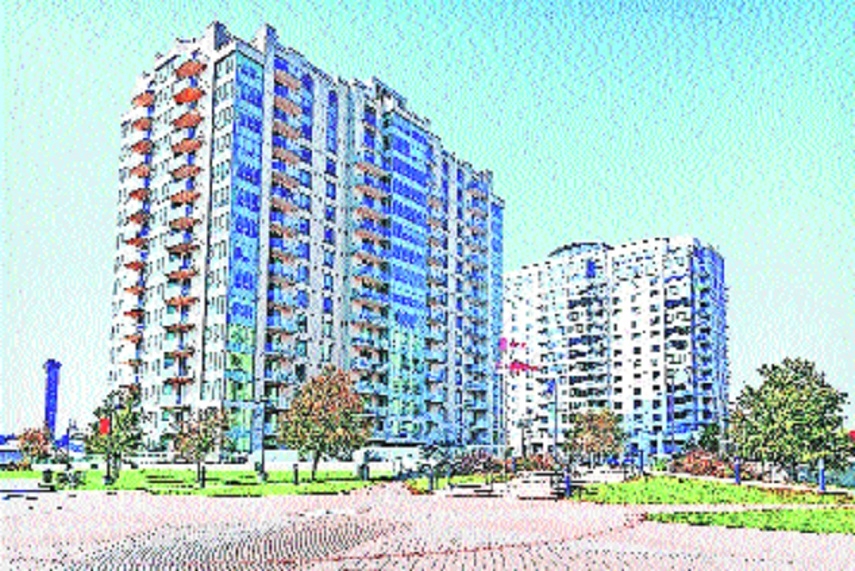
Uncertainty looms over more than 1,000 flat owners around Nagpur airport due to an escalating conflict between urban development approvals and aviation height regulations. Flat owners of about 64 multi-storey buildings, mostly under affordable housing schemes, are facing hardship because of the regulatory framework governing height clearances from the Airports Authority of India (AAI).
Recently, the AAI has served notices to the flat owners and developers raising objection over the height of the buildings.
However, the developers and flat owners have raised serious concerns over the issue and urged the authorities to create a transparent, predictable and legally certain regulatory framework that balances aviation safety with sustainable urban growth.
Highlighting the discrepancies in the regulatory framework, a flat owner said multiple AAI No Objection Certificates (NOCs) have been issued to the same properties with different permissible heights of the buildings.
At one such location in Chinchbhuvan, the AAI had initially allowed a certain height for a building but subsequently reduced it based on revised software calculations.
A builder, on the condition of anonymity, said that the technical modifications have directly affected many projects which have already been sanctioned or are partially constructed.
It is important to note that the uncertainty surrounding aviation height clearances is beginning to adversely affect investment decisions.
“Several proposed residential, commercial, institutional and mixed-use developments may become unviable if height restrictions continue to fluctuate without a stable regulatory framework.
This may significantly impact economic growth and overall development potential of Nagpur,” said the builder.
“When a municipal body sanctions a building plan based on a specific height clearance available at that point in time, developers proceed with construction on the basis of a legally issued permission. But if obstacle limitation surfaces or height calculations are subsequently altered, airport authorities should formally involve municipal authorities before enforcing revised limitations.
A coordinated review mechanism involving airport authorities, planning authorities and affected stakeholders is necessary to examine projects where substantial construction has already been completed,” said the builder.
In addition to this, there is lack of clarity with reference to the continuation of earlier approvals, validity of renewed NOCs, and protection available to projects already sanctioned.
“There should be a mechanism whereby projects constructed strictly as per the sanctioned building permission prevailing on the date of commencement are not denied occupancy merely because of subsequent software revisions,” said another builder.
The absence of a unified approval mechanism often leaves homebuyers caught in the middle. Beyond legal arguments lies a more immediate human cost - homebuyers wait for possession, banks classify stressed loans, construction workers lose employment opportunities, and developers face mounting interest burdens.
In some projects, financial exposure has already crossed several crores of rupees, creating risks not only for private stakeholders but also for lending institutions.